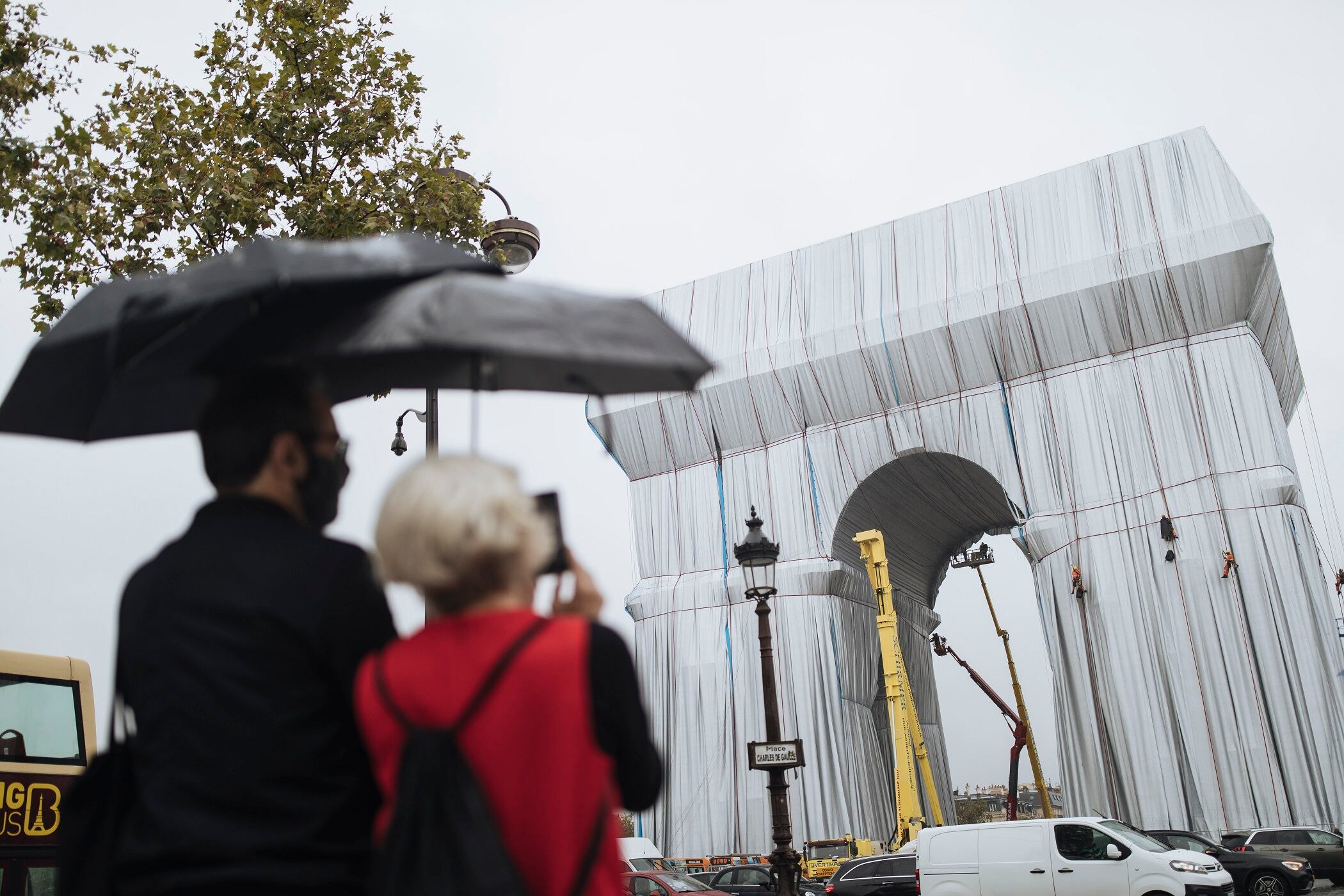
People watch workers wrapping the Arc de Triomphe monument, Wednesday, Sept. 15, 2021 in Paris. The "L'Arc de Triomphe, Wrapped" project by late artist Christo and Jeanne-Claude will be on view from, Sept. 18 to Oct. 3. The famed Paris monument will be wrapped in 25,000 square meters of fabric in silvery blue, and with 3,000 meters of red rope. (AP Photo/Lewis Joly)
By Arno Pedram
The city of Paris is unveiling a monumental artwork built around an actual monument: the Arc de Triomphe completely wrapped in silver and blue fabric.
The installation by late artist couple Christo and Jeanne-Claude, who conceived the project in 1961, will open on Saturday. Visits will take place for almost three weeks. At weekends, the Arc de Triomphe’s traffic-heavy roundabout will be entirely pedestrianized.
Visitors to the famous Napoleonic arch, which dominates the Champs-Elysees Avenue, will not only be able to see the gleaming fabric, but to touch it too — as the artists had intended.
Those climbing the 50 meters (164 feet) to the top will step on it when they reach the roof terrace.
At a press conference on the project entitled “Arc de Triomphe, Wrapped,” France’s Culture Minister Roselyne Bachelot called it “a formidable gift offered to Parisians, the French and beyond, to all art lovers.”
Bachelot added that it was “a posthumous testimony of artistic genius.”
Bulgarian-born Christo Vladimirov Javacheff met Jeanne-Claude Denat de Guillebon in Paris in 1958 and they later became lovers. The idea for the artwork was born in the early '60s, when they lived in Paris. Jeanne-Claude died in 2009, and Christo in May last year. The monument was to be wrapped last fall, but the COVID-19 pandemic delayed it.
Christo "wanted to complete this project. He made us promise him that we will do it,” the couple’s nephew, Vladimir Yavachev, told The Associated Press.
The 14 million-euro ($16.4 million) project is being financed through the sale of Christo’s preparatory studies, drawings, scale models, and other pieces of work, Yavachev said.
Passersby on Thursday looked up in awe. “It makes me think of a big gray elephant placed in Paris on the Champs-Elysee" said 47-year-old Thomas Thevenoud, who works nearby.
“You really rediscover the beauty of the form," said 39-year-old Parisian Agnieszka Wojel. “I couldn’t stop taking pictures because it’s extraordinary... We are very lucky.”
The artists were known for elaborate, temporary creations that involved blanketing familiar public places with fabric, including Berlin’s Reichstag and Paris’ Pont Neuf bridge, and creating giant site-specific installations, such as a series of 7,503 gates in New York City’s Central Park and the 24.5-mile “Running Fence” in California.
Yavachev said he plans to complete another one of their unfinished projects: a 150-meter-tall (492 feet) pyramid-like mastaba in Abu Dhabi.
“We have the blueprints, we just have to do it,” he said.
___
Masha Macpherson and Alex Turnbull in Paris contributed
Daniel Loría, SVP content strategy and editorial director at Boxoffice Media, joins Cheddar News to discuss what helped 'Scream' score number one at the box office and what it means for the horror genre.
Dave Levinthal, deputy Washington Bureau chief at Insider, joins Cheddar News to discuss Gallup's new survey that reveals more Americans leaned Republican by the end of 2021.
L’Oréal is doubling down on its investment in tech. The French beauty giant unveiled two new high-tech products ahead of CES 2022, aimed at simplifying the hair coloring process. Guive Balooch, global vice president of L’Oréal Technology Incubator, joined Cheddar's Opening Bell to discuss the company's innovations for hair coloring, including the Colorsonic application device and the Coloright AI diagnostic tool.
After meeting by chance in an airport, legendary actor Bill Murray and world-renowned cellist Jan Vogler joined forces to put out an album of poetry and music, go on a European concert tour, and release a feature documentary. Murray and Vogler joined Cheddar to dish about the experiences taking their “New Worlds: The Cradle of Civilization" on the road and filming the documentary that followed the pair, along with Mira Wang on violin and Vanessa Perez on piano, at their final show in Greece. "When this opportunity to play with Jan and Mira and Vanessa came along, I thought, well how bad can I be with these people behind me," Murray self-deprecatingly noted about his own musical talents.
On this episode of Cheddar Reveals: Director of Programs at Alpine Ascents breaks down how to mentally and physically prepare for climbing Mount Everest; American Himalayan Foundation's Vice President discusses Sherpa culture and ethos, and why they are so critical to the climb; A look at Curiosity Stream's 'History by the Numbers.'
All around the world, speed limits are placed on public roads to promote car safety and save lives. In that same world, car manufacturers have continued to look for ways to build faster and faster cars. Despite the dangers of speeding, many drivers are guilty of pushing the pedal from time to time. With cars being such a prevalent culture in everyday life, especially in the US, it’s worth wondering what it would take for car companies to once and for all settle the argument of safety versus freedom.
A recent study by MSI uncovers a vast racial divide in influencer marketing. The research found a 35% racial pay gap between white and black influencers. This gap is extremely wider than the gap in other industries such as education, business, and finance. The research also suggests that brands and agencies have the power to close this gap. Tiffany Hardin, founder and CEO of Gild Creative Group, joins Cheddar News to discuss.
Student loan collection company Navient agreed to cancel $1.7 billion in debt and paid more than $140 million in other penalties to settle a lawsuit over abusive lending practices. Josh Shapiro, the attorney general of Pennsylvania who led negotiations in the settlement, joined Cheddar to go over the details of the company's predatory lending. "What Navient would do is charge [borrowers] these exorbitantly high rates, even though they knew people couldn't pay them or they would likely default on them," he explained.