By Aamer Madhani and Dasha Litvinova
Face to face for just over two hours, President Joe Biden and Russia’s Vladimir Putin squared off in a secure video call Tuesday as the U.S. president put Moscow on notice that an invasion of Ukraine would bring enormous harm to the Russian economy.
The highly anticipated call between the two leaders came amid growing worries by the U.S. and Western allies about Russia’s threat to neighboring Ukraine.
Putin came into the meeting seeking guarantees from Biden that the NATO military alliance will never expand to include Ukraine, which has long sought membership. The Americans and their NATO allies said in advance that Putin’s request was a non-starter.
The White House said in a statement that Biden voiced “deep concerns” during the call about Russia’s troop buildup along the Ukraine border and made clear that the U.S. and allies would respond with “strong economic and other measures in the event of military escalation.” Biden also reiterated U.S. support for Ukraine’s sovereignty and territorial integrity.
As the U.S. and Russian presidents conferred, Ukrainian officials grew only more anxious about the tens of thousands of Russia troops that have been deployed near their border. Just hours before the start of the Biden-Putin video call, Ukrainian officials charged Russia had further escalated the smoldering crisis by sending tanks and snipers to war-torn eastern Ukraine to “provoke return fire” and lay a pretext for a potential invasion.
U.S. intelligence officials have not been able to independently verify that accusation, according to an administration official who spoke on the condition of anonymity to discuss the sensitive matter. But the official said that the White House has directly raised concerns with the Russians about “resorting to their old playbook” by trying to provoke the Ukrainians.
Kremlin spokesman Dmitry Peskov refused to comment on the allegations, redirecting questions to Russia’s Defense Ministry, which made no immediate comment.
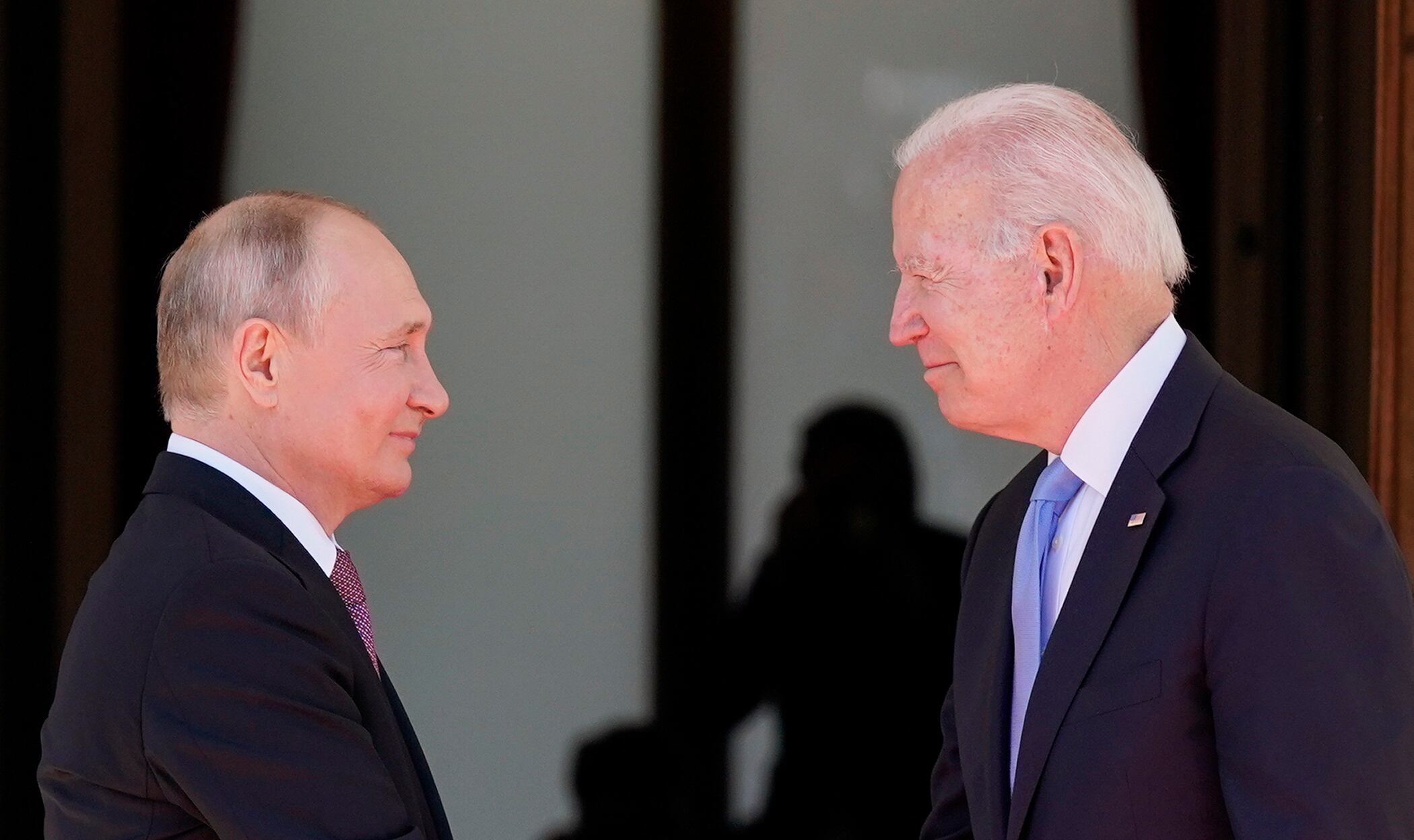
In a brief snippet from the start of the meeting broadcast by Russia state television, the two leaders offered friendly greetings to each other.
“I welcome you, Mr. President,” Putin said, speaking with a Russian flag behind him and a video monitor showing Biden in front of him.
“Good to see you again!” Biden replied with a chuckle. He then noted Putin’s absence from the recent Group of 20 summit in Rome. The Russian took part in the major gathering of industrial nations by video link because of concerns about COVID-19 at home.
“Unfortunately, last time we didn’t get to see one another at G-20,” Biden said. “I hope next time we meet to do it in person.”
Biden made clear that his administration stands ready to take actions that would exact “a very real cost” on the Russian economy, according to White House officials. Putin, for his part, had been expected to demand guarantees from Biden that the NATO military alliance will never expand to include Ukraine, which has long sought membership. That’s a non-starter for the Americans and their NATO allies.
“We’ve consulted significantly with our allies and believe we have a path forward that would impose significant and severe harm on the Russian economy,” White House press secretary Jen Psaki said Monday in previewing the meeting. “You can call that a threat. You can call that a fact. You can call that preparation. You can call it whatever you want to call it.”
The leader-to-leader conversation — Biden speaking from the White House Situation Room, Putin from his residence in Sochi —was one of the toughest of Biden’s presidency and came at a perilous time. U.S. intelligence officials have determined that Russia has massed 70,000 troops near the Ukraine border and has made preparations for a possible invasion early next year.
The U.S. has not determined whether Putin has made a final decision to invade.
Biden was vice president in 2014 when Russian troops marched into the Black Sea peninsula of Crimea and annexed the territory from Ukraine. Aides say the Crimea episode — one of the darker moments for President Barack Obama on the international stage — looms large as Biden looks at the smoldering current crisis.
The eastward expansion of NATO has from the start been a bone of contention, not just with Moscow but also in Washington. In 1996, when President Bill Clinton’s national security team debated the timing of membership invitations to former Soviet allies Poland, Hungary and the Czech Republic, Defense Secretary William Perry urged delay to keep Russian relations on track.
Poland, Hungary and the Czech Republic were formally invited in 1997 and joined in 1999. They were followed in 2004 by Bulgaria, Romania, Slovakia, Slovenia and the former Soviet states of Estonia, Latvia and Lithuania. Since then, Albania, Croatia, Montenegro and North Macedonia have joined, bringing NATO’s total to 30 nations.
A key principle of the NATO alliance is that membership is open to any qualifying country. And no outsider has membership veto power. While there’s little prospect that Ukraine would be invited into the alliance anytime soon, the U.S. and its allies won’t rule it out.
In Washington, Republicans are framing this moment as a key test of Biden’s leadership on the global stage. Biden vowed as a candidate to reassert American leadership after President Donald Trump’s emphasis on an “America first” foreign policy. But Republicans say he’s been ineffective in slowing Iran’s march toward becoming a nuclear power and that the Biden administration has done too little to counter autocratic leaders like China’s Xi Jinping, Iran’s Ayatollah Ali Khamenei and Putin.
“Fellow authoritarians in Beijing and Tehran will be watching how the free world responds,” Senate Minority Leader Mitch McConnell said from the Senate floor on Monday. “And President Biden has an opportunity to set the tone when he speaks with Putin.”
Trump, who showed unusual deference to Putin during his presidency, said in a Newsmax interview on Monday that the Biden-Putin conversation would not be a “fair match,” describing it as tantamount to the six-time Super Bowl champion New England Patriots facing a high school football team.
Ahead of the Putin call, Biden on Monday spoke with leaders of the United Kingdom, France, Germany and Italy to coordinate messaging and potential sanctions. He was to speak with them again on Tuesday following his call with Putin – any potential new sanctions against Russia.
Biden is also expected to speak with Ukrainian President Volodymyr Zelenskyy in coming days.
Putin apparently sees the current situation as a moment to readjust the power dynamic of the U.S.-Russia relationship, analysts say.
“It is about fundamental principles established 30 years ago for the relations between Russia and the West,” said Fyodor Lukyanov, a leading Moscow-based foreign policy expert. “Russia demands to revise these principles, the West says there’s no grounds for that. So, it’s impossible to come to an agreement just like that.”
Beyond Ukraine, there are plenty of other thorny issues on the table, including cyberattacks and human rights. Kremlin spokesman Peskov said U.S.-Russian relations are overall in “a rather dire state.”
Both the White House and the Kremlin sought in advance to lower expectations for Tuesday’s call. But they said the conversation itself was progress.
Peskov told reporters Tuesday that “obviously, if the two presidents decided to have a conversation, they intend to discuss issues and don’t mean to bring matters to a dead end.”
“Putin has repeatedly said that we look for good, predictable relations with the U.S.,” Peskov said. “Russia has never planned to attack anyone. But we have our own concerns, our own red lines — the president spoke clearly about that. To that, Mr. Biden responded that he doesn’t intend to accept any red lines. This issue will be discussed (during the call) as well.”
Peskov characterized the Biden-Putin call as a “working conversation during a very difficult period,” when “escalation of tensions in Europe is off the scale, extraordinary.”
___
Litvinova reported from Moscow. Associated Press writers Vladimir Isachenkov in Moscow and Robert Burns and Darlene Superville in Washington contributed to this report.
Updated on December 7, 2021, at 3:21 p.m. ET with the latest details.