By Chris Megerian, Lorne Cook, and Aamer Madhani
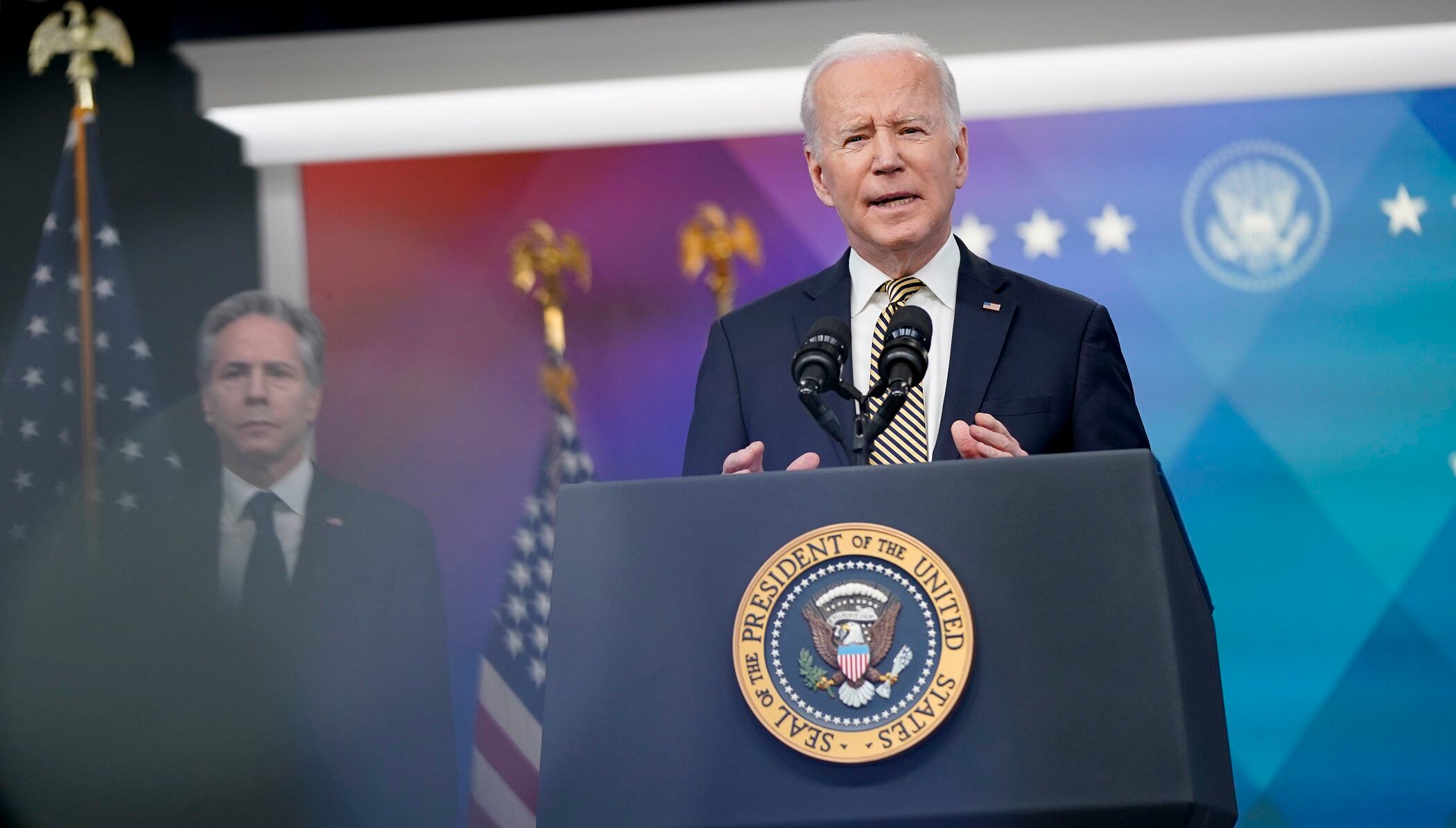
President Joe Biden and Western allies pledged new sanctions and humanitarian aid on Thursday in response to Vladimir Putin’s assault on Ukraine, but their offers fell short of the more robust military assistance that President Volodymyr Zelenskyy pleaded for in a pair of live-video appearances.
Biden also announced the U.S. would welcome up to 100,000 Ukrainian refugees — though he said many probably prefer to stay closer to home — and provide an additional $1 billion in food, medicine, water and other supplies.
The Western leaders spent Thursday crafting next steps to counter Russia’s month-old invasion — and huddling over how they might respond should Putin deploy chemical, biological or even a nuclear weapon. They met in a trio of emergency summits that had them shuttling across Brussels for back-to-back-to-back meetings of NATO, the Group of Seven industrialized nations and the 27-member European Council.
Biden, in an early evening news conference after the meetings, warned that a chemical attack by Russia “would trigger a response in kind."
“You’re asking whether NATO would cross. We’d make that decision at the time,” Biden said.
However, a White House official said later that did not imply any shift in the U.S. position against direct military action in Ukraine. Biden and NATO allies have stressed that the U.S. and NATO would not put troops on the ground in Ukraine.
The official was not authorized to comment publicly by name and spoke only on condition of anonymity.
Zelenskyy, while thankful for the newly promised help, made clear to the Western allies he needed far more than they're currently willing to give.
“One percent of all your planes, one percent of all your tanks,” Zelenskyy asked members of the NATO alliance. “We can’t just buy those. When we will have all this, it will give us, just like you, 100% security.”
Biden said more aid was on its way. But the Western leaders were treading carefully so as not to further escalate the conflict beyond the borders of Ukraine.
“NATO has made a choice to support Ukraine in this war without going to war with Russia," said French President Emmanuel Macron. "Therefore we have decided to intensify our ongoing work to prevent any escalation and to get organized in case there is an escalation.”
Billions of dollars of military hardware have already been provided. A U.S. official, who requested anonymity to discuss internal deliberations, said Western nations were discussing the possibility of providing anti-ship weapons amid concerns that Russia will launch amphibious assaults along the Black Sea coast.
Biden said his top priority at Thursday's meetings was to make certain that the West stayed on the same page in its response to Russian aggression against Ukraine.
"The single most important thing is for us to stay unified," he said.
Finland announced Thursday it would send more military equipment to Ukraine, its second shipment in about three weeks. And Belgium announced it will add one billion euros to its defense budget in response to Russia’s invasion..
At the same time, Washington will expand its sanctions on Russia, targeting members of the country’s parliament along with defense contractors. The U.S. said it will also work with other Western nations to ensure gold reserves held by Russia's central bank are subject to existing sanctions.
With Russia facing increasing international isolation, NATO Secretary-General Jens Stoltenberg also warned China against coming to Moscow's rescue. He called on Beijing “to join the rest of the world and clearly condemn the brutal war against Ukraine and not support Russia.”
But Stoltenberg, too, made clear that the West had a "responsibility to prevent this conflict from becoming a full-fledged war in Europe.”
The possibility that Russia will use chemical or even nuclear weapons has been a grim topic of conversation in Brussels.
Stoltenberg said that NATO leaders agreed Thursday to send equipment to Ukraine to help protect it against a chemical weapons attack.
“This could include detection equipment, protection and medical support, as well as training for decontamination and crisis management,” he said.
White House officials said that both the U.S. and NATO have been working on contingency planning should Russia deploy nonconventional weaponry. NATO has specially trained and equipped forces ready to be deployed if there should be such an attack against a member nation's population, territory or forces.
The White House National Security Council launched efforts days after the invasion through its “Tiger Team,” which is tasked with planning three months out, and a second strategy group working on a longer term review of any geopolitical shift that may come, according to a senior administration official. The official was not authorized to comment publicly and spoke on the condition of anonymity.
Both teams are conducting contingency planning for scenarios including Russia’s potential use of chemical or biological weapons, targeting of U.S. security convoys in the region, disruptions to global food supply chains and the growing refugee crisis.
Biden before departing for Europe on Wednesday said that the possibility of a chemical attack was a “real threat.” In addition, Kremlin spokesman Dmitry Peskov told CNN this week that Russia could consider using its nuclear weapons if it felt there were “an existential threat for our country.”
Finland's Prime Minister Sanna Marin on Thursday warned, “Russia is capable of anything.”
"They don’t respect any rules,” Marin told reporters. “They don’t respect any international laws that they are actually committed to.”
The Russian invasion has spurred European nations to reconsider their military spending, and Stoltenberg opened the NATO summit by saying the alliance must “respond to a new security reality in Europe.”
The bolstering of forces along NATO's eastern flank will put pressure on national budgets.
The energy crisis exacerbated by the war is a particularly hot topic for the European Council summit, where leaders from Spain, Portugal, Italy and Greece are hoping for an urgent, coordinated bloc-wide response. EU officials have said they will seek U.S. help on a plan to top up natural gas storage facilities for next winter, and they also want the bloc to jointly purchase gas.
German Chancellor Olaf Scholz has dismissed calls to boycott Russian energy supplies, saying it would cause significant damage to his country's economy. Scholz is facing pressure from environmental activists to quickly wean Germany off Russian energy, but he said the process will have to be gradual.
“To do so from one day to the next would mean plunging our country and all of Europe into recession," Scholz said Wednesday.
Ursula von der Leyen, head of the European Union’s executive arm, said before Biden’s visit that she wanted to discuss the possibility of securing extra deliveries of liquefied natural gas from the United States for the 27-nation bloc “for the next two winters.”
The EU imports 90% of the natural gas used to generate electricity, heat homes and supply industry, with Russia supplying almost 40% of EU gas and a quarter of its oil. The bloc is hoping to reduce its dependence on Russian gas by diversifying suppliers.
The U.S. is looking for ways to “surge” LNG supplies to Europe to help, said Jake Sullivan, Biden's national security adviser.
Poland and other eastern flank NATO countries will also be seeking clarity on how the U.S. and fellow European nations can assist in dealing with their growing concerns about Russian aggression as well as the refugee crisis. More than 3.5 million refugees have fled Ukraine in recent weeks, including more than 2 million to Poland.
Biden is to visit Poland on Friday, where the energy and refugee issues are expected to be at the center of talks with President Andrzej Duda.
Four new NATO battlegroups, which usually number between 1,000-1,500 troops, are being set up in Hungary, Slovakia, Romania and Bulgaria.
___
Madhani reported from Washington. Associated Press writers Matthew Lee, Hannah Fingerhut, Ellen Knickmeyer and Darlene Superville in Washington, Dasha Litvinova in Lviv, Ukraine, and Samuel Petrequin in Brussels contributed to this report.
Updated on March 24, 2022, at 3:58 p.m. ET with references to additional refugees raised.