By Aamer Madhani, Zeke Miller, and Ellen Knickmeyer
President Joe Biden hit back Thursday against Russia’s invasion of Ukraine, unleashing robust new sanctions, ordering the deployment of thousands of additional troops to NATO ally Germany and declaring that America would stand up to Russia's Vladimir Putin.
He also acknowledged that the invasion -- and efforts to thwart Putin -- will have a cost for Americans. But he sought to reassure that the economic pain that may come with rising energy prices will be short lived in the U.S.
As for the Russian president, Biden said, “He’s going to test the resolve of the West to see if we stay together. And we will.”
Targeting Russia's financial system, Biden said, the United States will block assets of large Russian banks, i mpose export controls aimed at the nation's high-tech needs and sanction its business oligarchs.
The president said the U.S. also will be deploying additional forces to Germany to bolster NATO after the invasion of Ukraine, which is not a member of the defense organization. Some 7,000 additional U.S. troops will be sent.
But some U.S. lawmakers—and Ukrainian officials—called on Biden to do more.
“There is more that we can and should do,” said Sen Bob Menendez, D-N.J., the chairman of the Foreign Relations Committee, pointing to the possibility of removing Russian banks from the SWIFT international banking system and sanctioning Putin personally. “Congress and the Biden administration must not shy away from any options.”
Senate Republican leader Mitch McConnell expressed support Thursday for Biden's latest moves but also urged Biden to apply maximum pressure on Putin.
“We’re all together at this point and we need to be together about what should be done,” McConnell said. “But I have some advice: Ratchet the sanctions all the way up. Don’t hold any back.”
Biden declared that Putin, who has referred to the collapse of the Soviet Union as the “greatest geopolitical catastrophe” of the past century, is looking beyond Ukraine.
“He has much larger ambitions,” Biden said. “He wants to, in fact, reestablish the former Soviet Union. That’s what this is about.”
The penalties announced Thursday fall in line with the White House’s insistence that it would hit Russia’s financial system and Putin's inner circle, while also imposing export controls that would aim to starve Russia’s industries and military of U.S. semiconductors and other high-tech products.
“Putin is the aggressor,” Biden said. “Putin chose this war, and now he and his country will bear the consequences."
But Biden, for now, held off imposing some of the most severe potential sanctions, including cutting Russia out of the SWIFT payment system, which allows for the transfers of money from bank to bank around the globe.
Biden announced the sanctions at the White House while Ukraine’s government reported mounting casualties inflicted by Russian forces attacking from the east, north and south.
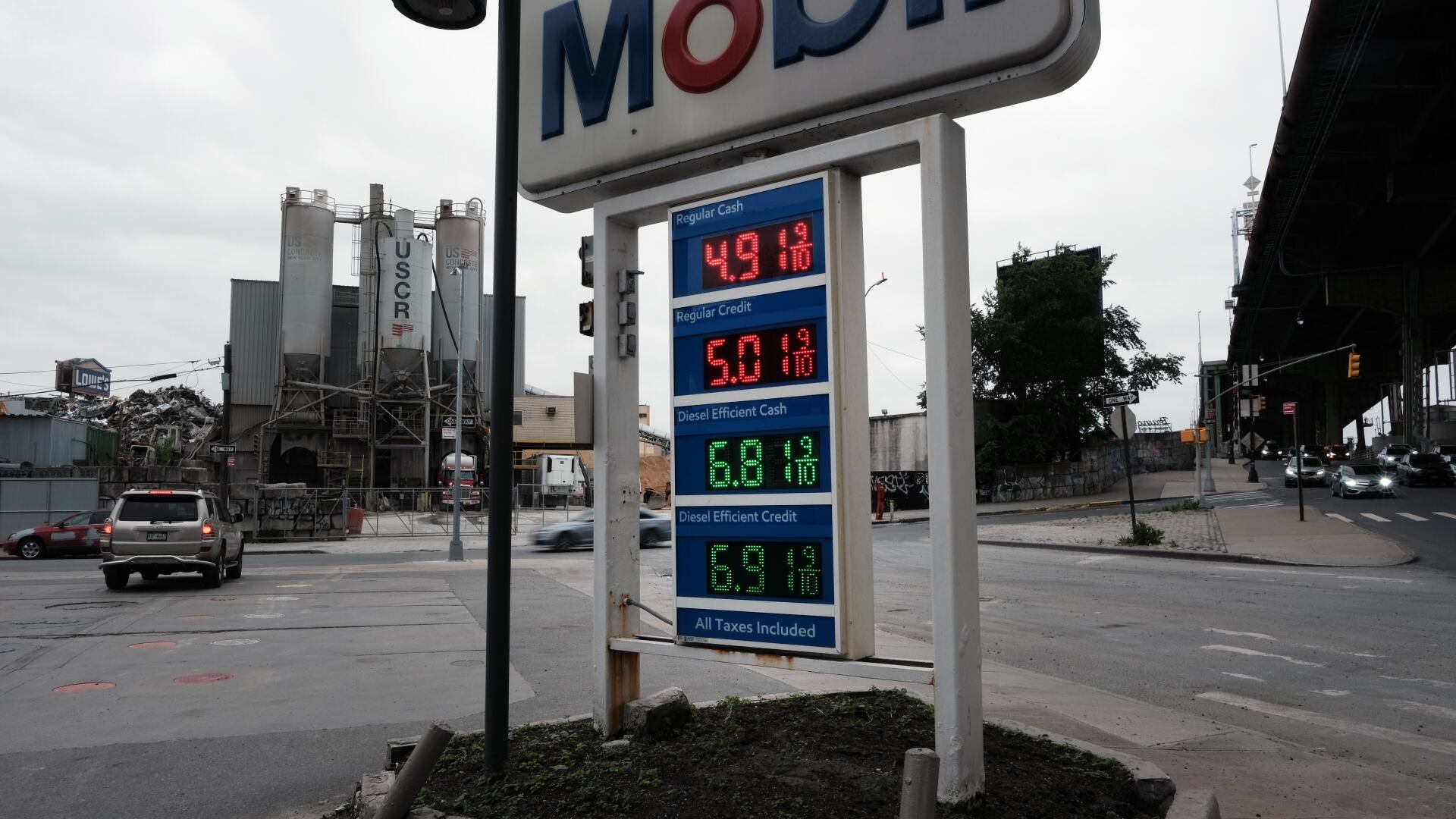
Oil and natural prices have already surged over concerns that Russia -- an energy production behemoth -- will slow the flow of oil and natural gas to Europe. Biden, however, acknowledged the sanctions are “going to take time” to have their effect on the Russian economy.
He also acknowledged that the invasion -- and efforts to thwart Putin--will have a cost for Americans. But he sought to reassure that the economic pain that may come with rising energy prices will be short lived for them.
Biden added that after Russia’s “brutal assault” against Ukraine it would be a mistake for Putin's actions to go unanswered. He said if they did, “the consequences for America would be much worse.”
“America stands up to bullies, we stand up for freedom,” Biden said. “This is who we are.”
Biden spoke hours after holding a virtual meeting with the leaders of Britain, Canada, France, Italy and Japan. European Commission President Ursula von der Leyen, European Council President Charles Michel, and NATO Secretary General Jens Stoltenberg also joined the meeting.
The president also met with his national security team in the White House Situation Room as he looked to flesh out U.S. moves in the rapidly escalating crisis.
While Biden described the sanctions as severe, Ukrainian officials urged the U.S. and West to go further and cut the Russians from the SWIFT financial system.
“We demand the disconnection of Russia from SWIFT, the introduction of a no-fly zone over Ukraine and other effective steps to stop the aggressor,” Ukraine President Volodymyr Zelenskyy said in a tweet.
The Biden administration, however, has shown some reluctance to cut Russia from SWIFT, at least immediately, because of concerns the move could also have enormous ramifications for Europe and other Western economies. Biden, answering questions from reporters, appeared to push a decision on SWIFT to European allies.
“It is always an option but right now that’s not the position that the rest of Europe wishes to take,” Biden said. He also contended that the financial sanctions he announced would be more damaging to Russia.
The Belgium-headquartered system allows for tens of millions of transactions daily among banks, financial exchanges and other institutions. The U.S. notably has previously blocked Iran from the system because of its nuclear program.
Officials in Europe have noted that the loss of SWIFT access by Russia could be a drag on the broader global economy. Russia has also equated a SWIFT ban to a declaration of war. And because the system cements the importance of the U.S. dollar in global finance, outright bans also carry the risk of pushing countries to use alternatives through the Chinese government or blockchain-based technologies.
Brian Frey, a former Justice Department prosecutor during the Trump administration said while SWIFT is the primary messaging system for financial payments, “there are alternatives to the system” and cutting Russia off would create a “splashback and immediate problems for the international community.”
The sanctions include targeting Russia’s two largest banks, Sberbank and VTB Bank. The U.S. Treasury Department says the sanctions overall “target nearly 80 percent of all banking assets in Russia and will have a deep and long-lasting effect on the Russian economy and financial system.”
Individuals close to Putin were also targeted in the latest sanctions. They include former chief of staff Sergei Ivanov; Andrey Patrushev, a Putin ally who has held high-ranking positions at the state-owned Gazprom Neft, and former Deputy Prime Minister Igor Sechin, chairman of the management board of the oil company Rosneft.
Treasury also announced sanctions against Belarusian banks, the country's defense industry and security officials over support for Russian invasion of Ukraine.
Biden said the export control measures he ordered would "impose severe cost on the Russian economy, both immediately and over time.” The measures will restrict Russia access to semiconductors, computers, telecommunications, information security equipment, lasers and sensors.
“We’re going to impair their ability to compete in a high tech 21st century economy," Biden said.
Meanwhile, Russia’s second-ranking diplomat in Washington was expelled in retaliation for the Russian expulsion of the No. 2 U.S. diplomat in Moscow earlier this month, a senior State Department official said Thursday.
The expulsion was unrelated to the invasion and is part of a long-running dispute between Washington and Moscow over embassy staffing. However, it comes as tensions between the two capitals have hit a post-Cold War high.
The official said the State Department had informed the Russian Embassy on Wednesday that it was expelling Minister Counselor Sergey Trepelkov, who is currently the No. 2 at the mission under Ambassador Anatoly Antonov. Russia expelled U.S. Deputy Chief of Mission Bart Gorman from Moscow in mid-February.
—-
Associated Press writers Lolita C. Baldor, Josh Boak, Fatima Hussein, Matthew Lee, Lisa Mascaro, Chris Megerian in Washington and Bruce Schreiner in Louisville, Kentucky, contributed reporting.
Updated on February 24, 2022, at 5:46 p.m. ET with additional details.