By Josh Boak

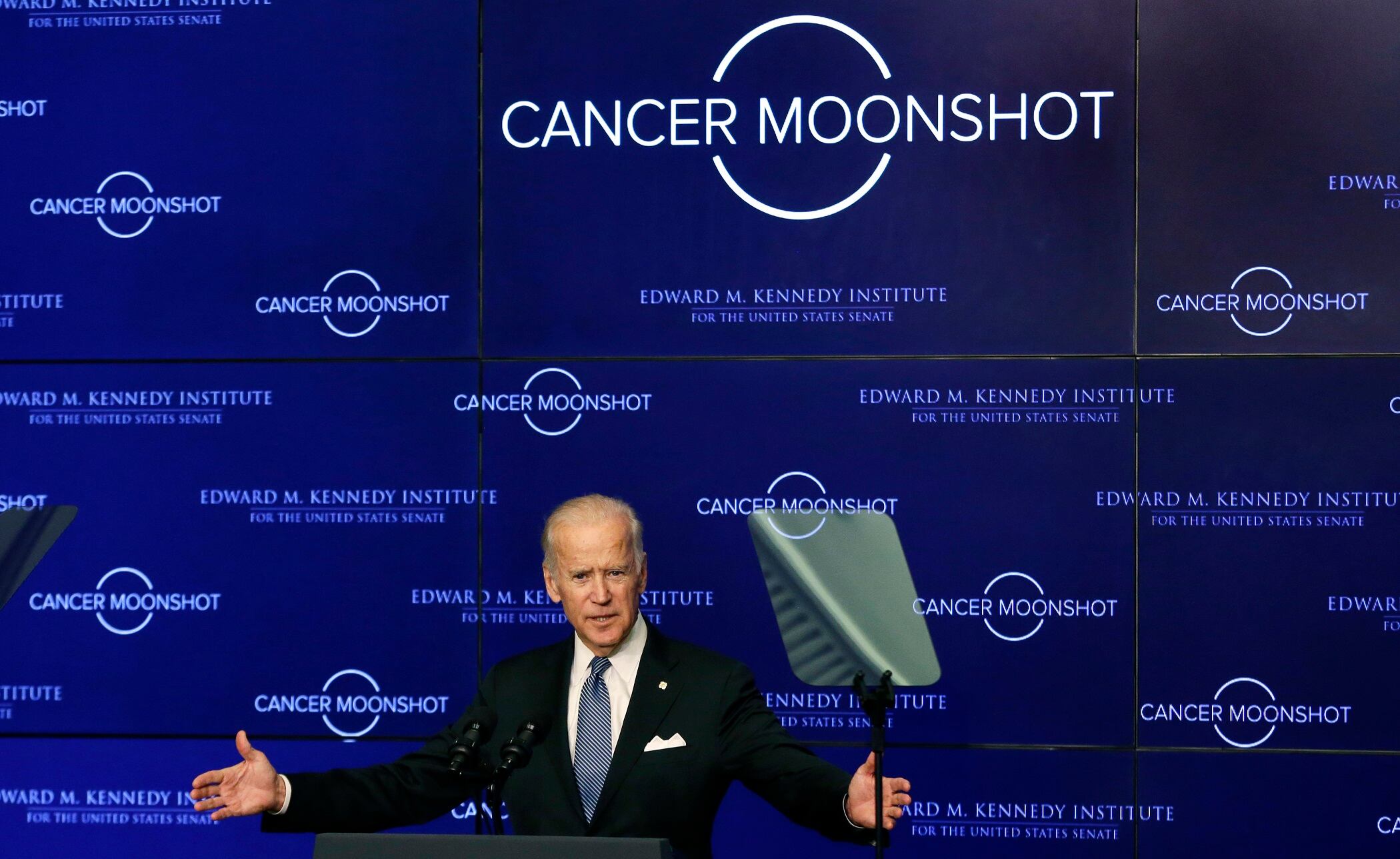
President Joe Biden is committing to reduce the cancer death rate by 50% — a new goal for the “moonshot” initiative against the disease that was announced in 2016 when he was vice president.

Biden has set a 25-year timeline for achieving that goal, part of his broader effort to end cancer as we know it, according to senior administration officials who previewed Wednesday's announcement on the condition of anonymity.

The issue is deeply personal for Biden: He lost his elder son, Beau, to brain cancer in 2015.

The pain experienced by the president is shared by many Americans. The American Cancer Society estimates that there will be 1,918,030 new cancer cases and 609,360 cancer deaths this year. What Biden is aiming to do is essentially save more than 300,000 lives annually from the disease, something the administration believes is possible because the age-adjusted death rate has already fallen by roughly 25% over the past two decades. The cancer death rate is currently 146 per 100,000 people, down from nearly 200 in 2000.

The American Cancer Society said in a statement that it applauded Biden for “putting national focus on this critical issue” and that “it will be standing shoulder to shoulder” with the administration.

Dr. Barron Lerner, a professor of medicine and population health at New York University Langone Health, said that “hyperbolic goals" can be needed to attract public attention but achieving the 50% reduction is “extremely unlikely.”

“Similar past efforts like the ‘War on Cancer’ have made gains, but they have been more modest,” said Lerner, the author “The Breast Cancer Wars.” “Cancer is many diseases and requires very complicated research. Translating these advances to the clinical setting is never easy either.”

Biden was scheduled to give remarks Wednesday from the East Room of the White House, along with his wife, Jill, and Vice President Kamala Harris. Also scheduled to attend the speech: members of Congress and the administration and about 100 members of the cancer community including patients, survivors, caregivers, families, advocacy groups and research organizations.

As part of the effort, Biden will assemble a “cancer Cabinet” that includes 18 federal departments, agencies and offices, including leaders from the Departments of Health and Human Services, Veterans Affairs, Defense, Energy and Agriculture.

There were no plans to announce new funding commitments on Wednesday, though the administration will outline why it believes it can curb cancer through efforts such as increased screening and removing inequities in treatment. The coronavirus pandemic has consumed health care resources and caused people to miss more than 9.5 million cancer screenings.

The White House also will host a summit on the cancer initiative and continue a roundtable discussion series on the subject. The goal is to improve the quality of treatment and people’s lives, something with deep economic resonance as well. The National Cancer Institute reported in October that the economic burden of treatment was more than $21 billion in 2019, including $16.22 billion in patient out-of-pocket costs.

President Barack Obama announced the cancer program during his final full year in office and secured $1.8 billion over seven years to fund research. Obama designated Biden, then his vice president, as “mission control," a recognition of Biden's grief as a parent and desire to do something about it. Biden wrote in his memoir “Promise Me, Dad” that he chose not to run for president in 2016 primarily because of Beau's death.

When Biden announced he wasn't seeking the Democratic nomination in 2016, he said he regretted not being president because "I would have wanted to have been the president who ended cancer, because it’s possible.”

The effort fell somewhat out of the public focus when Donald Trump became president, though Trump, a Republican, proposed $500 million over 10 years for pediatric cancer research in his 2019 State of the Union address.

Biden continued the work as a private citizen by establishing the Biden Cancer Initiative to help organize resources to improve cancer care. When Biden did seek the presidency in 2020, he had tears in his eyes as he said in an interview on MSNBC's “Morning Joe" that “Beau should be running for president, not me.”
Share:
More In Politics
Boosters For All, Diplomatic Boycott of Beijing Olympics & The Perfect Hug
Jill is joined by “Friend of the Pod” Mosheh Oinounou to talk booster shots, and whether “fully vaccinated” will eventually mean three shots, not two. Plus, the latest on the Kyle Rittenhouse trial. And the research is in: we know now the perfect way to hug. Also, Jill and Mosheh debate whether Airpods are passé.
Climate Deal Reached as COP26 Comes to a Close
A deal was reached as the COP26 Summit in Glasgow came to a close. Dr. Katharine Hayhoe, Chief Scientist at the Nature Conservancy and Author of 'Saving Us: A Climate Scientist's Case for Hope and Healing in a Divided World,' joined Cheddar News' Closing Bell to discuss the deal.
Doctors Warn of More Active Flu Season in U.S.
As we move into the colder months in the U.S., health experts are warning of a more active flu season than last year, sounding the alarm on what many are calling a 'twindemic.' Dr. Syra Madad, infectious disease epidemiologist, joined Cheddar's 'Search for the Cure' to discuss the intersection of the flu season with the Covid-19 pandemic.
The Priorities of Biden's Universal Pre-K Plan
Schools across the country could expect to see billions of dollars towards providing a more accessible Universal Pre-K program. Steven Barnett, Board of Governors Professor and Director of the National Institute for Early Education Research at Rutgers University, joined Cheddar News to discuss more.
Breaking Down Legal Challenge to Biden Vaccine Mandate for Businesses
The Fifth Circuit Court of Appeals court temporarily held up President Biden's vaccine mandate for workplaces with more than 100 employees as the various lawsuits challenging it are combined. Marjorie Mesidor, a partner at the law firm Phillips & Associates, PLLC, joined Cheddar to break down the arguments in play. "They [the Biden Administration] say we have the authority to do this under the broad powers that are given under OSHA," she said. "What the Republic side then is saying, no, this is overbroad."
UN Climate Summit Wraps with New Agreement Among Nations
The UN climate summit wrapped up over the weekend after days of negotiations over the summit's final agreement. The agreement pushes countries to reassess their climate goals by the end of next year, do more for countries facing the worst effects of climate change, and also calls for a "phase down" of coal and other fossil fuel subsidies. The White House praised the agreement, but underscored the feelings of many world leaders by saying it isn't enough. Deborah Brosnan, climate expert and president of Deborah Brosnan and Associates, joined Cheddar's News Wrap to discuss.
Sen. Schumer Presses President Biden to Tap Oil Reserves to Lower Gas Prices
President Biden is under some pressure from members of his own party over rising gas prices. Senate Majority Leader Chuck Schumer has called for the president to utilize oil reserves to lower gas prices ahead of the holiday season, as gas prices are currently at a seven-year high. Energy Workforce & Technology Council CEO Leslie Beyer joins Cheddar News' Closing Bell to discuss.
Harry's To Provide Mental Health Support For Veterans And Afghan Refugees
The men's brand Harry's is teaming up with Stop Soldier Suicide and Headstrong to help provide mental health support with a $500,000 financial commitment. The withdrawal of troops from Afghanistan triggered a range of mental health responses from veterans and active service members, as well as displaced refugees who are now acclimating to a new way of life. Maggie Hureau, Harry's head of social impact, joined Cheddar News to talk about the partnership and why Harry's chose to get involved in mental health care.
What Inflation Means For American Businesses
Inflation has risen to its highest level in 31 years, sending consumer prices on everything from groceries to gas to rent surging. For many businesses, that's good news as inflation typically means better profit margins. According to data from FactSet, nearly two out of three of the biggest U.S. publicly traded companies have reported fatter profit margins so far this year compared to the same stretch of 2019, before the pandemic. Gregory Daco, chief U.S. economist for Oxford Economics, breaks down how the top businesses are reaping the benefits of inflation, and when consumers can expect inflation to ease.
Load More