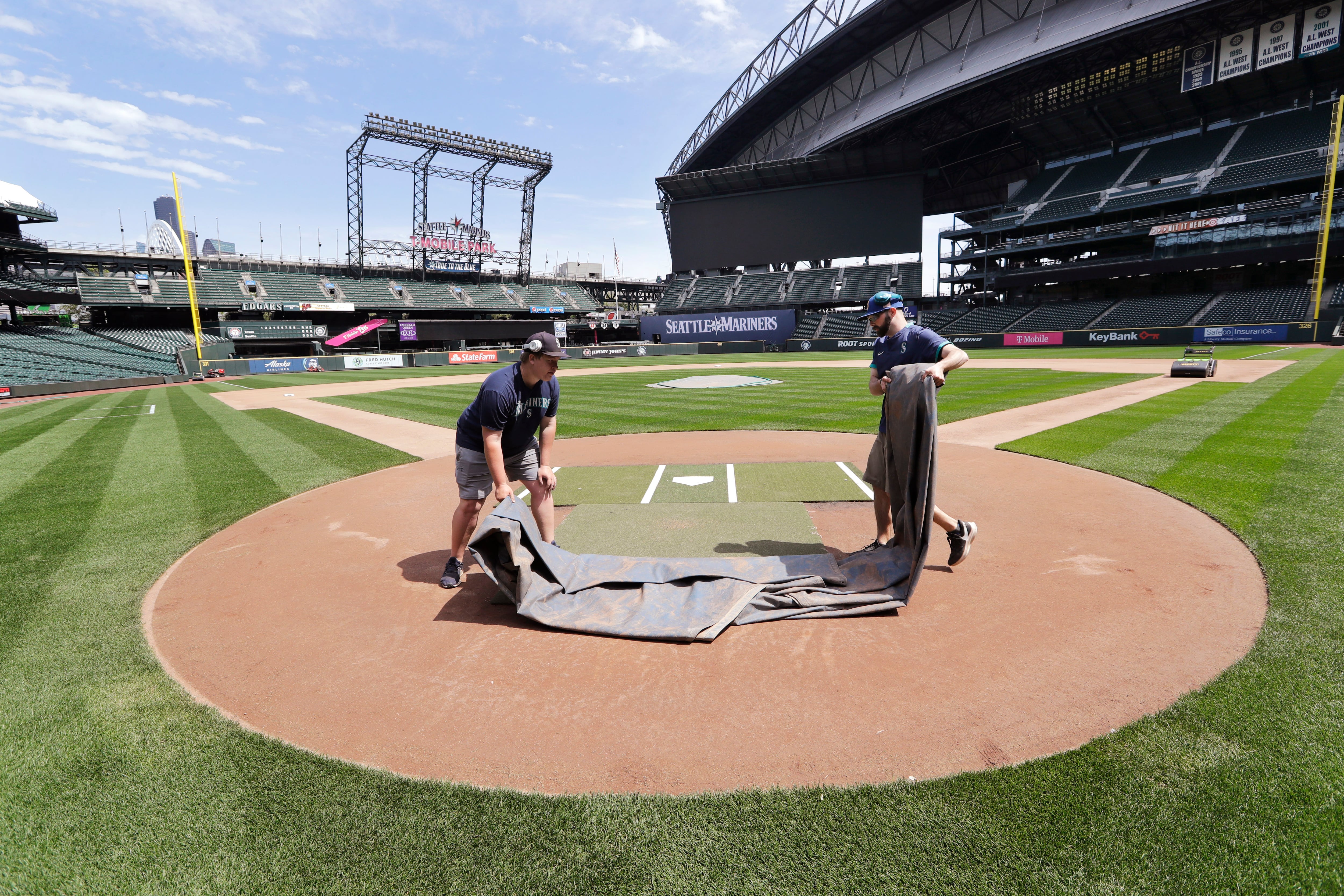
Grounds crew workers Jacob Weiderstrom, left, and Marcus Gignac pull a tarp off home plate as they continue to keep the Seattle Mariners' field in playing shape as the ballpark goes into its seventh week without baseball played because of the coronavirus outbreak Monday, May 11, 2020, in Seattle. (AP Photo/Elaine Thompson)
By Ronald Blum
The baseball players' association gave management a wide-ranging response Thursday to a 67-page proposed set of protocols for a season to be played during the coronavirus pandemic.
Management had presented the union and the 30 teams the proposed draft last Friday.
The union said Thursday it addressed: protections for high-risk players, access to pre- and postgame therapies, testing frequency, protocols for positive tests, in-stadium medical personnel, and sanitization procedures.
Players viewed many of the concepts in the original draft as over-the-top, such as arriving in uniform at the ballparks, a prohibition on them leaving hotels without team permission, and a ban on guests other than immediate family members. Players also objected to a ban on the use of showers and hydrotherapy.
The union wants more frequent testing than management's proposed “multiple times per week.”
MLB is expected to make an economic proposal to the union within a few days. MLB hopes to start the season by early July.
Tech stocks are rallying on strong earnings and massive AI investment. Investors are watching Nvidia & hyperscaler spending for clues on how long it will last.
Sean Klitzner, showrunner and co-creator of Beast Games, previews the Feb. 25 finale packed with bigger stunts, wild twists, and the highest stakes yet.
Bob Sallmann, CFO of McGraw Hill, breaks down the quarter’s standout performance, digital expansion, and how AI tools are driving education innovation.
Daniel Desrochers, International Trade Reporter at POLITICO, joins us to break down the ruling, the billions at stake, and what it means for consumers.