By Scott McFettridge
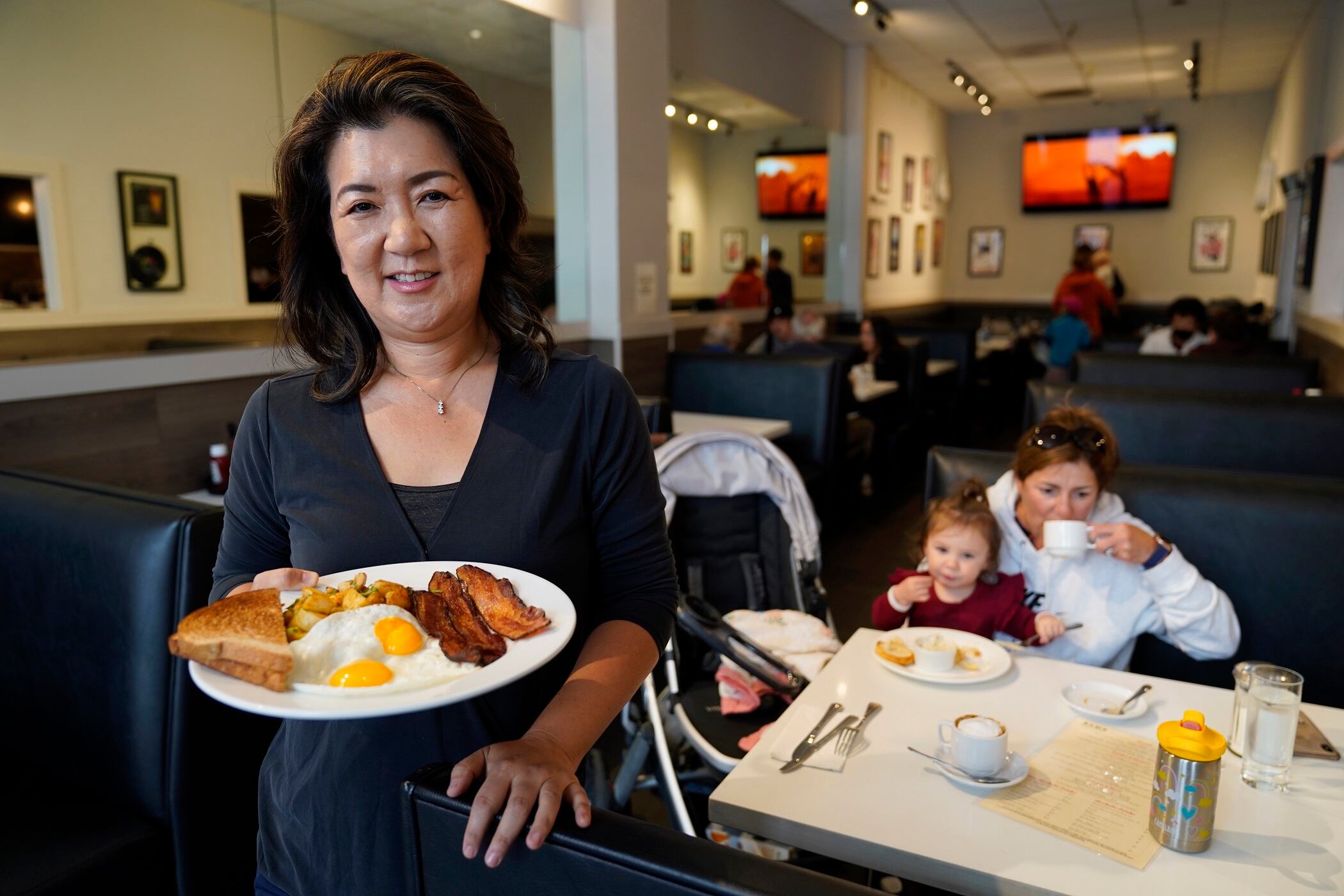
Thanks to a reworked menu and long hours, Jeannie Kim managed to keep her San Francisco restaurant alive during the coronavirus pandemic.
That makes it all the more frustrating that she fears her breakfast-focused diner could be ruined within months by new rules that could make one of her top menu items — bacon — hard to get in California.
“Our number one seller is bacon, eggs and hash browns,” said Kim, who for 15 years has run SAMS American Eatery on the city’s busy Market Street. “It could be devastating for us.”
At the beginning of next year, California will begin enforcing an animal welfare proposition approved overwhelmingly by voters in 2018 that requires more space for breeding pigs, egg-laying chickens and veal calves. National veal and egg producers are optimistic they can meet the new standards, but only 4% of hog operations now comply with the new rules. Unless the courts intervene or the state temporarily allows non-compliant meat to be sold in the state, California will lose almost all of its pork supply, much of which comes from Iowa, and pork producers will face higher costs to regain a key market.
Animal welfare organizations for years have been pushing for more humane treatment of farm animals but the California rules could be a rare case of consumers clearly paying a price for their beliefs.
With little time left to build new facilities, inseminate sows and process the offspring by January, it’s hard to see how the pork industry can adequately supply California, which consumes roughly 15% of all pork produced in the country.
“We are very concerned about the potential supply impacts and therefore cost increases,” said Matt Sutton, the public policy director for the California Restaurant Association.
California's restaurants and groceries use about 255 million pounds of pork a month, but its farms produce only 45 million pounds, according to Rabobank, a global food and agriculture financial services company.
The National Pork Producers Council has asked the U.S. Department of Agriculture for federal aid to help pay for retrofitting hog facilities around the nation to fill the gap. Hog farmers said they haven't complied because of the cost and because California hasn't yet issued formal regulations on how the new standards will be administered and enforced.
Barry Goodwin, an economist at North Carolina State University, estimated the extra costs at 15% more per animal for a farm with 1,000 breeding pigs.
If half the pork supply was suddenly lost in California, bacon prices would jump 60%, meaning a $6 package would rise to about $9.60, according to a study by the Hatamiya Group, a consulting firm hired by opponents of the state proposition.
At one typical hog farm in Iowa, sows are kept in open-air crates measuring 14-square-feet when they join a herd and then for a week as part of the insemination process before moving to larger, roughly 20-square foot group pens with other hogs. Both are less than the 24 square feet required by the California law to give breeding pigs enough room to turn around and to extend their limbs. Other operations keep sows in the crates nearly all of the time so also wouldn't be in compliance.
The California Department of Food and Agriculture said that although the detailed regulations aren't finished, the key rules about space have been known for years.
“It is important to note that the law itself cannot be changed by regulations and the law has been in place since the Farm Animal Confinement Proposition (Prop 12) passed by a wide margin in 2018," the agency said in response to questions from the AP.
The pork industry has filed lawsuits but so far courts have supported the California law. The National Pork Producers Council and a coalition of California restaurants and business groups have asked Gov. Gavin Newsom to delay the new requirements. The council also is holding out hope that meat already in the supply chain could be sold, potentially delaying shortages.
Josh Balk, who leads farm animal protection efforts at the Humane Society of the United States, said the pork industry should accept the overwhelming view of Californians who want animals treated more humanely.
“Why are pork producers constantly trying to overturn laws relating to cruelty to animals?” Balk asked. “It says something about the pork industry when it seems its business operandi is to lose at the ballot when they try to defend the practices and then when animal cruelty laws are passed, to try to overturn them.”
In Iowa, which raises about one-third of the nation's hogs, farmer Dwight Mogler estimates the changes would cost him $3 million and allow room for 250 pigs in a space that now holds 300.
To afford the expense, Mogler said, he’d need to earn an extra $20 per pig and so far, processors are offering far less.
“The question to us is, if we do these changes, what is the next change going to be in the rules two years, three years, five years ahead?” Mogler asked.
The California rules also create a challenge for slaughterhouses, which now may send different cuts of a single hog to locations around the nation and to other countries. Processors will need to design new systems to track California-compliant hogs and separate those premium cuts from standard pork that can serve the rest of the country.
At least initially, analysts predict that even as California pork prices soar, customers elsewhere in the country will see little difference. Eventually, California’s new rules could become a national standard because processors can’t afford to ignore the market in such a large state.
Kim, the San Francisco restaurant owner, said she survived the pandemic by paring back her menu, driving hundreds of miles herself through the Bay Area to deliver food and reducing staff.
Kim, who is Korean-American, said she’s especially worried for small restaurants whose customers can't afford big price increases and that specialize in Asian and Hispanic dishes that typically include pork.
“You know, I work and live with a lot of Asian and Hispanic populations in the city and their diet consists of pork. Pork is huge,” Kim said. “It’s almost like bread and butter.”
___
Associated Press writers David Pitt in Des Moines, Iowa, and Stephen Groves in Alvord, Iowa, contributed to this story.