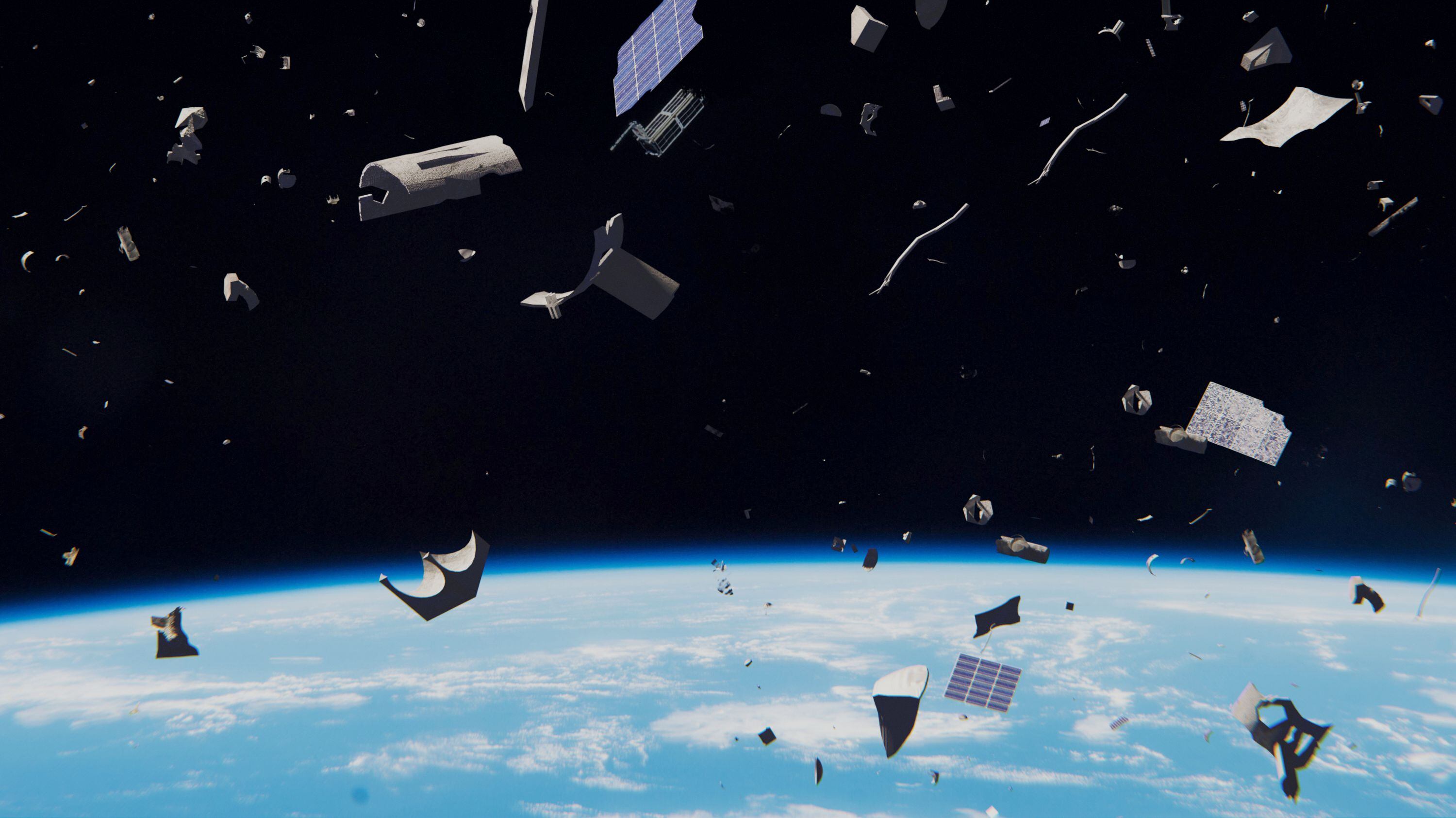
Right now, circling the Earth, is a satellite with a death sentence.
DirecTV's Spaceway-1 satellite is launching itself into a band of space junk called the graveyard orbit. The emergency measure became necessary after an unexplained battery malfunction in December put the broadcast satellite in jeopardy of exploding. Solar panels are powering it for now, but the battery will automatically turn back on once it passes into the Earth's shadow in late February, according to an FCC filing.
At that point, it's uncertain what exactly would have happened, but any explosion in the planet's geostationary orbit is messy business. That's where most of the world's largest satellites operate, and even a tiny piece of debris can cause catastrophic damage.
Boeing, which designed and built the satellite, has not provided details about the cause of the battery failure, but stated that it "occurred in the course of beyond-contract-life operation after a collection of events that have a very low likelihood of occurring on other satellites." AT&T ($T), the parent company of DirecTV, did not respond to a request for comment.
Whatever the cause of the failure, the clock is ticking. The best practice now is to empty the fuel tank, then use the last dregs to boost the satellite 186 miles away into the graveyard orbit.
Because of the battery issue, however, Spaceway-1 won't have enough time to burn off its fuel before the maneuver and could technically still explode out there in the land of the dead.
"Once something explodes and becomes smaller objects, all bets are off on how those things behave, which is part of the problem," said Moriba Jah, a former astronaut and a professor of aerospace engineering at the University of Texas. "We have a lot of evidence that there's debris that has come back from the graveyard and is crossing the active geoorbital highway."
Whether the best or worst case scenario plays out in this case, a number of space experts agree that the current system for retiring old or malfunctioning satellites needs some work.
With the prospect of thousands of more commercial satellites filling the skies due to private companies like OneWeb and SpaceX — which plans to launch up to 42,000 satellites over the next decade — the need for reforms could become even more urgent in the near future.
"Sometimes you can follow all the right rules and technology still fails you," said Victoria Samson of the Secure World Foundation, a nonprofit that deals in space sustainability and debris mitigation. "The question then becomes 'how do you handle a response at that point, other than crossing your fingers and hoping for the best?"
'Space Hygiene'
There are two basic options when a satellite reaches the end of its life. You can hurtle it into the atmosphere to burn up upon re-entry, or send it out to the graveyard orbit. Satellites in the low Earth orbit (LEO) use the former, while satellites in the geostationary orbit (GEO) use the latter.
Beyond a set of best practices and international guidelines, the system has no enforcement mechanism to make sure satellite operators comply. This places the onus on individual companies, and the countries that license them, to keep the orbital lanes clean and clear.
"It's really hard to regulate an environment where there is no overarching authority," said Chris Blackerby, COO of Astroscale Holdings, a private orbital debris removal company based in Japan. "There is a generally accepted practice that if you launch a satellite into orbit, you will remove it within 25 years of the end of that satellite's mission."
The working theory in the space community is that no single satellite operator wants to clutter up space lanes because they too need them for future missions.
"Best behavior is to not junk it up for everybody, and basically that's worked pretty well because everybody who uses space has an incentive to keep it as clean and as useful as possible," said Lauren Grego, a senior scientist for the Union of Concerned Scientists, which maintains a database of active satellites and has advocated for better protocols in satellite management.
"Stuff usually pretty gracefully dies at some point," she added.
But junk has nonetheless found a way into Earth's orbit. According to one estimate from the Surrey Space Centre in England, there are 8,000 tons of debris floating around the planet. NASA tracks 500,000 individual pieces of debris each moving at 17,500 mph.
Debris has accumulated over decades, as satellites were either intentionally or accidentally damaged or destroyed in the course of their life spans. One recent example includes a collision in 2009 between Russian and U.S. satellites that generated 2,000 pieces of trackable debris.
The concern among scientists and analysts like Grego and Samson is that shared incentives alone won't be enough to avoid future incidents once more satellites crowd the skies.
"If you look at FCC filings, in theory there could potentially be 50,000 new satellites launched over the next several years," Samson said. "This is compared to 2,200 active satellites, so that is a whole order of magnitude difference, which means you're going to have a lot more satellites reaching the end of their life and coming back down or that simply don't work."
The best way to reform the system is an open question, but companies like Astroscale have offered some alternatives to tossing them off into space.
New World Order
Blackerby said there are two main components to his company's approach to space sustainability. The first is providing a greater awareness of where objects are in space, or what's called space situational awareness (SSA), which requires robust data sharing between governments and companies. There has been an international push to pool more data, but the effort is ongoing.
The second is developing new technologies to physically move broken satellites out of the way.
"What we'd like to see is some kind of assurance that if a satellite fails in orbit that there is a backup plan to bring it out of the way," he said.
The company has proposed that every satellite include a magnet plate on its surface that would allow a backup satellite to tug it out of the way on short notice. "It's sort of like AAA," he said.
Other variations on high-tech trash collection, such as specialized nets and harpoons, have been proposed as well, but getting companies and governments to embrace them is a separate struggle that requires making the case for long-term sustainability against short-term costs.
"The technology is being worked on for that, but the policies aren't in place," Samson said. "It's sort of a mixed bag."
Jah of the University of Texas frames the issue in the kind of moral terms that have come to define the environmental movement here on Earth.
"My problem is that we have disposable orbits, period. The way to think about it is that we essentially have landfills in space," he said.
"There's only so many specific highways in space where we put satellites. Given that it's a finite resource that everyone has a right to use, it's definitely in need of environmental protection."