By Jim Heintz, Yuras Karmanau, Vladimir Isachenkov and Dasha Litvinova
Russia renewed its aerial assault Wednesday on Ukraine’s second-largest city in a pounding that lit up the skyline with balls of fire over populated areas, even as both sides said they were ready to resume talks aimed at stopping the fighting.
Seven days into Russia's invasion, a refugee crisis unfolded on the European continent, with the United Nations saying that more than 870,000 people have fled Ukraine and that the number could soon hit 1 million.
Ukraine’s State Emergency Service reported that more than 2,000 civilians have been killed, but that could not immediately be independently verified, and neither side has disclosed its military casualties.
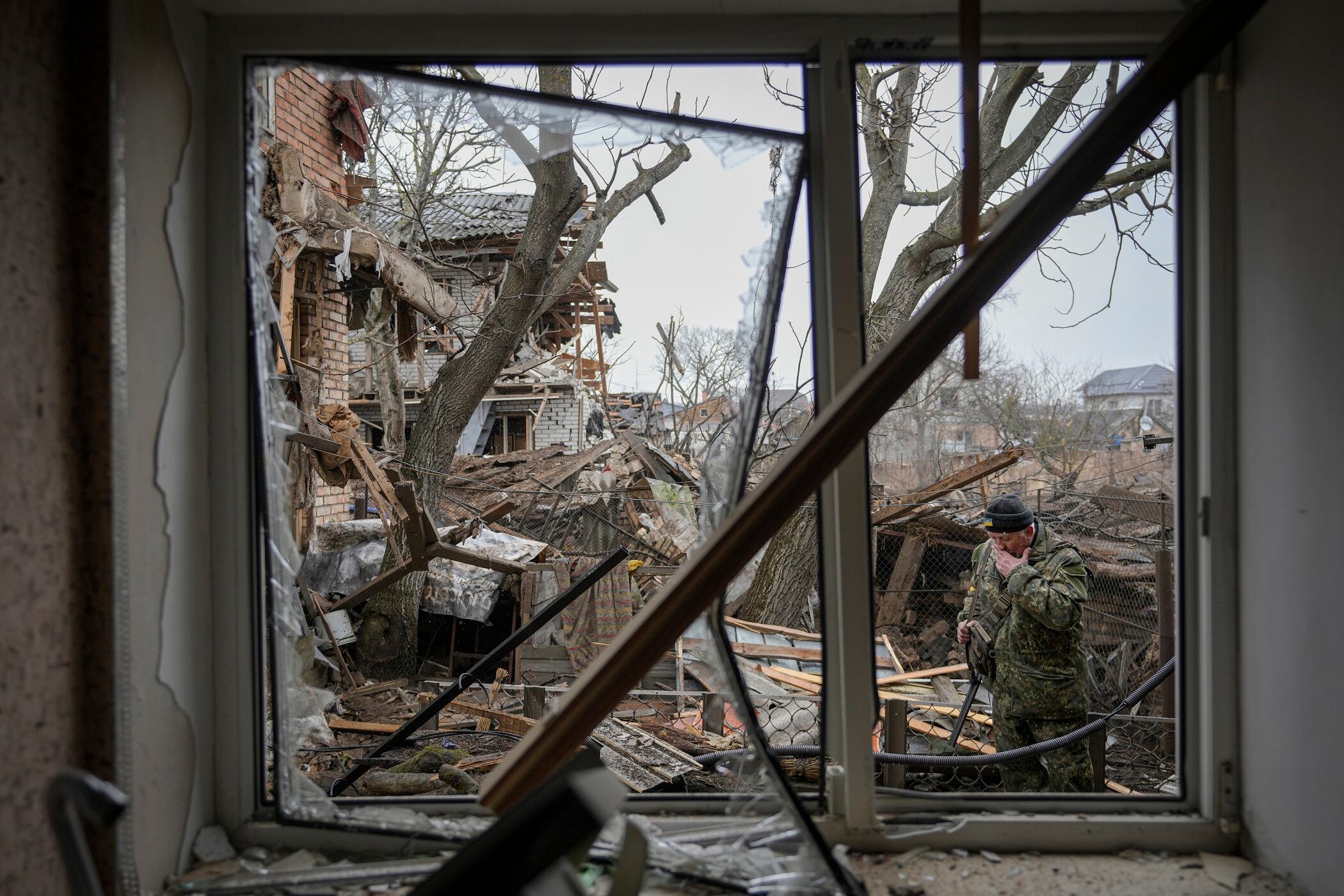
Kharkiv, Ukraine's second-biggest city, with a population of about 1.5 million, came under bombardment again Wednesday, and a strike reportedly hit a hospital in the country’s north. Meanwhile, a 40-mile-long (64-kilometer) column of Russian tanks and other vehicles stood outside the capital, Kyiv, while invading forces pressed their assault on the strategic port cities of Kherson and Mariupol in the south.
The two sides held talks on Monday, agreeing only to keep talking. It was not immediately clear when new talks might take place or what they would yield. Ukrainian President Volodymyr Zelenskyy said on Tuesday that Russia should stop bombing before another meeting.
Zelenskyy has decried Russia’s attacks on civilian targets as a blatant terror campaign, while U.S. President Joe Biden warned on Tuesday that if Russian leader Vladimir Putin is not made to “pay a price” for the invasion, the aggression won't stop with one country.
Russia, too, ramped up its rhetoric, with Foreign Minister Sergei Lavrov reminding the world about the country's vast nuclear arsenal. In an interview with Al-Jazeera, he said: “A third world war will be nuclear, and devastating," according to Russian news sites.
A Russian attack hit the regional police and intelligence headquarters in Kharkiv, killing four people and wounding several others, Ukraine's emergency service said. It added that residential buildings were also hit, but did not provide details.
A blast blew the roof off of the five-story police building and set the top floor on fire, according to videos and photos released by the service. Pieces of the building were strewn across the streets.
In the northern city of Chernihiv, two cruise missiles hit a hospital, according to the Ukrainian UNIAN news agency, which quoted the health administration chief, Serhiy Pivovar, as saying authorities were working to determine the casualty toll.
In besieged Mariupol, at least one teenager died and two more were wounded by apparent Russian shelling.
The three boys were rushed to a regional hospital. One had lost his legs in the attack and died soon after arriving, according to an Associated Press reporter at the scene. Family members told the AP the three had been playing soccer near a school when the shelling hit.
The attacks came a day after Russia, intensifying its attacks on cities, bombed Kharkiv's central square — where at least six people were reported killed — and struck Kyiv's main TV tower, where authorities said five died. Kyiv's nearby Babi Yar Holocaust memorial also came under fire, but the main monument was not damaged.
Zelenskyy expressed outrage at the attack near Babi Yar, where Nazi occupiers killed more than 33,000 Jews over two days in 1941.
Even as Russia pressed its assault, Kremlin spokesman Dmitry Peskov said that a delegation would be ready later in the day to meet Ukrainian officials.
Ukrainian Foreign Minister Dmytro Kuleba also said his country was ready but noted that Russia's demands have not changed and that he wouldn't accept any ultimatums. Neither side said where the talks might take place.
In other developments:
— The price of oil continued to soar, reaching $112 per barrel, the highest since 2014.
— Russia found itself increasingly isolated economically as Airbus and Boeing said they would cut off spare parts and technical support to the country's airlines, a major blow. Airbus and Boeing jets account for the vast majority or Russia’s passenger fleet.
Peskov, the Kremlin spokesman, acknowledged the global economic punishment hitting Russia is unprecedented but said that Moscow had been prepared for all manner of sanctions and that the potential damage had been taken into account before launching the invasion.
“We have experience with this. We have been through several crises,” he said.
Britain's Defense Ministry said Kharkiv and Mariupol were encircled. A third city, Kherson, was under pressure, but there were conflicting reports as to who was in control.
Mariupol Mayor Vadym Boychenko said the attacks there had been relentless.
“We cannot even take the wounded from the streets, from houses and apartments today, since the shelling does not stop,” he was quoted by the Interfax news agency as saying.
The International Atomic Energy Agency, the United Nations’ nuclear watchdog, said Russia had told the agency that its military had taken control around Ukraine’s largest nuclear power plant, but operations there were continuing normally.
The agency's top official warned that the fighting poses a danger to Ukraine's 15 nuclear reactors.
“When there is a conflict ongoing, there is of course a risk of attack or the possibility of an accidental hit,” Rafael Mariano Grossi, director-general of the International Atomic Energy Agency, said in Vienna.
Russia already seized control of the decommissioned Chernobyl power plant, the scene in 1986 of the world’s worst nuclear disaster.
___
Isachenkov and Litvinova reported from Moscow; Karmanau reported from Lviv, Ukraine. Mstyslav Chernov in Mariupol, Ukraine; Sergei Grits in Odesa, Ukraine; Robert Burns, Zeke Miller and Eric Tucker in Washington; Francesca Ebel, Josef Federman and Andrew Drake in Kyiv; Lorne Cook in Brussels; and other AP journalists from around the world contributed to this report.