By Suzan Fraser and Zeynep Bilginsoy

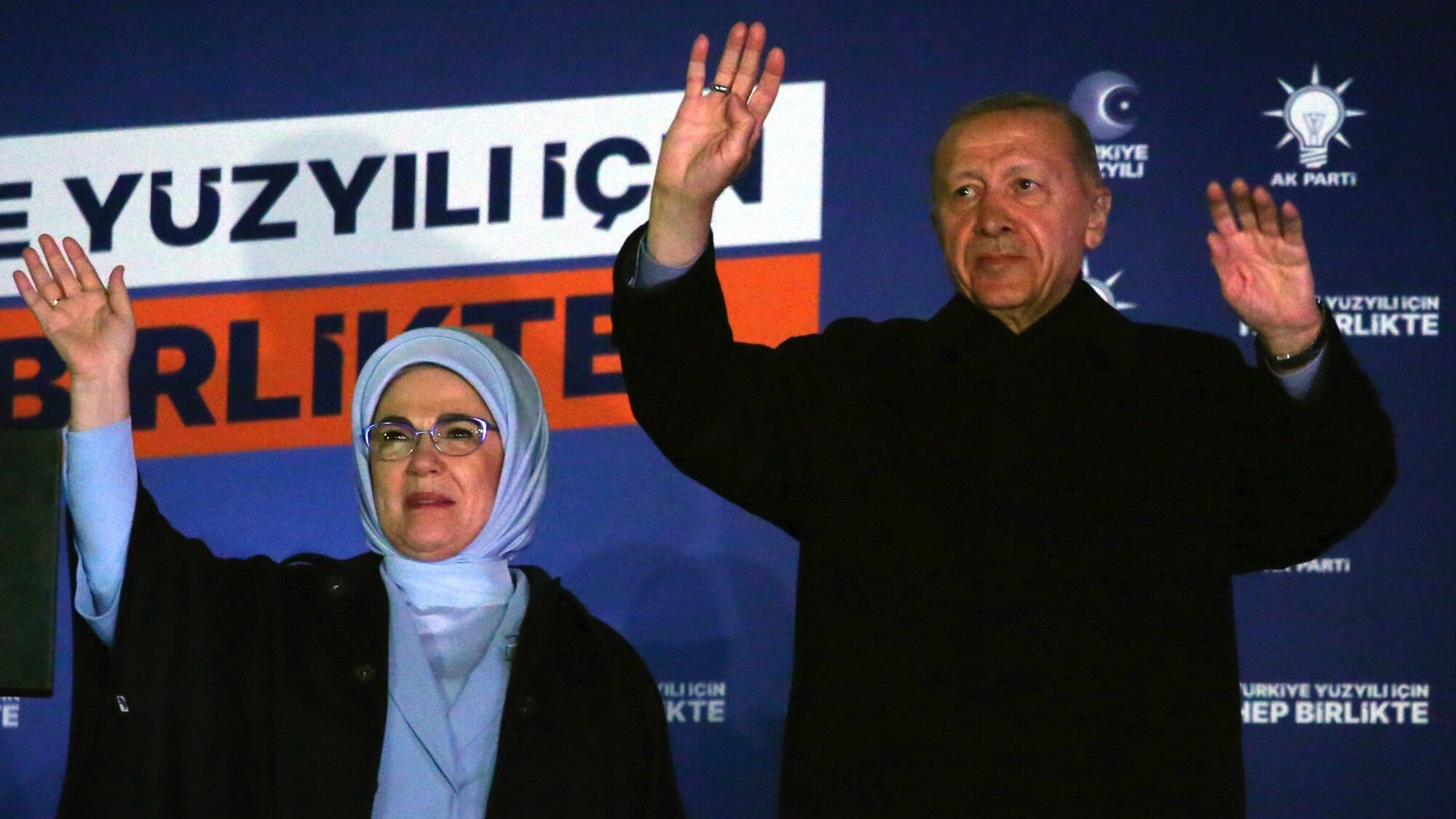
Turkey’s presidential electionsappeared to be heading toward a second-round runoff on Monday, with President Recep Tayyip Erdogan, who has ruled his country with a firm grip for 20 years, leading over his chief challenger, but falling short of the votes needed for an outright win.

With votes of Turkish citizens living abroad still being counted, results from the state-run Anadolu news agency showed Erdogan had 49.3% of the votes, with his main rival, Kemal Kilicdaroglu garnering 45%.

Erdogan, 69, told supporters in the early hours of Monday that he could still win. He said, however, that he would respect the nation’s decision if the race went to a runoff on May 28.

The vote was being closely watched to see if the strategically located NATO country — which has a coast on the Black Sea to the north, and neighbors Iran, Iraq and Syria to the south — remains under the control of the increasingly authoritarian president or can embark on a more democratic course that was envisioned by Kilicdaroglu.

Opinion polls in the runup to Sunday’s vote had given Kilicdaroglu, the joint candidate of a six-party opposition alliance, a slight lead over Erdogan, who has governed Turkey as either prime minister or president since 2003.

Kilicdaroglu sounded hopeful for a second-round victory.

“We will absolutely win the second round ... and bring democracy” said Kilicdaroglu, 74, maintaining that Erdogan had lost the trust of a nation now demanding change.

This year’s election came amid a backdrop of economic turmoil, a cost-of-living crisis and a February earthquake that killed more than 50,000 people. Western nations and foreign investors are also awaiting the outcome because of Erdogan’s unorthodox leadership of the economy and often mercurial but successful efforts to put Turkey at the center of international negotiations.

As in previous years, Erdogan led a highly divisive campaign in his bid to stretch his rule into a third decade. He portrayed Kilicdaroglu, who had received the backing of the country’s pro-Kurdish party, of colluding with “terrorists” and of supporting what he called “deviant” LGBTQ rights. In a bid to woo voters hit hard by inflation, he increased wages and pensions and subsidized electricity and gas bills, while showcasing Turkey’s homegrown defense industry and infrastructure projects.

Kilicdaroglu, for his part, campaigned on promises to reverse crackdowns on free speech and other forms of democratic backsliding, as well as to repair an economy battered by high inflation and currency devaluation.

The election results showed that Erdogan’s ruling Justice and Development Party was also set to retain its majority in the 600-seat parliament, although the assembly has lost much of its legislative power after a referendum to change the country’s system of governance to an executive presidency narrowly passed in 2017.

Anadolu news agency said Erdogan’s ruling party alliance was hovering around 49.3%, while Kilicdaroglu’s Nation Alliance had around 35.2% and support for a pro-Kurdish party stood above 10%.

“That the election results have not been finalized doesn’t change the fact that the nation has chosen us,” Erdogan said.

More than 64 million people, including the overseas voters, were eligible to vote and nearly 89% voted. This year marks 100 years since Turkey’s establishment as a republic — a modern, secular state born on the ashes of the Ottoman Empire.

Voter turnout in Turkey is traditionally strong, despite the government suppressing freedom of expression and assembly over the years and especially since a 2016 coup attempt. Erdogan blamed the failed coup on followers of a former ally, cleric Fethullah Gulen, and initiated a large-scale crackdown on civil servants with alleged links to Gulen and on pro-Kurdish politicians.

Erdogan, along with the United Nations, helped mediate a deal with Ukraine and Russia that allowed Ukrainian grain to reach the rest of the world from Black Sea ports despite Russia’s war in Ukraine. The agreement, which is implemented by a center based in Istanbul, is set to expire in days, and Turkey hosted talks last week to keep it alive.

But Erdogan also has held up Sweden’s quest to join NATO, contending that nation has been too lenient on followers of the U.S.-based cleric and members of pro-Kurdish groups that Turkey considers national security threats.

Critics maintain the president’s heavy-handed style is responsible for a painful cost-of-living crisis. The latest official statistics put inflation at about 44%, down from a high of around 86%. The price of vegetables became a campaign issue for the opposition, which used an onion as a symbol.

In contrast with mainstream economic thinking, Erdogan contends that high interest rates fuel inflation, and he pressured the Central Bank of the Republic of Turkey to lower its main rate multiple times.

Erdogan’s government also faced criticism for its allegedly delayed and stunted response to the 7.8 magnitude earthquake that left 11 southern provinces devastated. Lax implementation of building codes is thought to have exacerbated the casualties and misery.
Share:
More In Politics
States Turn to Unusual Solutions as Schools Face Staffing Shortages
With an increasing number of teachers and staff calling out sick by the day, the state of Oklahoma is turning to an unusual solution. Republican Governor Kevin Stitt has issued an executive order that permits state employees to work as substitute teachers. Shaily Baranwal, founder and CEO of Elevate K-12, joins Cheddar News to discuss.
Possible Cracks Between U.S. and Allies on Issue of Ukraine and Russia
On Thursday, Secretary of State Antony Blinken addressed the stance of the U.S. and its allies should Russia make any forays into Ukraine, a seeming response to President Biden's remarks that should Putin engage in something short of a full invasion, there might be some indecision among allied nations regarding what to do. Ariel Cohen, a senior fellow at the think tank Atlantic Council, joined Cheddar to discuss the difficulty faced by Blinken wrangling unity as tensions run high in the region. "There'll be a smaller incursion, and the president implied, there'll be a weaker response because our European allies have created this horrible situation where they are dependent on Moscow for their gas supply," Cohen explained.
Biden Approval Rating Tanking at One-Year Mark Over Issues Like Inflation
During a nearly two-hour press conference on Wednesday, President Biden spoke on his accomplishments and challenges from the first year of his presidency, and what his administration hopes to accomplish in the coming year. However, his approval ratings are underwater as COVID remains a big concern for voters — as does inflation, noted Tom Bevan, co-founder and president of polling aggregator RealClearPolitics. "The public thinks [inflation] is priority number one, and the administration is concerned about it, they talk about it, but they're not spending enough time on it as far as the public is concerned," said Bevan.
Behind Australian Judges Ruling for Allowing Novak Djokovic Deportation
The drama surrounding tennis star Novak Djokovic continues after he was deported from Australia over the weekend due to the nation's COVID-19 vaccine requirements. Djokovic was forced to leave the country on the eve of what was to be his first match in defense of his Australian Open title after three judges ruled in favor of his removal and revealed their reasoning for doing so. Adding to his woes, a law recently passed in France is putting his chances of defending his French Open title in jeopardy. The director of Marist's Center for Sports Communication, Jane McManus, joined Cheddar to discuss the ongoing fallout.
Louisiana Senate Candidate on Smoking Weed in His Campaign Ad
As the midterm elections get ever closer, candidates have been getting creative with their campaigns to stick out and to connect with voters. Gary Chambers, a Democratic candidate for the U.S. Senate from Louisiana, has definitely attracted attention with an advertisement featuring him smoking a blunt, making a point about the inequity of anti-cannabis laws. "We wanted to bring the seriousness of the moment," he said of the ad. "But we also wanted to make sure that people understand that there are 19 states that are legal right now but Black people and brown people are being over-incarcerated in mostly Southern and Midwestern states in America for cannabis possession."
TLDR Act Provides the 'TLDR' on Sites' Terms of Service
If some members of Congress have their way, there might finally be a 'TLDR' on sites' terms of service, introduced by the terms-of-service labeling, design, and readability act – or TLDR for short. With this act, users will actually understand what they're agreeing to or the many ways in which their data is being used before pressing 'accept.' J.D. sat down with co-sponsor of the bill and Senator Bill Cassidy, to discuss.
All Eyes on Biden: Amid Inflation, Pandemic, How Can President Push Agenda While His Party Controls Washington?
President Joe Biden's first year in office is wrapping up. What has he achieved, and what else remains on the table while the Democrats have control of Washington? Amid an ongoing pandemic and rising inflation, Biden's approval rating is at an all-time low and his party is plagued by infighting. Will he be able to continue pushing key parts of his agenda? Paul Glastris, former Bill Clinton speechwriter & Editor-in-chief of 'Washington Monthly,' joins Cheddar News' Closing Bell to discuss the president's achievements in his first year, where he's fallen short, and what he must do in order to get more of his agenda signed into law.
Senate Bills to Reign in Big Tech Anticompetitive Practices Could Hurt Consumers
Tech giants Meta, Amazon, Alphabet, and Apple are faced with a bipartisan antitrust legislation effort underway in the Senate Judiciary Committee. The companies stand accused of promoting their own goods and services over smaller competitors on their platforms, holding too much monopolistic power via their app stores and services. Adam Kovacevich, founder and CEO of Chamber of Progress, a technology industry trade group, joined Cheddar to argue that the bills that are being debated currently could end up hurting consumers, rather than helping.
Load More