By Suzan Fraser and Zeynep Bilginsoy
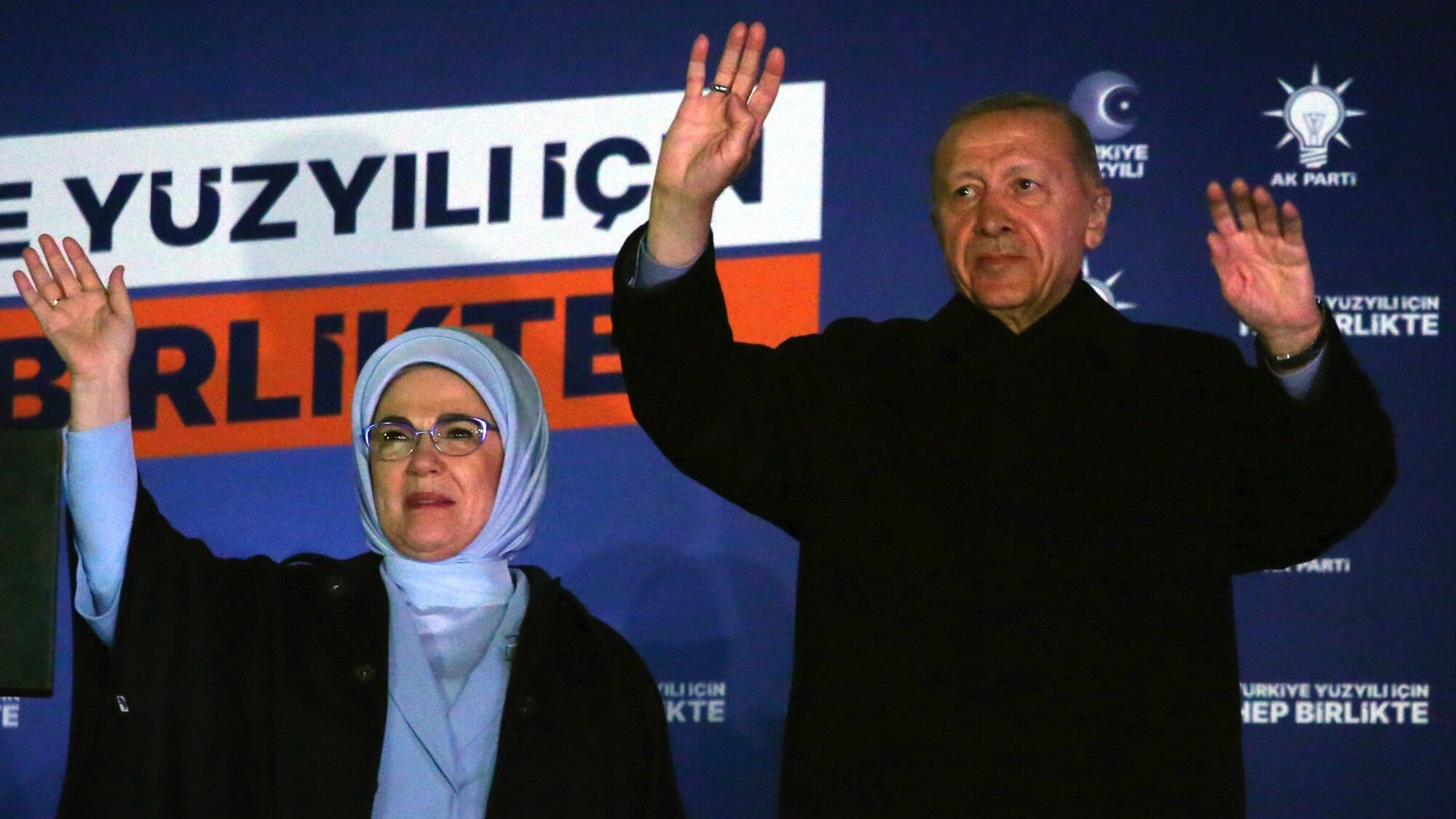
Turkey’s presidential electionsappeared to be heading toward a second-round runoff on Monday, with President Recep Tayyip Erdogan, who has ruled his country with a firm grip for 20 years, leading over his chief challenger, but falling short of the votes needed for an outright win.
With votes of Turkish citizens living abroad still being counted, results from the state-run Anadolu news agency showed Erdogan had 49.3% of the votes, with his main rival, Kemal Kilicdaroglu garnering 45%.
Erdogan, 69, told supporters in the early hours of Monday that he could still win. He said, however, that he would respect the nation’s decision if the race went to a runoff on May 28.
The vote was being closely watched to see if the strategically located NATO country — which has a coast on the Black Sea to the north, and neighbors Iran, Iraq and Syria to the south — remains under the control of the increasingly authoritarian president or can embark on a more democratic course that was envisioned by Kilicdaroglu.
Opinion polls in the runup to Sunday’s vote had given Kilicdaroglu, the joint candidate of a six-party opposition alliance, a slight lead over Erdogan, who has governed Turkey as either prime minister or president since 2003.
Kilicdaroglu sounded hopeful for a second-round victory.
“We will absolutely win the second round ... and bring democracy” said Kilicdaroglu, 74, maintaining that Erdogan had lost the trust of a nation now demanding change.
This year’s election came amid a backdrop of economic turmoil, a cost-of-living crisis and a February earthquake that killed more than 50,000 people. Western nations and foreign investors are also awaiting the outcome because of Erdogan’s unorthodox leadership of the economy and often mercurial but successful efforts to put Turkey at the center of international negotiations.
As in previous years, Erdogan led a highly divisive campaign in his bid to stretch his rule into a third decade. He portrayed Kilicdaroglu, who had received the backing of the country’s pro-Kurdish party, of colluding with “terrorists” and of supporting what he called “deviant” LGBTQ rights. In a bid to woo voters hit hard by inflation, he increased wages and pensions and subsidized electricity and gas bills, while showcasing Turkey’s homegrown defense industry and infrastructure projects.
Kilicdaroglu, for his part, campaigned on promises to reverse crackdowns on free speech and other forms of democratic backsliding, as well as to repair an economy battered by high inflation and currency devaluation.
The election results showed that Erdogan’s ruling Justice and Development Party was also set to retain its majority in the 600-seat parliament, although the assembly has lost much of its legislative power after a referendum to change the country’s system of governance to an executive presidency narrowly passed in 2017.
Anadolu news agency said Erdogan’s ruling party alliance was hovering around 49.3%, while Kilicdaroglu’s Nation Alliance had around 35.2% and support for a pro-Kurdish party stood above 10%.
“That the election results have not been finalized doesn’t change the fact that the nation has chosen us,” Erdogan said.
More than 64 million people, including the overseas voters, were eligible to vote and nearly 89% voted. This year marks 100 years since Turkey’s establishment as a republic — a modern, secular state born on the ashes of the Ottoman Empire.
Voter turnout in Turkey is traditionally strong, despite the government suppressing freedom of expression and assembly over the years and especially since a 2016 coup attempt. Erdogan blamed the failed coup on followers of a former ally, cleric Fethullah Gulen, and initiated a large-scale crackdown on civil servants with alleged links to Gulen and on pro-Kurdish politicians.
Erdogan, along with the United Nations, helped mediate a deal with Ukraine and Russia that allowed Ukrainian grain to reach the rest of the world from Black Sea ports despite Russia’s war in Ukraine. The agreement, which is implemented by a center based in Istanbul, is set to expire in days, and Turkey hosted talks last week to keep it alive.
But Erdogan also has held up Sweden’s quest to join NATO, contending that nation has been too lenient on followers of the U.S.-based cleric and members of pro-Kurdish groups that Turkey considers national security threats.
Critics maintain the president’s heavy-handed style is responsible for a painful cost-of-living crisis. The latest official statistics put inflation at about 44%, down from a high of around 86%. The price of vegetables became a campaign issue for the opposition, which used an onion as a symbol.
In contrast with mainstream economic thinking, Erdogan contends that high interest rates fuel inflation, and he pressured the Central Bank of the Republic of Turkey to lower its main rate multiple times.
Erdogan’s government also faced criticism for its allegedly delayed and stunted response to the 7.8 magnitude earthquake that left 11 southern provinces devastated. Lax implementation of building codes is thought to have exacerbated the casualties and misery.