By Jennifer Sinco Kelleher
Brian Keaulana is the quintessential Native Hawaiian waterman, well-known in Hawaii and beyond for his deep understanding of the ocean, gifted with surfing and lifeguarding skills passed down from his big-wave rider father.
Now, as one of the islands' standard-bearers of surfing, Keaulana wants to further boost the sport in his homeland by building an artificial wave pool just down the road from the beach — a spot where competitive surfers could always be guaranteed the perfect breaks that are sometimes elusive in nature.
The bold proposal has made waves in Hawaii, particularly among some Native Hawaiians, and raised questions about how a modern-day sport followed by millions worldwide fits into the cultural legacy of islanders who have been riding waves for millennia.
The project has landed in court and reflects the unease some Native Hawaiians feel about the commercialization of what long has been a cultural touchstone.
“They’re profiting off a cultural practice by controlling it by making these wave pools, which are going to destroy the actual beach that is nearby,” said Healani Sonoda-Pale, a plaintiff in a civil case seeking to stop the wave pool. “I cannot speak for other Hawaiians. All I can I say is as a Hawaiian ... it goes against my culture.”
Surfer and writer Mindy Pennybacker said the controversy highlights a struggle over how to balance tradition with a booming sport. In researching her book, “Surfing Sisterhood Hawai‘i: Women Reclaiming the Waves,” she learned of creative ways Hawaiians compensated when there was no surf, including finding standing river waves or sledding down hillsides.
She also sees how wave pools help athletes improve, noting a World Surf League championship tour competition over Memorial Day weekend at a California wave pool developed by pro surfer Kelly Slater.
“The beauty of surfing, and the frustration of surfing at the recreational and competitive level, remains the unpredictability and how surfers have to have the reflexes to deal with changing conditions,” she said.
The lawsuit — filed in state environmental court by a group of Hawaiians and residents near the proposed site — alleges the 7 million-gallon (26-million liter) artificial pool would damage nearshore limu, or seaweed, and desecrate iwi kupuna, or ancient Hawaiian remains.
Bidding to halt the project, the lawsuit challenges the Hawaii Community Development Authority’s approval and finding that it will have no significant environmental impacts. The development authority and the state attorney general’s office declined to comment on the lawsuit, which seeks a new environmental review.
A hearing is set for July and it’s not clear when a judge might rule.
Sonoda-Pale pointed out that the artificial lagoon would be 2 miles (3.2 kilometers) from a beach called White Plains, long a popular surf spot.
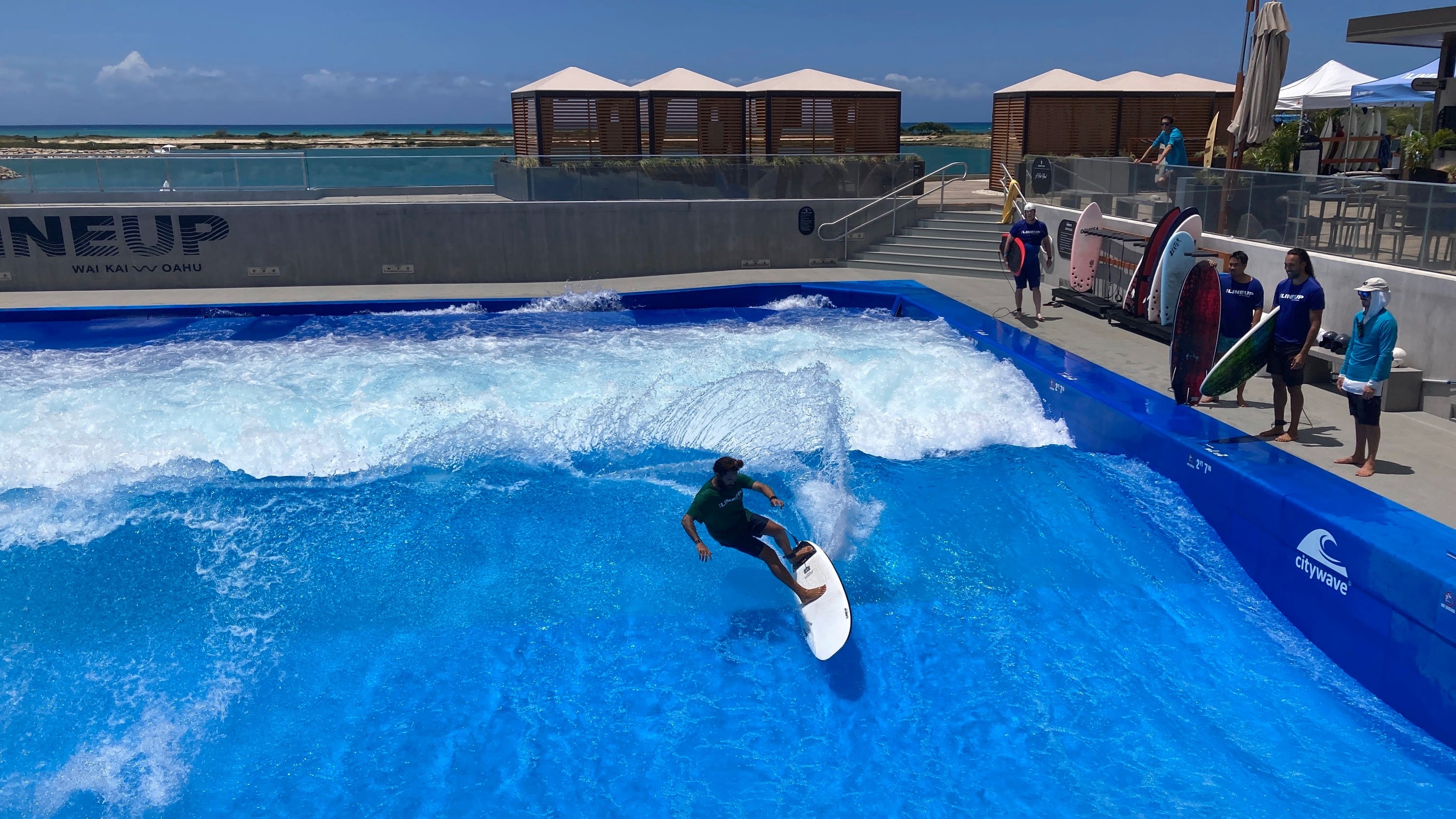
A wave pool recently opened nearby and opponents say another one is unnecessary and a waste of water. But Keaulana remains committed, noting ocean conditions aren't always ideal for learning how to surf or save lives.
One recent afternoon, no one was surfing at Makaha beach in west Oahu, where Keaulana grew up. Conditions were too calm despite Makaha's world-famous reputation for its ferocious shore break.
“The ocean is the greatest treasure that we have," he said, but "it can be flat. It can be big. It can be dirty. It can have, you know, sharks here and there."
He worries Hawaii's Olympic surfing hopefuls are at a disadvantage to competitors who can easily train at one of several surf parks worldwide. A wave pool allows for more time on a surfboard in an hour than most surfers get in the ocean in a week, he said.
“You see these surfers going to these surf parks and catching wave after wave and they are honing their skills and then they go into the ocean when there's a swell,” he said. “Boom. They're already primed and ready.”
Using the latest technology, the facility would simulate ideal conditions needed to keep top surfers competitive and serve as a “life-saving lab” for teaching safety skills in a controlled setting, he said.
His business partner, Keno Knieriem, said waves can be customized with a tap on a tablet, noting an electromechanical system would use panels to generate up to 1,000 waves per hour, mimicking ocean swells up to 8 feet (2.4 meters) high. Some 80 surfers could work different waves simultaneously: barrelling waves, big waves, kid-friendly waves, Knieriem said.
“That would be sick,” professional surfer Sheldon Paishon said of the details. He grew up surfing at Makaha and now surfs all over the world, and has trained at the Slater wave pool and a Texas one. “When the waves are small ... we could go there and do our thing.”
Ikaika Kaulukukui, surf operations manager for the exisiting wave pool at a facility called Wai Kai, said it has improved his surfing.
“Everyone comes to Hawaii for you know, big winter waves, like we're ... the mecca for big-wave surfing ... but that's not gonna be here ... every day,” he said.
Sonoda-Pale, who calls herself a water protector, questioned whether a wave pool is really necessary to excel at surfing. While she surfed in her youth, she’s no longer an active surfer.
“I know as a cultural practice that from our histories, when the surf was up, families would drop everything they’re doing and go out and surf,” she said. “So, the timeline of when to surf, when it is a good time to surf ... was made by nature, was made by Kanaloa,” she added, referring to the Hawaiian ocean god.
Knieriem said the project would incorporate water conservation and off-the-grid electricity and feature native plants in its landscaping. Keaulana said a vacant tract in an area outside Honolulu known as Kalaeloa was selected because it wasn’t pristine and had been used as an aircraft engine test site for the U.S. military.
Besides a surf lagoon, the 19-acre (7.6-hectare) site also would feature rock climbing, beach volleyball, skateboarding and other activities. The proposed facility is eyeing a summer 2024 opening, though it's not clear how the lawsuit could affect the timeline.
“We’ve met with a number of Hawaiian cultural advisors and conducted extensive archaeological and environmental studies to ensure that we protect and mālama the site,” said a company statement online, using the Hawaiian word that can mean “to take care of.”
Keaulana said he’s hopeful differences can be worked out with hooponopono, a traditional, culture-based form of mediation. Project opponents say they are open to such a meeting.
“I'm more disappointed in myself. I felt — and we felt — that we've pretty much tried to do everything possible,” Keaulana said of concerns about the project. “I just feel to be Hawaiian is to meet up and work your differences and problems out."