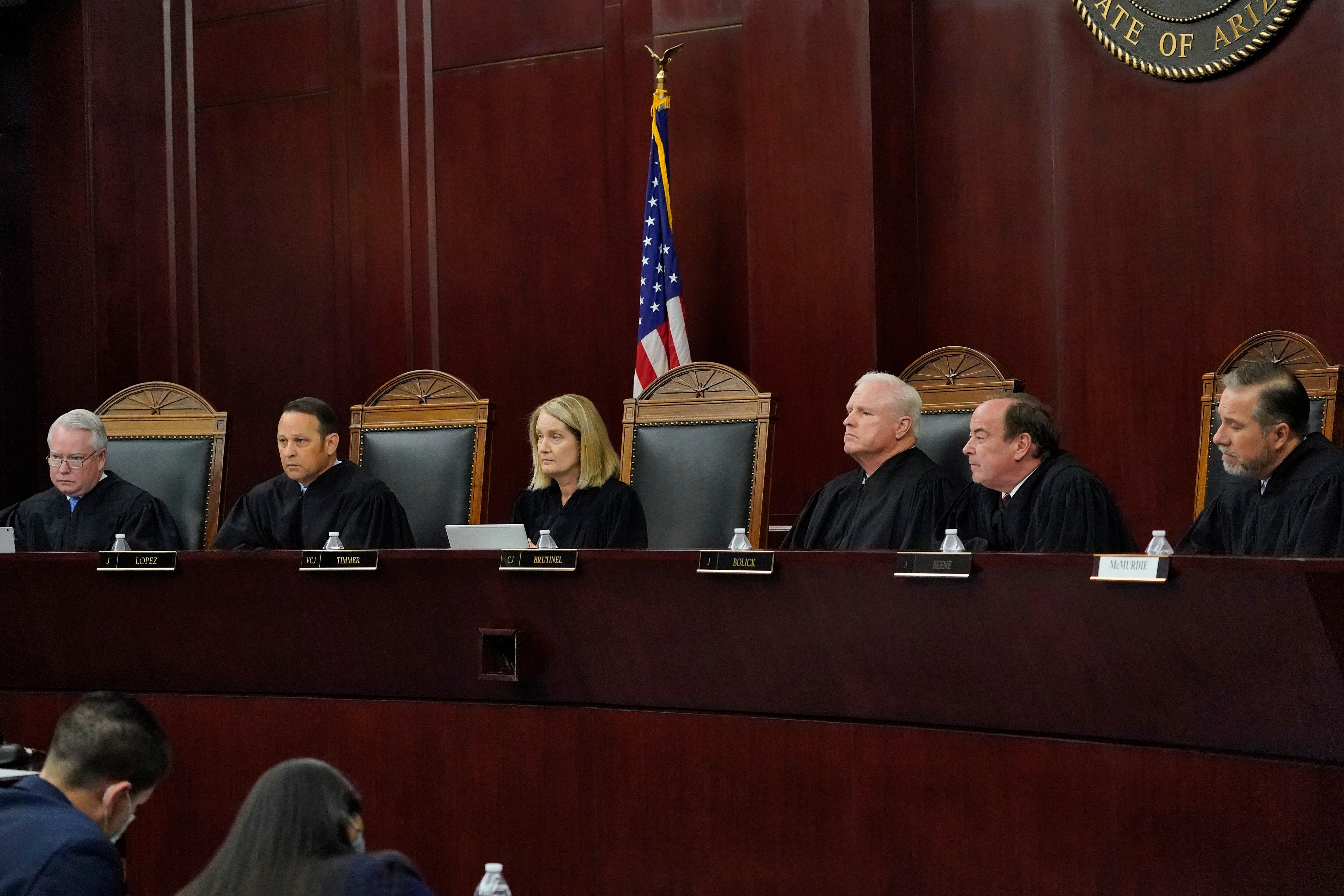
The Arizona Supreme Court ruled Tuesday that the state can enforce its long-dormant law criminalizing all abortions except when a mother’s life is at stake.
The case examined whether the state is still subject to a law that predates Arizona’s statehood. The 1864 law provides no exceptions for rape or incest, but allows abortions if a mother’s life is in danger. The state’s high court ruling reviewed a 2022 decision by the state Court of Appeals that said doctors couldn’t be charged for performing the procedure in the first 15 weeks of pregnancy.
An older court decision blocked enforcing the 1864 law shortly after the U.S. Supreme Court issued the 1973 Roe v. Wade decision guaranteeing a constitutional right to an abortion. After the U.S. Supreme Court overturned Roe v. Wade in June 2022, then state Attorney General Mark Brnovich, a Republican, persuaded a state judge in Tucson to lift the block on enforcing the 1864 law. Brnovich’s Democratic successor, Attorney General Kris Mayes, had urged the state’s high court to side with the Court of Appeals and hold the 1864 law in abeyance. Since the U.S. Supreme Court’s 2022 decision ending a nationwide right to abortion, most Republican-controlled states have started enforcing new bans or restrictions and most Democrat-dominated ones have sought to protect abortion access.
Currently, 14 states are enforcing bans on abortion at all stages of pregnancy, with limited exceptions. Two states ban the procedure once cardiac activity can be detected, which is about six weeks into pregnancy and often before women realize they’re pregnant.
Nearly every ban has been challenged with a lawsuit. Courts have blocked enforcing some restrictions, including bans throughout pregnancy in Utah and Wyoming.
A proposal pending before the Arizona Legislature that would repeal the 1864 law hasn’t received a committee hearing this year. “Today’s decision to reimpose a law from a time when Arizona wasn’t a state, the Civil War was raging, and women couldn’t even vote will go down in history as a stain on our state,” Mayes said Tuesday.
The justices said the state can start enforcing the law in 14 days. Former Arizona Gov. Doug Ducey, who signed the state's current law restricting abortion after 15 weeks, posted on X saying Tuesday's ruling was not the outcome he would have wanted.
“I signed the 15-week law as governor because it is thoughtful policy, and an approach to this very sensitive issue that Arizonans can actually agree on,” he said. President Joe Biden called the 1864 Arizona law cruel.
“Millions of Arizonans will soon live under an even more extreme and dangerous abortion ban, which fails to protect women even when their health is at risk or in tragic cases of rape or incest,” he said in a statement. “Vice President Harris and I stand with the vast majority of Americans who support a woman’s right to choose. We will continue to fight to protect reproductive rights and call on Congress to pass a law restoring the protections of Roe v. Wade.”

President Donald Trump has signed an executive order to block states from regulating artificial intelligence. He argues that heavy regulations could stifle the industry, especially given competition from China. Trump says the U.S. needs a unified approach to AI regulation to avoid complications from state-by-state rules. The order directs the administration to draw up a list of problematic regulations for the Attorney General to challenge. States with laws could lose access to broadband funding, according to the text of the order. Some states have already passed AI laws focusing on transparency and limiting data collection.
The New York Times and President Donald Trump are fighting again. The news outlet said Wednesday it won't be deterred by Trump's “false and inflammatory language” from writing about the 79-year-old president's health. The Times has done a handful of stories on that topic recently, including an opinion column that said Trump is “starting to give President Joe Biden vibes.” In a Truth Social post, Trump said it might be treasonous for outlets like the Times to do “FAKE” reports about his health and "we should do something about it.” The Republican president already has a pending lawsuit against the newspaper for its past reports on his finances.
President Donald Trump says he will allow Nvidia to sell its H200 computer chip used in the development of artificial intelligence to “approved customers” in China. Trump said Monday on his social media site that he had informed China’s leader Xi Jinping and “President Xi responded positively!” There had been concerns about allowing advanced computer chips into China as it could help them to compete against the U.S. in building out AI capabilities. But there has also been a desire to develop the AI ecosystem with American companies such as chipmaker Nvidia.
House Republicans in key battleground districts are working to contain the political fallout expected when thousands of their constituents face higher bills for health insurance coverage obtained through the Affordable Care Act. For a critical sliver of the GOP majority, the impending expiration of the enhanced premium tax credits after Dec. 31 could be a major political liability as they potentially face midterm headwinds in a 2026 election critical to President Donald Trump’s agenda. For Democrats, the party’s strategy for capturing the House majority revolves around pinning higher bills for groceries, health insurance and utilities on Republicans.
President Donald Trump says a deal struck by Netflix last week to buy Warner Bros. Discovery “could be a problem” because of the size of the combined market share. The Republican president says he will be involved in the decision about whether federal regulators should approve the deal. Trump commented Sunday when he was asked about the deal as he walked the red carpet at the Kennedy Center Honors. The $72 billion deal would bring together two of the biggest players in television and film and potentially reshape the entertainment industry.
The two-sentence footnote raised serious concerns about accuracy and credibility.
Load More