By Brian Slodysko
A handful of states remained in play Friday in the tightly contested U.S. presidential race. The outcome of contests in Georgia, North Carolina, Pennsylvania, and Nevada will determine whether Democrat Joe Biden or President Donald Trump wins.
The solidly Republican state of Alaska has also not been called because it is only 50% counted and will not release absentee numbers until Nov. 10. It is not expected to impact the outcome.
The Associated Press reviews the states that will determine the presidency:
___
GEORGIA: Outstanding ballots left to be counted and a razor-thin margin
THE BACKGROUND: A razor-thin margin and ongoing vote count are what’s making the Georgia contest between President Donald Trump and Joe Biden too early to call.
Votes are still being counted across the state, though many from counties where Biden was in the lead.
Biden inched past the incumbent in the tally as of 1 p.m. EST Friday, leading by fewer than 1,600 votes of nearly 5 million ballots cast -- a lead of about 0.03 percentage points. Under Georgia state law, a candidate can request a recount if the margin is within 0.5 percentage points. The AP does not declare winners in races that go to a recount.
Electoral research conducted by the AP found there have been at least 31 statewide recounts since 2000. Three of those changed the outcome of the election. The initial margins in those races were 137 votes, 215 votes, and 261 votes.
Among all 31 recounts, the largest shift in results was 0.1%, in the 2006 race for Vermont’s Auditor of Accounts. This was a low turnout election in which the initial results had one candidate winning by 137 votes. The candidate eventually lost by 102 votes, for a swing of 239 votes.
The average shift in the margin between the top two candidates was 0.019 percentage points.
___
NEVADA: A tight vote margin and large number of ballots that have yet to be counted made the Nevada race too early to call.
THE BACKGROUND: With more than 1.2 million ballots counted, Democrat Joe Biden held a 20,137 vote lead Friday afternoon — a roughly 1.6 percentage point edge over Republican Donald Trump. But even after about 85% of the estimated vote had been tallied, tens of thousands of votes remained to be counted statewide, which could eat into Biden’s advantage.
Many of the ballots were in Clark County, home to Las Vegas, a Democratic-leaning area where most of the state’s voters live. Biden held a nearly 9 percentage point lead over Trump in the county on Friday. And elections officials there said they plan to continue counting an additional 63,000 mail ballots there over the weekend.
Yet questions remain over just how much of the vote was left to count across the state, including these:
— Clark County officials said Thursday that they would be releasing the results of 51,000 ballots on Friday. But they later clarified that they had overestimated the size of the batch and released results from about 30,000 ballots instead.
— Separately, state officials said Thursday that there were about 190,000 votes left to count statewide, a total that included mail ballots and provisional ballots from voters who registered or updated their registration at the polls. But it was unclear if that figure took into account the overestimated number of ballots by Clark County election officials.
In a tight race, that could delay the AP declaring a winner. For example, in the 2004 race between George W. Bush and John Kerry, the AP did not call the winner of the election in Ohio until it was able to confirm that Bush’s lead exceeded the number of provisional ballots left to be counted.
Nevada, once a swing state, has trended toward Democrats in the past decade. Trump narrowly lost Nevada in 2016. Bush was the last Republican to win there, in 2004.
___
NORTH CAROLINA: Race too early to call. Ballots left to count.
THE BACKGROUND: Trump prematurely claimed early Wednesday that he won the state.
“We’ve clearly won North Carolina, where we’re up 1.7%, 77,000 votes with only approximately 5% left. They can’t catch us,” he said during an appearance at the White House. Trump also said he planned to contest the U.S. presidential election before the Supreme Court. It was unclear, exactly, what legal action he might pursue.
Though Trump is correct that he held a nearly 77,000-vote lead, which he maintained Thursday morning, the race is too early to call with up to 116,000 mail ballots left to count, as well as about 41,000 provisional ballots statewide.
As long as those ballots are postmarked by Nov. 3, state election officials have until Nov. 12 to count them. And when it comes to mail ballots, Biden was outperforming Trump. That means the ballots yet to be counted could give Biden a lead.
___
PENNSYLVANIA: Tens of thousands of ballots left to be counted.
THE BACKGROUND: A close margin and a large number of outstanding votes are what’s making the Pennsylvania contest between President Donald Trump and Joe Biden too early to call.
The Democrat opened a lead of more than 13,500 votes Friday afternoon over Trump, of more than 6.5 million votes cast — a lead of about 0.21%. State law dictates that a recount must be held if the margin between the two candidates is less than 0.5%. There are tens of thousands of votes left to count.
Additionally, there are potentially tens of thousands of provisional ballots that remain to be tabulated, though an exact number remained unclear. Those ballots will be counted after officials verify they are eligible to be included.
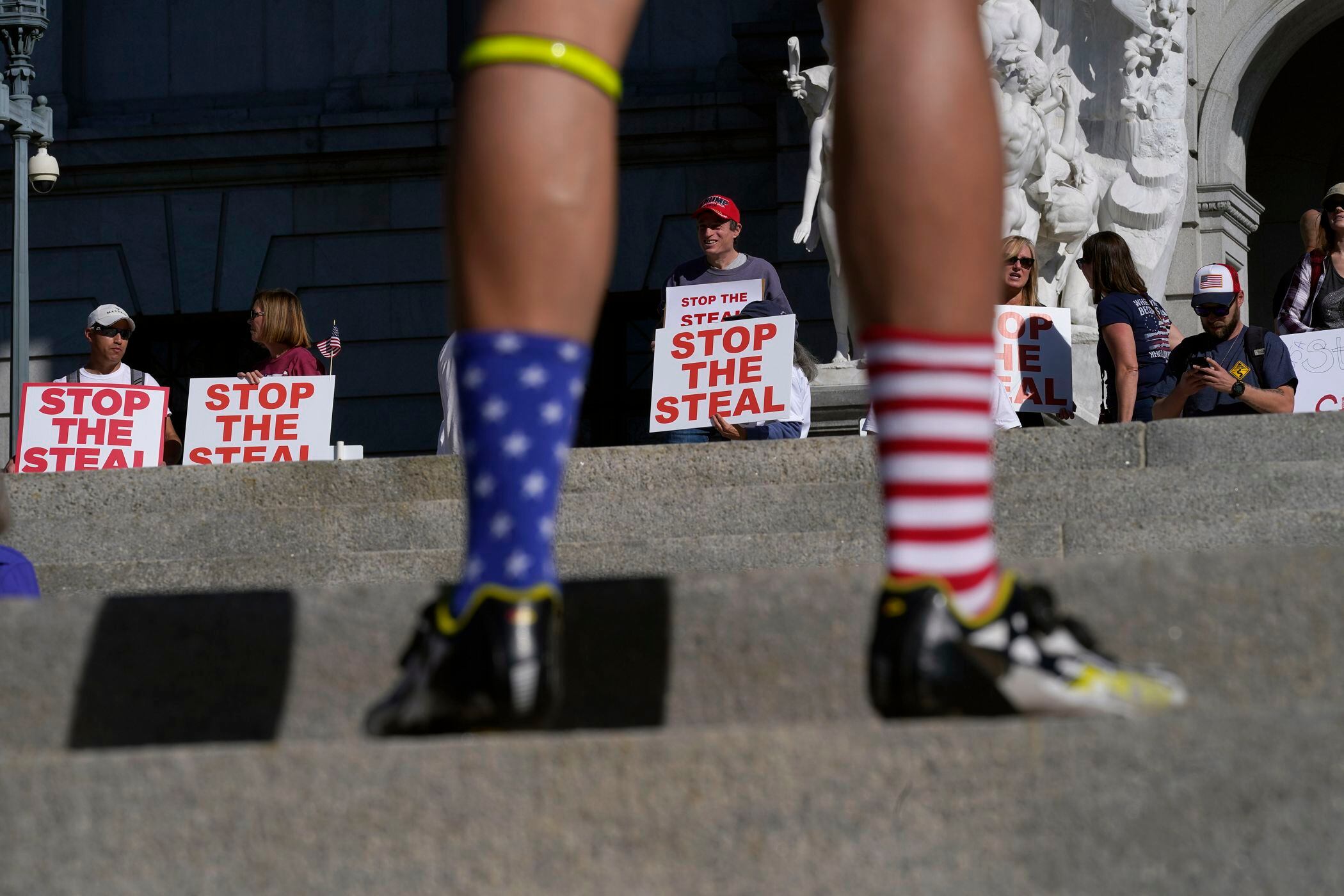
Elections officials are not allowed to process mail-in ballots until Election Day under state law. It’s a form of voting that has skewed heavily in Biden’s favor after Trump spent months claiming without proof that voting by mail would lead to widespread voter fraud.
Mail ballots from across the state overwhelmingly broke in Biden’s direction.
There’s also a possibility the race won’t be decided for days. If there is less than a half percentage point difference between Biden's and Trump’s vote totals, state law dictates that a recount must be held.
Democrats had long considered Pennsylvania a part of their “blue wall” — a trifecta that also includes Wisconsin and Michigan — that for years had served as a bulwark in presidential elections. In 2016, Trump won each by less than a percentage point.
Biden, who was born in Scranton, claims favorite-son status in the state and has long played up the idea that he was Pennsylvania’s “third senator” during his decades representing neighboring Delaware. He’s also campaigned extensively in the state from his home in Delaware.