STEVE PEOPLES, BILL BARROW and ALEXANDRA JAFFE
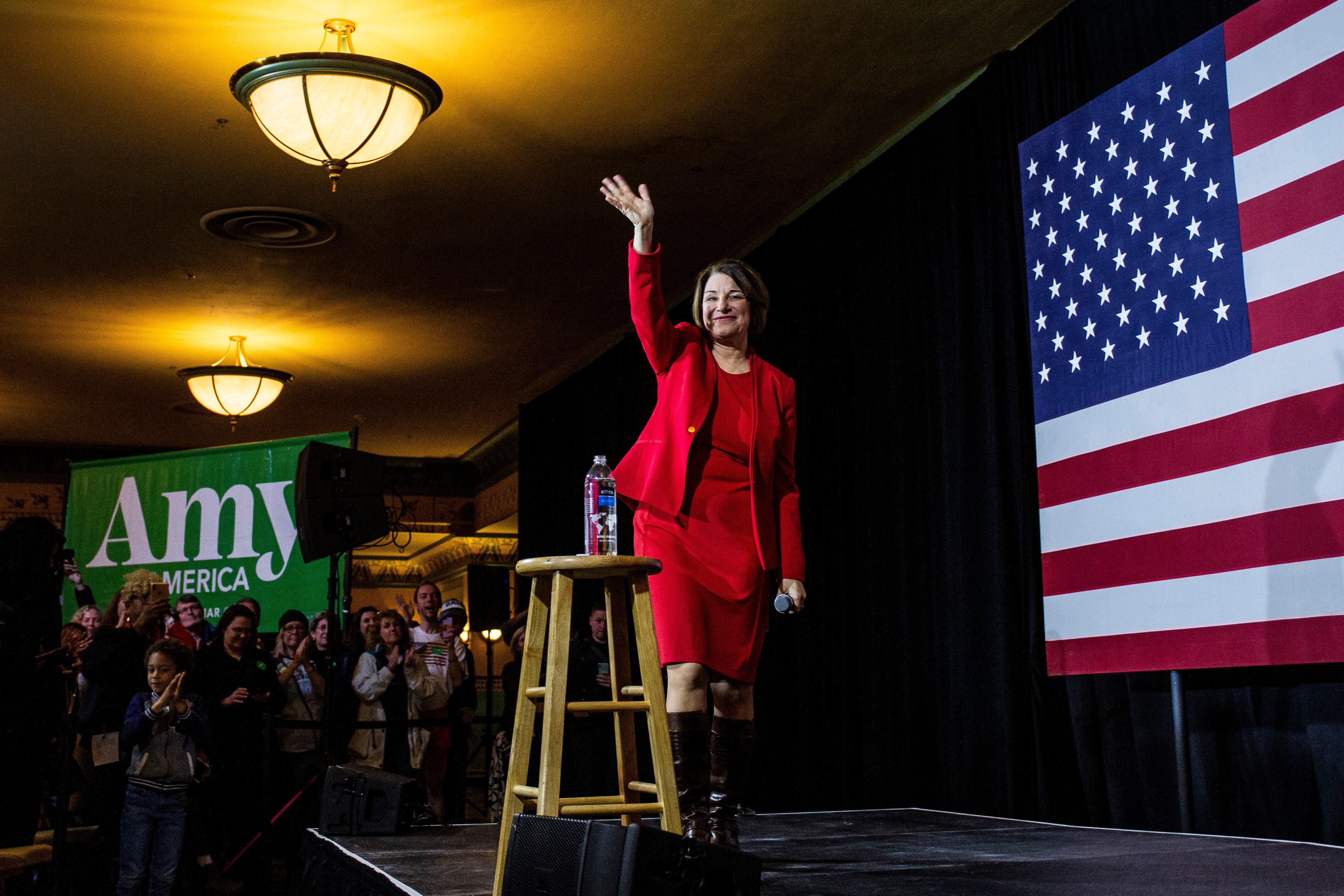
Amy Klobuchar suspended her presidential campaign Monday as the Democratic Party's moderate wing coalesced further behind Joe Biden to blunt the rise of Bernie Sanders on the eve of Super Tuesday.
Klobuchar made the decision to leave the race and endorse Biden just 18 hours before polls began opening across 14 states, including her native Minnesota, in the party's turbulent nomination fight. She becomes the third Democrat to abandon their presidential bid since Biden scored a resounding victory in South Carolina, his first of the 2020 roller coaster nomination fight.
Pete Buttigieg announced his exit late Sunday. He and Biden spoke late Sunday night, but it was unclear if Buttigieg planned to endorse the former vice president.
A shrinking group of other Democrats vowed to press on, potentially toward a contested convention.
The fast-moving developments came at a key crossroads in the Democratic Party's turbulent primary season. Fourteen states, one U.S. territory and Democrats abroad will vote on Tuesday, which offers almost 10 times as many delegates in a single day than have been awarded over the first month.
Fiery progressive Sanders remained the undisputed front-runner. But the rest of the field was decidedly unsettled, even after Biden's South Carolina blowout and the departures of Klobuchar, Buttigieg and billionaire activist Tom Steyer.
New York billionaire Mike Bloomberg in particular could create problems for Biden's establishment appeal. Bloomberg, who will appear on a 2020 ballot for the first time on Tuesday, has invested more than half a billion dollars into presidential bid and wracked up many high-profile endorsements of his own.
Yet Biden appeared to have the momentum on the eve of Super Tuesday after his blowout South Carolina victory.
The Biden campaign reported back-to-back days of $5 million fundraising hauls, by far the best 48-hour stretch of his campaign. Biden himself touted the threshold Sunday night on a call with donors, according to one person on the call.
And the campaign highlights a several new endorsements. Perhaps the most powerful endorsement would come from former President Barack Obama, who has a relationship with most of the candidates and has talked with several in recent weeks as primary voting has begun. He spoke with Biden after his South Carolina victory, but still has no plans to endorse in the primary at this point.
Yet the new Biden backers include California Sen. Barbara Boxer, Rep. Jennifer Wexton, D-Va., Illinois Secretary of State Jesse White, former Arkansas Sen. Blanche Lincoln, and Rep. Gil Cisneros, D-Calif.
Virginia Rep. Don Beyer, the first member of Congress to endorse Buttigieg, said he planned to endorse Biden and expected Buttigieg to as well.
"I do think it's the most logical," Beyer said of a Biden endorsement, given his echo of the former Vice President's call for civility, a mantra of the Buttigieg campaign. "I think Joe is the next best possibility."
Biden, meanwhile, pressed his case during a round of national television interviews that reflected a stark reality a day after his resounding primary victory in South Carolina: The former vice president was forced to rely upon free media coverage because he was understaffed, underfunded and almost out of time as he fought to transform his sole win into a national movement.
Biden pledged to improve his campaign operation, his fundraising haul — and even his own performance — in an interview on ABC's "This Week." He warned of a "stark choice" between him and Sanders, while making the case he was the candidate who could win up and down the ballot and in states beyond those voting next week.
Biden added a swipe at one of Sanders' signature lines during an appearance on "Fox New Sunday": "The people aren't looking for revolution. They're looking for results."
Sanders was focused on California, the crown jewel of Super Tuesday. California alone offers 415, which is more than double the amount of delegates allocated through Iowa, New Hampshire, Nevada and South Carolina.
Sanders predicted victory in California as he rallied thousands of supporters in multiple stops and attacked Biden's record on foreign policy, trade and Social Security, among other issues.
"My point here is not just to be negative about Joe," Sanders said. "My point here is to ask you, 'What campaign is going to beat Donald Trump?'"
Sanders has struggled to win over many elected officials in Washington, but earned a high-profile endorsement Monday from Democracy for America, a national grassroots organization originally led by former Vermont Gov. Howard Dean, that boasts thousands of members across the county.
"The overwhelming support for Bernie we saw in our member vote should be a wake-up call to the broken, visionless, corporate Democratic establishment," said the organization's chair Charles Chamberlain. "American's want fundamental change in Washington, not a return to the status quo."
The future for candidates not names Biden or Sanders appeared uncertain at best.
A handful of high-profile political strategists with ties to the former president encouraged Biden's rivals — including Bloomberg — to quit the race to allow anti-Sanders' Democrats to unify behind Obama's former vice president.
"Most of them have seen the writing on the wall for at least the last week," said Rufus Gifford, who held top fundraising posts on both of Obama's campaigns and was part of Biden's fundraising operation. "It's clear the Democratic alternative to Bernie Sanders is Joe Biden."
Text messages reviewed by The Associated Press revealed an outpouring of interest in Biden from donors supporting other candidates, including Buttigieg and Elizabeth Warren.
But in an example of Biden's challenge ahead, Sanders said Sunday he raised an eye-popping $46.5 million for February. That compared to $29 million for Warren and $18 million for Biden over the same period.
Sanders, who dominated the money race for much of the year even though he did not court wealthy donors, said it was not the overall fundraising haul that should impress but the enthusiasm of working people fueling his candidacy.
Biden allies conceded that the post-South Carolina fundraising surge would have little impact on Super Tuesday.
"Super Tuesday is too close," said former Pennsylvania Gov. Ed Rendell, a Biden supporter. "Fortunately, Joe Biden has been on the national scene for 35 years. He has less need to advertise."
In addition to his phone call with Biden, Buttigieg also spoke with Obama, who has been calling most of the candidates who have departed the race. Obama praised Buttigieg's campaign and his decision to step aside at this critical juncture in the Democratic primary, according to a person with knowledge of the call.
Biden's other rivals showed no interest in getting out of the race. In fact, some vowed to keep fighting no matter what happened on Super Tuesday.
Warren campaign manager Roger Lau spoke brazenly of pushing into a floor battle at the Democratic National Convention this summer if no candidate emerged from the primary season with a clear majority, which was possible even if someone had a large delegate lead.
"The convention in Milwaukee is the final play," Lau wrote in a Sunday memo.
And Bloomberg, who this week will be on the ballot for the first time, insisted that he was not going anywhere before Tuesday's primaries.
"I'm optimistic," he told voters in Selma, Alabama, where many of the White House hopefuls gathered for ceremonies commemorating civil rights heroism.
Yet Bloomberg received a mixed reception as he spoke from the pulpit of Selma's Brown Chapel AME Church. Multiple parishioners stood and turned their backs to the New York billionaire neared the end of his 10-minute speech. That was after the pastor told the congregation that Bloomberg initially said he was too busy to attend because he had to "beat Donald Trump."
Through four primary contests, the AP allocated at least 58 delegates to Sanders, including two added Sunday as South Carolina's remaining votes dribbled in. Biden vaulted past Buttigieg into second place with at least 50 delegates — shrinking Sanders' lead from what had been 30 delegates before South Carolina to eight. Buttigieg, Warren and Klobuchar remained stuck at 26, eight and seven, respectively.
But the first four states were always more about momentum more than math. Super Tuesday states offer a trove of 1,344 new delegates based on how candidates finish. Just 150 delegates have been awarded so far.
___
Peoples reported from Washington and Barrow reported from Columbia, South Carolina. Associated Press writers Brian Slodysko, Will Weissert, Hope Yen, Julie Pace and Seth Borenstein in Washington contributed to this report.