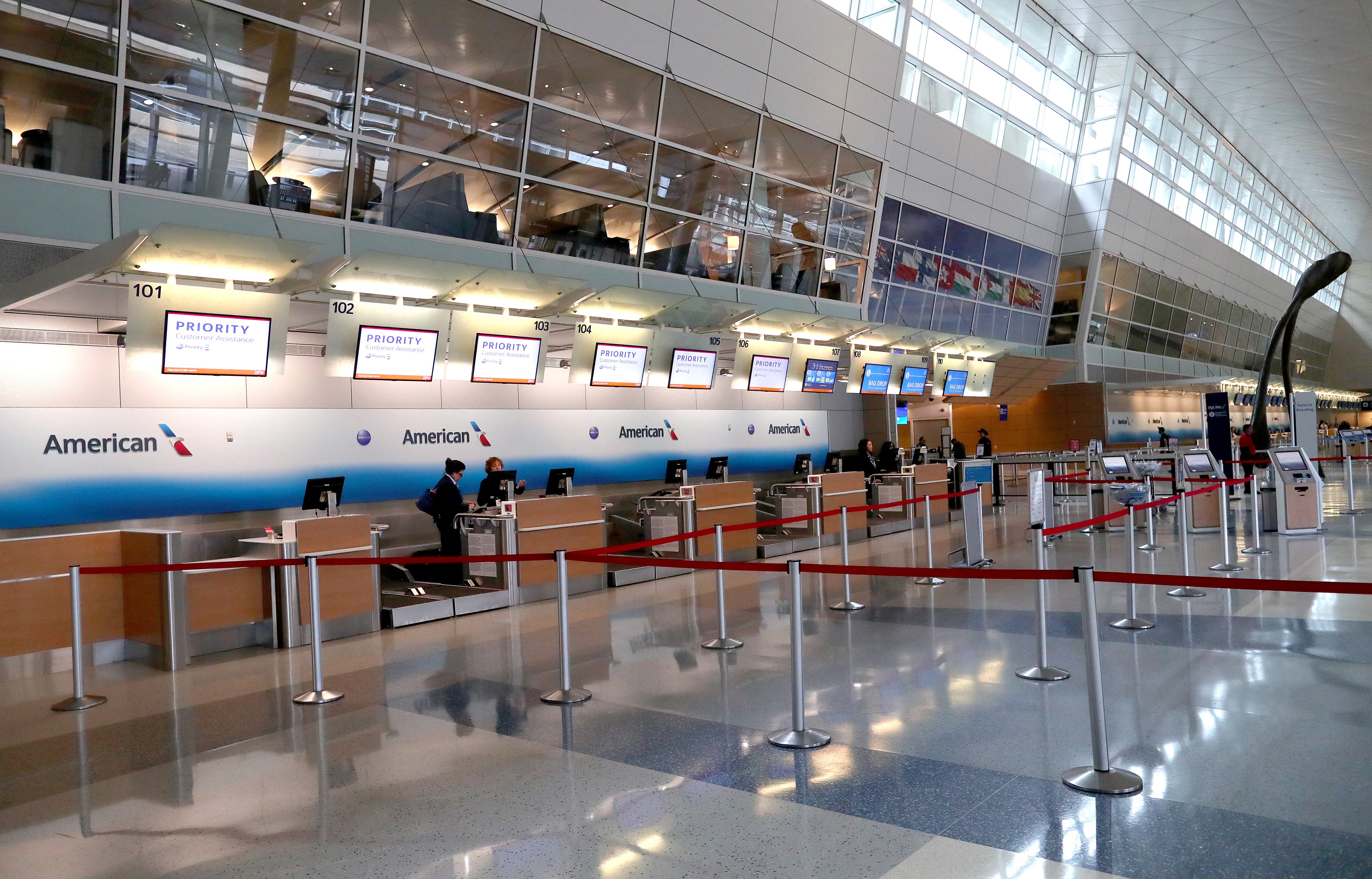
The financial crisis that's sent airlines around the world into a tailspin promises to be more severe – and inflict more pain on the industry – than even the 2008 financial meltdown or the downturn that followed the Sept. 11 terrorist attacks in 2001, industry and financial experts say.
But even as momentum for an enormous bailout package builds in the White House and on Capitol Hill, it's sparked a growing backlash as some Democratic lawmakers, consumer advocates, and antitrust experts openly question whether the little-loved industry, weeks after celebrating its most profitable year on record, is effectively hustling American taxpayers even as it continues shaking down passengers for everything from carry-on bags to packets of peanuts.
"The coronavirus is severely hurting our economy, and financial assistance may be needed for some of our most impacted industries," Sen. Ed. Markey (D-Mass.) said in a statement. "But any infusion of money to the airlines must have some major strings attached."
The impacts of the coronavirus pandemic on the industry have been swift and dramatic: As the Trump administration and other countries institute tough travel restrictions, tourism destinations close their doors, and health experts around the world urge people to stay home to help contain the spread of the coronavirus disease, also known as COVID-19, airlines have seen ticket sales and their stock prices plummet.
The big three U.S. airlines – United, Delta, and American – have had their market values plunge by 64 percent, 44 percent, and 45 percent respectively as of Tuesday afternoon from the beginning of the year. United, in particular, has slashed its flight capacity by more than half. An international consulting firm meanwhile warned this week that major airlines, without swift government support, would soon find themselves declaring bankruptcy.
"This is really, really bad," said James Peoples, a professor of economics specializing in the airline industry at the University of Wisconsin-Milwaukee. "This is different than the financial crisis – which was severe – because the financial crisis was about wealth and income of passengers, so those with money could still fly. This is different: This is health-risk related, which has nothing to do with your income, nothing to do with your wealth."
The U.S. airline industry has called for an estimated $54 billion federal bailout package of taxpayer-backed loans, grants, and other measures to help remain solvent. Congress and the White House are widely expected to enact some form of major relief; the Trump administration, in particular, has named the airline industry as one of its top priorities amid the financial downturn.
The proposed package has drawn swift comparisons to the Bush administration's $81 billion bailout of Detroit's big three automakers – Ford, General Motors, and Chrysler – in late-2008 as the financial crisis unfolded. Industry experts have also drawn parallels to the $15 billion aid package for airlines that was enacted weeks after the Sept. 11 attacks.
"All involve major shocks to the industry that in some sense could be deemed external," said Jeff Prince, professor of business economics and public policy at Indiana University's Kelley School of Business, and chief economist for the Federal Communication Commission. "Then and now there is a sense of the industries being vital to the American economy."
The sinking fortunes for the airline industry and its increasingly urgent calls for a bailout mark a radical turnabout for a U.S. sector that only weeks ago was lauding another banner year. United Airlines, for example, reported a 2019 profit of $3 billion, up from $2.1 billion the year before. Delta Airlines, which brought in an outsize $4.8 billion, said that last year was the "best year in our history." Worldwide, the airline industry posted a profit in each of the past 10 years, and the U.S. industry – buoyed by robust domestic travel – outperformed the rest of the global sector.
That glowing economic performance has put the U.S. airline industry in a much healthier financial position than in the 2008 and 2001 crises when airlines were being squeezed by much more debt on their balance sheets and far higher fuel prices. While benchmark oil prices in 2001 and 2008 were hovering close to $100 a barrel, driving up the cost of jet fuel, an oil price war between Saudi Arabia and Russia has sent crude prices crashing to the low $30s.
"Of all the profit that airlines have been making in recent years all over the world, the lion's share of that profit was made by the U.S. carriers," said Nawal Taneja, an executive-in-residence at Ohio State University's Fisher College of Business who has worked extensively in the airline industry. "So as long as domestic travel does not come to a complete halt, the U.S. in some ways is in a better state and is going to come out better."
Yet, that's also made the proposed bailout far harder to swallow for some experts and consumer rights advocates – especially for an industry that's done little to endear itself among its customers. U.S. airlines in the past decade have consolidated from six carriers to three, vastly expanding their market and political influence. Meanwhile, they've instituted new fees on everything from seat selection to snacks, headphones, and, among budget carriers like Spirit, even carry-on bags.
As recently as 2017, public opinion of airlines reached a nadir after high-profile confrontations between near-powerless passengers and frustrated flight crews aboard Delta, United, and Spirit flights made global headlines. Video of a United passenger being violently dragged down the aisle of his flight went viral – and the airlines' bungled public response to the outcry prompted The New York Times to even create a timeline tracking United's half-hearted apologies.
Some experts argue that the airline industry has only itself to blame for its current financial crunch: Rather than build cash reserves or a rainy-day fund, for example, American Airlines spent $15 billion on a cash buyback starting in 2014 to boost its share price. Fees on passengers meanwhile only spiraled upward.
"There are plenty of things American could have done with all that money," Columbia Law Professor Tim Wu wrote in an op-ed in The New York Times on Tuesday titled "Don't Feel Sorry for the Airlines."
Other experts don't disagree. But they also warn that without a bailout, bankruptcies and the potential elimination of certain U.S. airlines will inflict wider pain on the country's economy and make passengers even more powerless.
"Imagine if this crisis without a bailout results in further consolidation: That would provide these carriers with even greater market power to charge for services that we should not have to pay additional fees for," Peoples said. "You do want to keep a critical number of air carriers solvent so that we can continue to promote competition when this crisis is over."
Labor groups are eager to make sure that such a bailout is not a blank check, chiefly by pushing lawmakers to include provisions that would safeguard jobs. A handful of environmental organizations hope to add measures related to greenhouse gas emissions and climate change. Wu, of Columbia Law, wants to see caps on fees and "an end to the airlines' pursuit of smaller and smaller seats."
Sen. Markey, in a statement, called for "new rules to prohibit consumer abuses like unfair change and cancellation fees; protections for front-line workers like flight attendants, pilots, and airport workers; special consideration for our smaller, regional carriers not represented by the major trade associations; and the development of long-term strategies and targets to reduce the carbon footprint of the airline industry."
How long the airline turbulence will last is far from clear: With powerful data analytics, consolidated control over routes, and lessons learned from 2008, airlines have become more adaptable, experts say. But the challenges posed by coronavirus are especially tough to surmount: As governments around the world struggle to adequately respond to the spread of coronavirus, there is no certainty over how long travelers will be forced to stay at home. And one of the only things that is certain is that travel restriction will remain in place – and likely even expanded to include other countries or even domestic flights.
"It's a public health-related issue that's related very close to how people travel," said Vikrant Vaze, an assistant professor specializing in the airline industry at Dartmouth University's Thayer School of Engineering. "It's an infectious disease that we're talking about, and the fact that it's traveling country to country and state to state means that the airlines are in the thick of it right from the beginning."