A machine using ultrasound and AI can gauge the fattiness of a tuna fish
By Yuri Kageyama
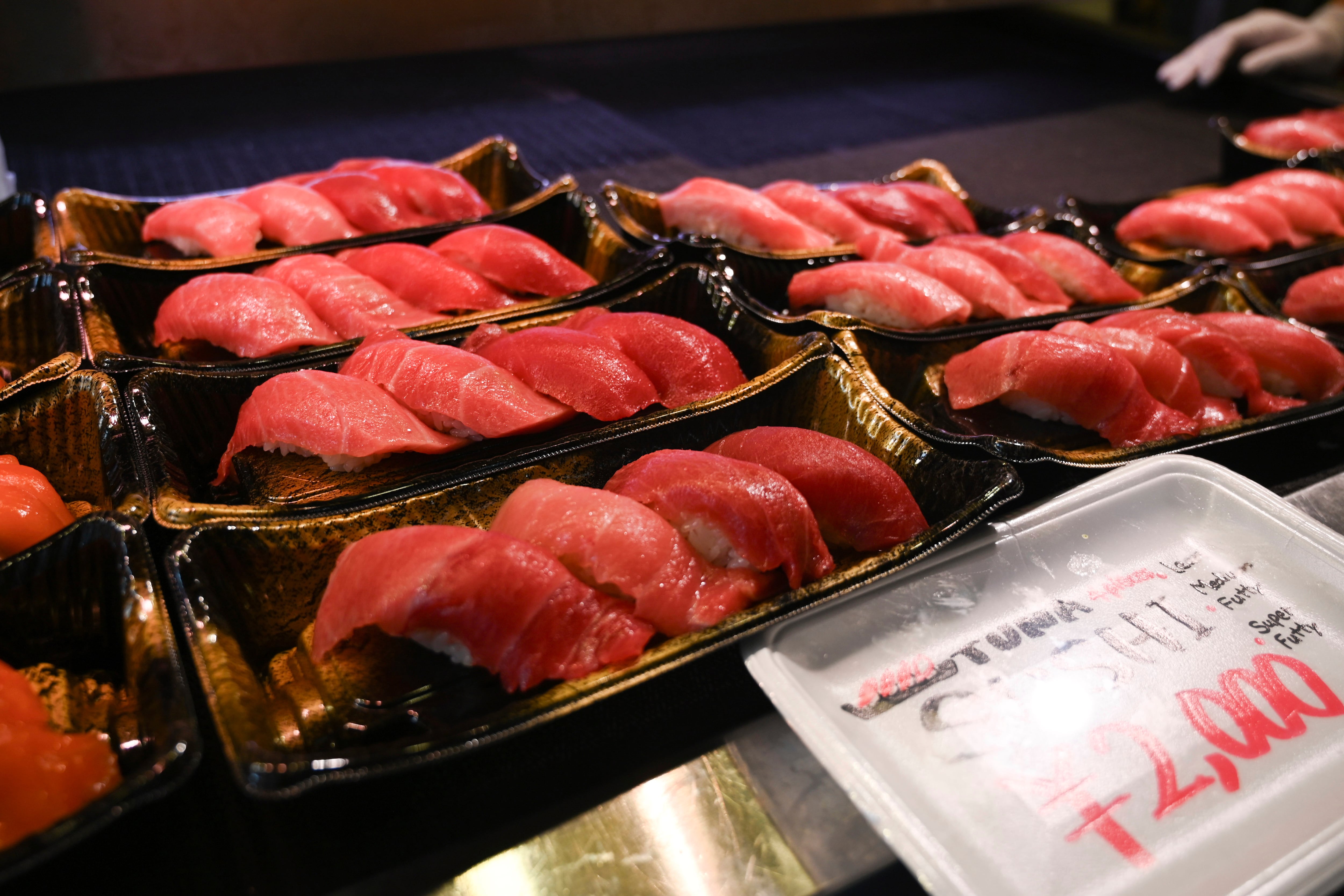
A display shows tuna sushi sets being sold at a market stall in Tokyo, Japan, Thursday, April 10, 2025. (AP Photo/Ayaka McGill)
KAWASAKI, Japan (AP) — Seafood lovers know the fatty marbling is what makes tuna sashimi and sushi so tasty, so for the industry, it’s the fish’s level of fattiness that’s used to judge its quality and pricing.
Usually, several people assess how fatty a tuna is by cutting the tail with a giant saw-like knife, an operation that takes about 60 seconds per fish.
But now a machine called Sonofai uses ultrasound waves to do the job in 12 seconds, operated by a person without prior knowledge of how to carve fish.
Fujitsu, the Japanese company behind the technology, invited reporters this week for a demonstration of Sonofai, a word blended from “sono” referring to “sound,” “f” for Fujitsu, and “ai,” or artificial intelligence. The name refers to its components but also stands for “son of AI.”
A conveyor belt transports a whole frozen tuna fish, about a meter (3 feet) in size, into a machine that beams ultrasound waves. Sensors pick up the waves to draw a zigzagging diagram on a screen to indicate the fish’s fattiness.
Fatty meat absorbs fewer sound waves than lean meat and AI sorts real data from misleading “noise,” or irregularities.
Hisashi Ishida, president of Sonofai, the startup behind the technology, who also heads Ishida Tec Co., which makes food-manufacturing equipment, says it’s safer, more sanitary and efficient.
“Fatty fish tastes good, feels better on your tongue and is called ‘toro,’ ” he said. “Overseas needs are growing because sushi culture is now appreciated around the world.”
Beef has a grading system for fat and expected flavor, but being able to gauge the quality of tuna is new, according to Hideto Okada, who oversees AI at Fujitsu.
Sonofai uses the same technology as medical ultrasound scans where high-frequency inaudible sound waves are absorbed or bounced back to create video-like images of things that aren’t visible, like a fetus inside a mother’s womb. Unlike the CT scan or X-ray, it doesn’t use radiation, which can harm tissue.
Chris Edwards, a medical doctor and professor at Queensland University of Technology, who trains sonographers, or health-care professionals who specialize in ultrasound, has studied how ultrasound can be used to see the fattiness of a human liver, linked to diabetes and other health problems.
“They can look at one fish and compare it to another and say ‘Oh, that one’s definitely got more fat than that one,’” he told The Associated Press in an interview.
But Sonofai won't be at your neighborhood sushi chef.
Fish-processing outfits and fishing organizations are the likely buyers. The machine is set to go on sale in June for about 30 million yen ($207,000) each, at first in Japan but expanding to the U.S. and other places later. They'll also work on future upgrades to test for freshness, firmness and other characteristics of tuna and other fish varieties.
Waymo's self-driving taxis have been in the spotlight for both negative and positive reasons. This week, the automated ride-hailing taxis went viral after a San Francisco woman gave birth inside a Waymo taxi while on her way to the hospital. A Waymo spokesperson on Wednesday confirmed the unusual delivery. It said the company's rider support team detected unusual activity inside the vehicle and alerted 911. The taxi arrived safely at the hospital before emergency services. Waymo's popularity is growing despite heightened scrutiny following an illegal U-turn and the death of a San Francisco cat. The company, owned by Alphabet, says it is proud to serve riders of all ages.
OpenAI has appointed Slack CEO Denise Dresser as its first chief of revenue. Dresser will oversee global revenue strategy and help businesses integrate AI into daily operations. OpenAI CEO Sam Altman recently emphasized improving ChatGPT, which now has over 800 million weekly users. Despite its success, OpenAI faces competition from companies like Google and concerns about profitability. The company earns money from premium ChatGPT subscriptions but hasn't ventured into advertising. Altman had recently announced delays in developing new products like AI agents and a personal assistant.
President Donald Trump says he will allow Nvidia to sell its H200 computer chip used in the development of artificial intelligence to “approved customers” in China. Trump said Monday on his social media site that he had informed China’s leader Xi Jinping and “President Xi responded positively!” There had been concerns about allowing advanced computer chips into China as it could help them to compete against the U.S. in building out AI capabilities. But there has also been a desire to develop the AI ecosystem with American companies such as chipmaker Nvidia.
The end of 2025 is almost upon us. And it’s time to unpack Spotify Wrapped. On Wednesday, the music streaming giant delivered its annual recap — giving its hundreds of millions of users worldwide a look at the top songs, artists, podcasts and other audio they listened to over the past year. Spotify isn’t the only platform to roll out a yearly glimpse of data collected from consumers’ online lives. But since its launch about a decade ago, Wrapped has become one of the most anticipated. And Spotify is billing the 2025 edition to be the biggest yet, with a host of new features it hopes may also address some disappointments users had last year.
Elon Musk’s X unveiled a feature that lets users see where an account is based. Online sleuths and experts quickly found that many popular accounts, often posting in support of the U.S. MAGA movement with thousands or hundreds of thousands of followers, are based outside the U.S. This raises concerns about foreign influence in U.S. politics.