By Lisa Mascaro, Kevin Freking and Stephen Groves
The threat of a federal government shutdown suddenly lifted late Saturday as President Joe Biden signed a temporary funding bill to keep agencies open with little time to spare after Congress rushed to approve the bipartisan deal.
The package drops aid to Ukraine, a White House priority opposed by a growing number of GOP lawmakers, but increases federal disaster assistance by $16 billion, meeting Biden’s full request. The bill funds government until Nov. 17.
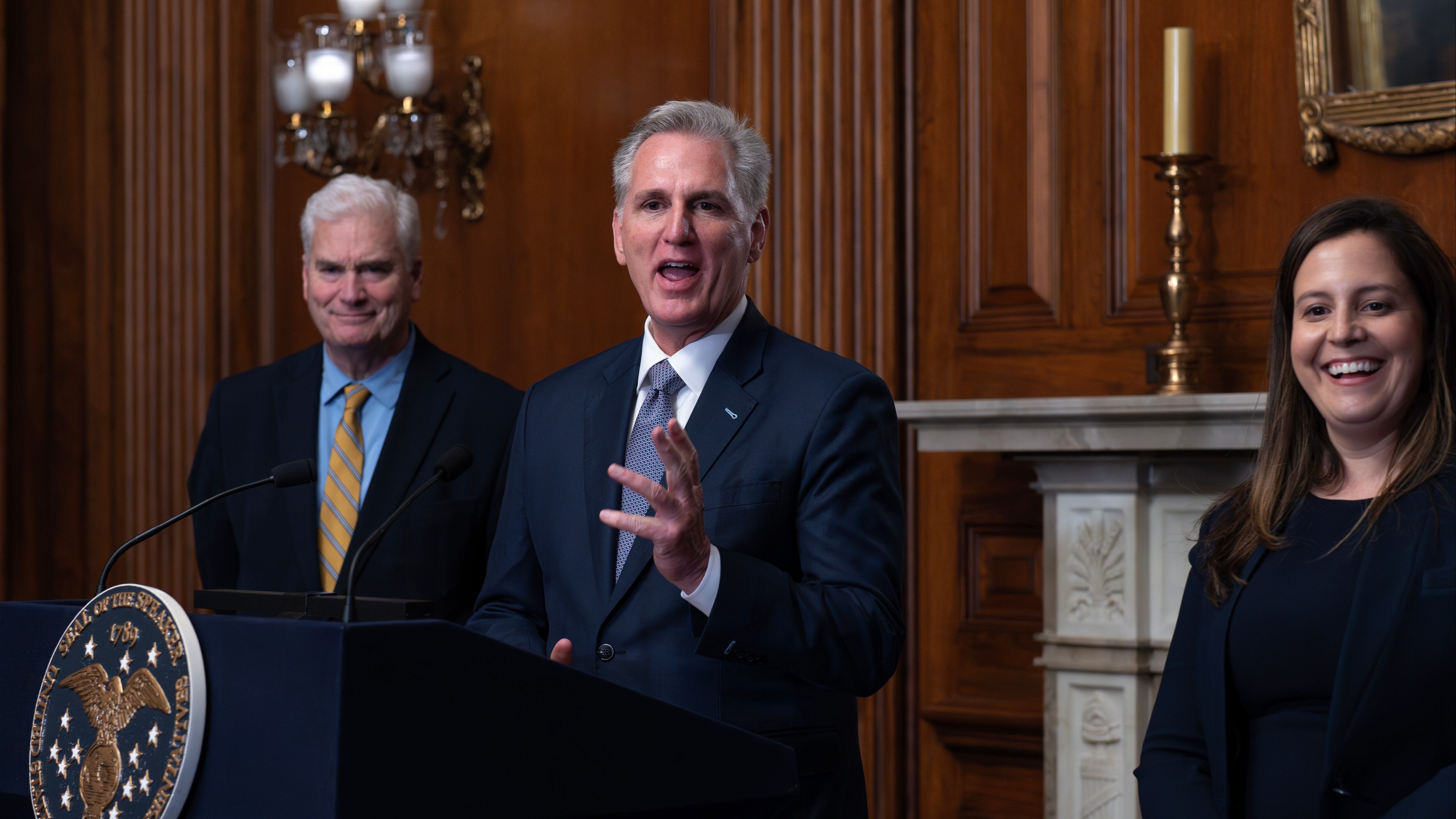
After chaotic days of turmoil in the House, Speaker Kevin McCarthy abruptly abandoned demands for steep spending cuts from his right flank and instead relied on Democrats to pass the bill, at risk to his own job. The Senate followed with final passage closing a whirlwind day at the Capitol.
“This is good news for the American people,” Biden said in a statement.
He also said the United States “cannot under any circumstances allow American support for Ukraine to be interrupted" and expected McCarthy "will keep his commitment to the people of Ukraine and secure passage of the support needed to help Ukraine at this critical moment."
It’s been a sudden head-spinning turn of events in Congress ahead of the midnight funding deadline after grueling days in the House pushed the government to the brink of a disruptive federal shutdown.
The outcome ends, for now, the threat of a shutdown, but the reprieve may be short-lived. Congress will again need to fund the government in coming weeks risking a crisis as views are hardening, particularly among the right-flank lawmakers whose demands were ultimately swept aside this time in favor of a more bipartisan approach.
“We’re going to do our job,” McCarthy, R-Calif., said before the House vote. “We’re going to be adults in the room. And we’re going to keep government open.”
If no deal was in place before Sunday, federal workers would have faced furloughs, more than 2 million active-duty and reserve military troops would have had to work without pay and programs and services that Americans rely on from coast to coast would have begun to face shutdown disruptions.
“It has been a day full of twists and turns, but the American people can breathe a sigh of relief: There will be no government shutdown," said Senate Majority Leader Chuck Schumer, D-N.Y.
The package funds government at current 2023 levels until mid-November, and also extends other provisions, including for the Federal Aviation Administration. The package was approved by the House 335-91, with most Republicans and almost all Democrats supporting. Senate passage came by an 88-9 vote.
But the loss of Ukraine aid was devastating for lawmakers of both parties vowing to support President Volodymyr Zelenskyy after his recent Washington visit. The Senate bill included $6 billion for Ukraine, and both chambers came to a standstill Saturday as lawmakers assessed their options.
"The American people deserve better," said House Democratic leader Hakeem Jeffries of New York, warning in a lengthy floor speech that “extreme" Republicans were risking a shutdown.
For the House package to be approved, McCarthy was forced to rely on Democrats because the speaker's hard-right flank has said it will oppose any short-term funding measure, denying him the votes needed from his slim majority. It's a move that is sure to intensify calls for his ouster.
After leaving the conservative holdouts behind, McCarthy is almost certain to be facing a motion to try to remove him from office, though it is not at all certain there would be enough votes to topple the speaker. Most Republicans voted for the package Saturday while 90 opposed.
"If somebody wants to remove me because I want to be the adult in the room, go ahead and try,” McCarthy said of the threat to oust him. “But I think this country is too important.”
The White House was tracking the developments on Capitol Hill and aides were briefing the president, who was spending the weekend in Washington.
Senate Republican leader Mitch McConnell, who has championed Ukraine aid despite resistance from his own ranks, is expected to keep pursuing U.S. support for Kyiv in the fight against Russia.
“I have agreed to keep fighting for more economic and security aid for Ukraine,” McConnell, R-Ky., said before the vote.
Late at night, the Senate stalled when Sen. Michael Bennet, D-Colo., held up the vote, seeking assurances Ukraine funds would be reconsidered.
“I know important moments are like this, for the United States, to lead the rest of the world,” Bennet said, noting his mother was born in Poland in 1938 and survived the Holocaust. “We can’t fail.”
The House's quick pivot comes after the collapse Friday of McCarthy's earlier plan to pass a Republican-only bill with steep spending cuts up to 30% to most government agencies and strict border provisions that the White House and Democrats rejected as too extreme. A faction of 21 hard-right Republican holdouts opposed it.
"Our options are slipping away every minute,” said one senior Republican, Rep. Mario Diaz-Balart of Florida.
The federal government had been heading straight into a shutdown that posed grave uncertainty for federal workers in states all across America and the people who depend on them — from troops to border control agents to office workers, scientists and others.
Families that rely on Head Start for children, food benefits and countless other programs large and small were confronting potential interruptions or outright closures. At the airports, Transportation Security Administration officers and air traffic controllers had been expected to work without pay, but travelers could have faced delays in updating their U.S. passports or other travel documents.
The White House has brushed aside McCarthy's overtures to meet with Biden after the speaker walked away from the debt deal they brokered earlier this year that set budget levels.
Catering to his hard-right flank, McCarthy had made multiple concessions including returning to the spending limits the conservatives demanded back in January as part of the deal-making to help him become the House speaker.
But it was not enough as the conservatives insisted the House follow regular rules, and debate and approve each of the 12 separate spending bills needed to fund the government agencies, typically a months-long process. In the Senate, all the no votes against the package came from Republicans.
McCarthy’s chief Republican critic, Rep. Matt Gaetz of Florida, has warned he will file a motion calling a vote to oust the speaker.
Some of the Republican holdouts, including Gaetz, are allies of former President Donald Trump, who is Biden's chief rival in the 2024 race. Trump has been encouraging the Republicans to fight hard for their priorities and even to “shut it down.”
At an early closed-door meeting at the Capitol, several House Republicans, particularly those facing tough reelections next year, urged their colleagues to find a way to prevent a shutdown.
“All of us have a responsibility to lead and to govern,” said Republican Rep. Mike Lawler of New York.
The lone House Democrat to vote against the package, Rep. Mike Quigley of Illinois, the co-chair of the Congressional Ukraine Caucus, said, “Protecting Ukraine is in our national interest.”
Associated Press writers Colleen Long and Mary Clare Jalonick contributed to this report.