By Zeke Miller, Ellen Knickmeyer and Aamer Madhani
Israel has agreed to put in place four-hour daily humanitarian pauses in its assault on Hamas in northern Gaza, the White House said Thursday, as President Joe Biden pressed Israelis for a multi-day stoppage in the fighting in a bid to negotiate the release of hostages held by the militant group.
Biden had asked Israeli Prime Minister Benjamin Netanyahu to institute the daily pauses during a Monday call and said he had also asked the Israelis for a pause of at least three days to allow for hostage negotiations.
“Yes,” Biden said, when asked whether he had asked Israel for a three-day pause. “I’ve asked for even a longer pause for some of them.” He added there was “no possibility” of a formal cease-fire at the moment, and said it had “taken a little longer” than he hoped for Israel to agree to the humanitarian pauses.
National Security Council spokesman John Kirby said a daily humanitarian pause would be announced Thursday and that the Israelis had committed to announcing each four-hour window at least three hours in advance. Israel, he said, also was opening a second corridor for civilians to flee the areas that are the current focus of its military campaign against Hamas, with a coastal road joining the territory’s main north-south highway.
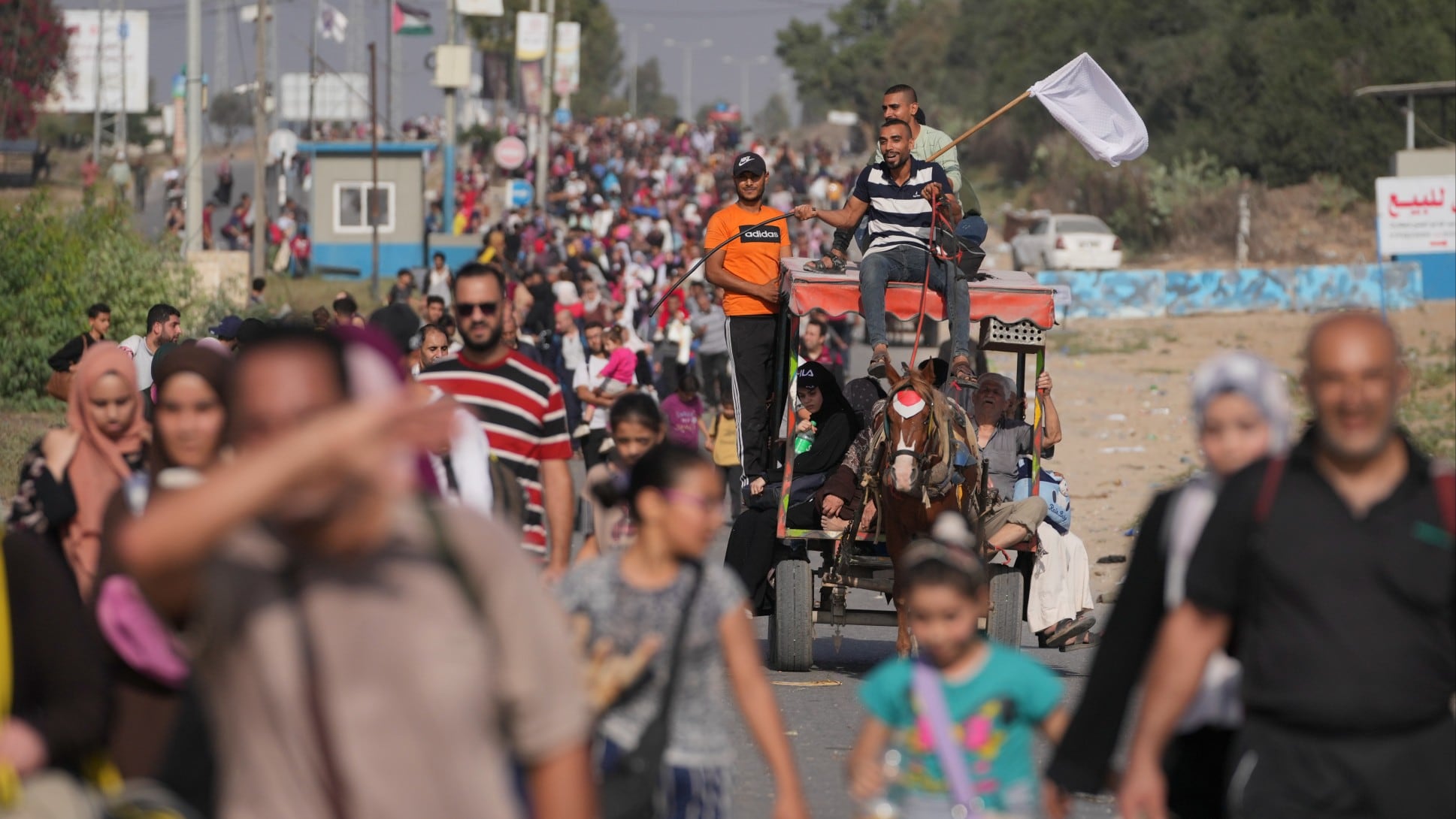
Similar short-term pauses have occurred over the past several days as tens of thousands of civilians have fled southward, but Thursday’s announcement appeared to be an effort to formalize and expand the process, as the U.S. has pressed Israelis to take greater steps to protect civilians in Gaza.
Asked in a Fox News interview that aired Thursday about the prospect of a daily humanitarian pause, Netanyahu replied that "the fighting continues against the Hamas enemy, the Hamas terrorists, but in specific locations for a given period, a few hours here, a few hours there, we want to facilitate a safe passage of civilians away from the zone of fighting. And we’re doing that.”
Biden’s push for an even longer pause comes as part of a renewed diplomatic push to free hostages taken by Hamas and other militant groups to the Gaza Strip during their Oct. 7 surprise attack on Israel.
Israeli officials estimate that militants still hold 239 hostages, including children and the elderly, from the attack that also saw 1,400 people killed in Israel. U.S. officials say fewer than 10 Americans are among those held captive. More than 10,800 people have been killed in Gaza, according to the Health Ministry in the Hamas-run territory.
Kirby told reporters Thursday that pauses could be useful for “getting all 239 hostages back with their families, to include the less than 10 Americans that we know are being held. So if we can get all the hostages out, that’s a nice finite goal.”
“Humanitarian pauses can be useful in the transfer process,” he added.
Indirect talks were taking place in Qatar — which also played a role in the freeing of four hostages by Hamas last month — about a larger release of hostages. CIA Director William Burns was in Doha on Thursday for talks with the Qatari prime minister, Sheikh Mohammed bin Abdulrahman Al Thani, and the head of Israel’s Mossad intelligence agency, David Barnea, according to a U.S. official. The official spoke with The Associated Press on the condition of anonymity to discuss sensitive matters.
Qatar is a frequent go-between in international dealings with Hamas, and some top Hamas political leaders make their home in the Gulf country. The U.S. official stressed Burns was not playing a lead role in the negotiations.
Kirby confirmed that the U.S. continues to have “active discussions with partners about trying to secure the release of hostages,” noting in particular Qatar’s help.
Sen. Ben Cardin, chairman of the Senate Foreign Relations Committee, told the AP that several issues need to be resolved in the negotiations, including whether a more extended pause in fighting or the hostage release would come first, and whether it would be possible to access all the hostages to know how many there were and the state of their health,
Cardin, D-Md., returned to Washington this week after helping lead a congressional delegation to the Middle East for talks with leaders from Egypt, Israel and Saudi Arabia. He and fellow lawmakers met with Biden on Wednesday night to brief him on their talks in the region.
“We have been told in the last several weeks that progress is imminent ... and then nothing happens,” he said. He added, "I hope we’ll see some progress, but we’ve been disappointed in the past.”
Lt. Col. Richard Hecht, an Israeli military spokesman, said there had been no shift in Israeli tactics. ’There’s no cease-fire,” he told reporters. ”‘These are tactical local pauses for humanitarian aid, which are limited in time and area."
“These evacuation corridors are for civilians to move south to safer areas where they can receive humanitarian aid.” Asked about Kirby’s announcement, he said: “It’s not a shift,” though he said Israel would try to expand these humanitarian corridors.
Secretary of State Antony Blinken had warned Israel last week that it risked destroying an eventual possibility for peace unless it acted swiftly to improve humanitarian conditions in Gaza for Palestinian civilians as it intensifies its war against Hamas.
In a blunt call for Israel to pause military operations to allow for the immediate and increased delivery of assistance, Blinken said the situation would drive Palestinians toward further radicalism and effectively end prospects for any eventual resumption of peace talks.
French President Emmanuel Macron had opened a Gaza aid conference on Thursday with an appeal for Israel to protect civilians, saying that “all lives have equal worth” and that fighting terrorism “can never be carried out without rules.”
Kirby said Uzra Zeya, the State Department’s under secretary for civilian security, democracy and human rights; special envoy David Satterfield; and Sarah Charles, who leads the USAID’s bureau for humanitarian assistance, were representing the U.S. at the Paris conference. Israel has not been invited by France to the conference.
Satterfield on Thursday described improving aid delivery for central and southern Gaza, but described no such effort in the northern battle zone other than to help civilians flee the intensifying Israeli assault.
He told reporters via an online briefing that the international community had been able to get fuel to turn back on water desalination plants in the south, and that aid into the south was averaging 100 trucks a day. Two pipelines supplying clean drinking water to the south from Israel have been turned back on.
“We do see the ability in the coming days, we hope, to meet the minimum requirements of the population in the south,” he said. “And I’m speaking of the south and the center, not of the north, which remains a kinetic area.”
AP writers Josh Boak, Colleen Long and Michelle Price in Washington contributed.
Updated Nov. 10 at 4:02 a..m. ET with the latest details.