By Dánica Coto
U.S. Vice President Kamala Harris announced Thursday that the U.S. is investing more than $100 million in the Caribbean region to crack down on weapons trafficking, help alleviate Haiti’s humanitarian crisis and support climate change initiatives.
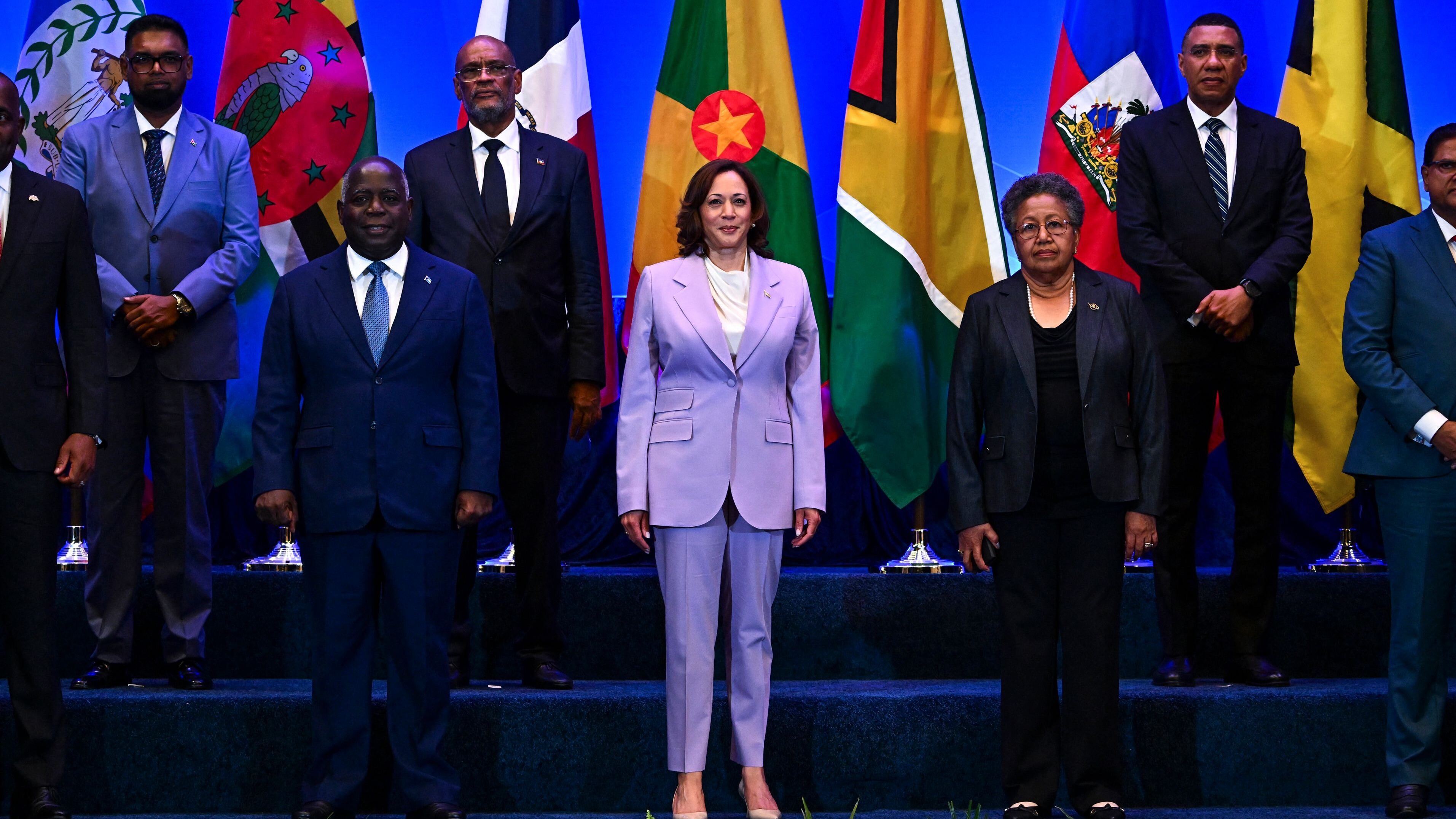
The announcement was made ahead of an official trip to the Bahamas for a meeting of Caribbean and U.S. leaders hosted by Harris and Bahamian Prime Minister Philip Davis. Harris, who is the highest-ranking U.S. official to visit the Bahamas since it became independent 50 years ago, landed shortly after noon.
Dozens of greeters including school children and members of her sorority greeted Harris as the Royal Bahamas Police Force band dressed in black, red and white uniform played.
As part of the initiatives, the U.S. Justice Department expects to appoint a coordinator to oversee cases involving illegal weapons smuggling in the Caribbean as island nations report a rise in violent crimes. In addition, the State Department vowed to help improve forensic work in the region, help strengthen local police departments and support a unit based in Trinidad and Tobago aimed at helping islands solve gun-related cases and provide training for the collection and analysis of related intelligence.
The U.S., with help from the U.K., also will establish a program in the eastern Caribbean to mentor local judges and prosecutors in a bid to improve prosecutions of gun-related crimes as island nations struggle with a backlog of cases.
The State Department also expects to work with Haiti’s National Police, a severely underfunded and understaffed agency struggling to quell a surge in gang violence, to help investigate and prosecute crimes with U.S. ties that involve gangs, weapons smuggling and human trafficking.
That initiative is considered key given that gangs are estimated to control up to 80% of the Haitian capital of Port-au-Prince as killings and kidnappings soar across the metropolitan area and beyond.
U.S. senior administration officials said the worsening security situation requires an international response, and that the U.S. strongly supports the deployment of a multinational force to Haiti.
In October, Haitian Prime Minister Ariel Henry requested the immediate deployment of a foreign armed force, but the U.N. Security Council, along with the U.S. and Canada, have yet to respond. Henry, along with other leaders of Caribbean nations, is expected to attend Thursday's meeting with Harris.
U.S senior administration officials said discussion are ongoing, and that any decision about military force would be done in consultation with the U.N. and Haiti's government.
Harris announced that the U.S. Agency for International Development will invest nearly $54 million in Haiti to help fight a sharp rise in starvation and provide access to potable water and healthcare. Almost half of Haiti’s more than 11 million people are facing acute food insecurity, and 19,000 are in catastrophic famine conditions.
Another $10.5 million will go toward supporting Haiti’s agricultural sector as poverty deepens, with some 60% of the population earning less than $2 a day.
USAID also expects to invest $20 million to help Caribbean businesses that use technologies related to renewable energy and energy efficiency. Another nearly $15 million will be used to boost emergency response and preparedness across the region.
Additional funds will help low-lying island nations whose economies largely depend on tourism prepare and adapt to climate change.