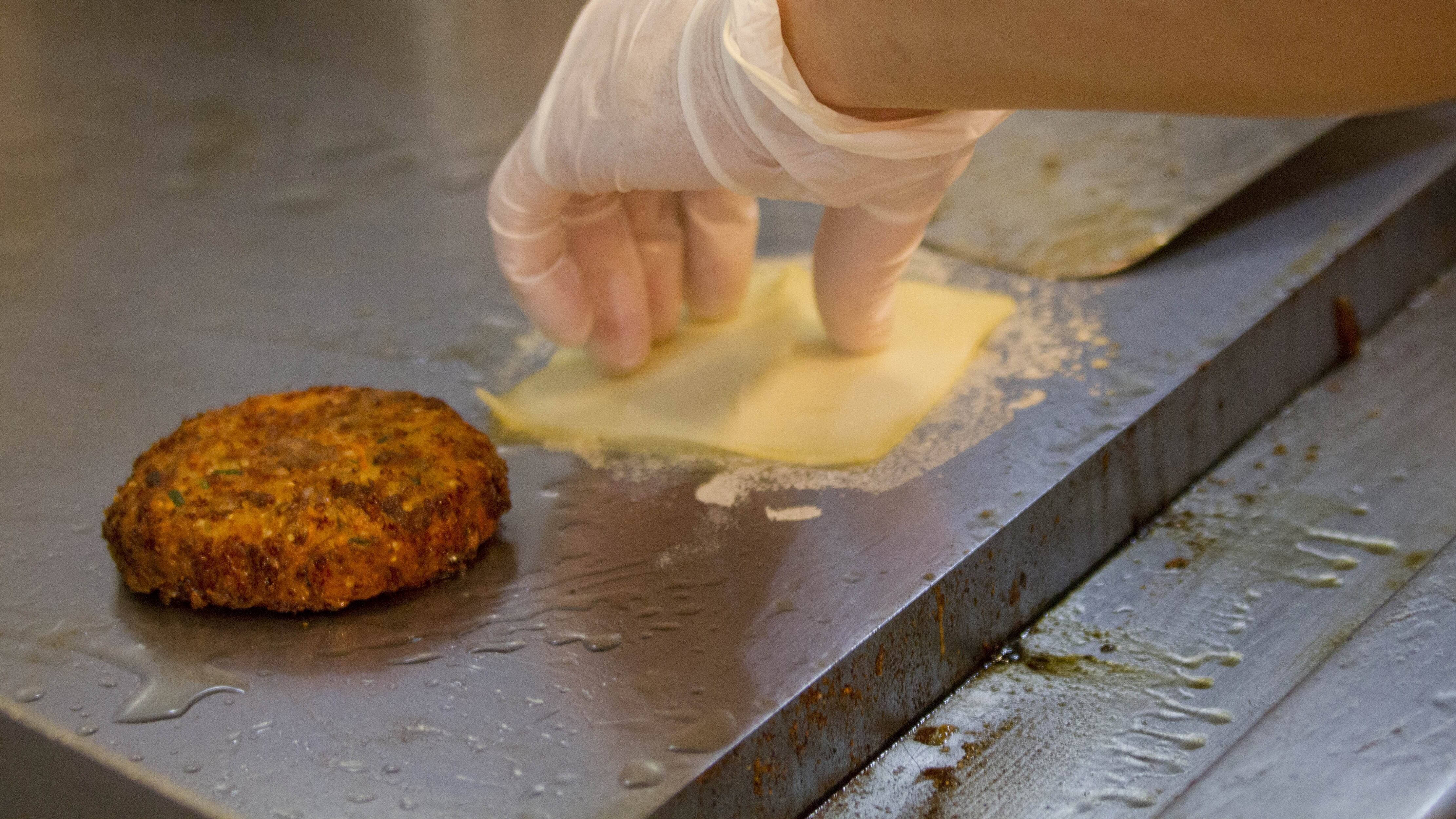
In this file photo from Tuesday, Jan. 27, 2015, a BurgerFi restaurant employee prepares to add cheese to a veggie burger as she grills an order at the Aventura, Fla., restaurant. (AP Photo/Wilfredo Lee)
Plant-based products that do not contain meat can continue to be labeled “sausages” or “burgers,” European lawmakers said Friday, when they rejected a proposal back by the meat industry to ban the terms.
In votes on issues relating to agricultural products, the European Parliament said that so-called veggie burgers, soy steaks and vegan sausages can continue to be sold as such in restaurants and shops across the union.
Europe’s largest farmers' association, Copa-Cogeca, had supported a ban, arguing that labeling vegetarian substitutes with designations bringing meat to mind was misleading for consumers.
On the opposite side of the debate, a group of 13 organizations including Greenpeace and WWF urged lawmakers to reject the proposed amendments, arguing that a ban would have not only exposed the EU “to ridicule," but also damaged its environmental credibility.
They said promoting a shift toward more plant-based diet is in line with the EU Commission's ambition to tackle global warming. Losing the ability to use the terms steak or sausage might make those plant-based products more obscure for consumers.
After the vote, the European Consumer Organization, an umbrella group bringing together consumers' associations, praised the MEPs for their “common sense."
“Consumers are in no way confused by a soy steak or chickpea-based sausage, so long as it is clearly labeled as vegetarian or vegan," the group said in a statement. “Terms such as ‘burger’ or ‘steak’ on plant-based items simply make it much easier for consumers to know how to integrate these products within a meal."
Together with Greenpeace, the group regretted that lawmakers accepted further restrictions on the naming of alternative products containing no dairy. Terms like ‘almond milk’ and ‘soy yogurt’ are already banned in Europe after the bloc's top court ruled in 2017 that purely plant-based products can't be marketed using terms such as milk, butter or cheese, which are reserved for animal products.
Peter Andersen, Chief Investment Officer at Anderson Capital Management, discusses the ramifications of Europe reducing dependence on Russian oil and how the Fed may respond to rising interest rates.
U.S. markets opened mixed on reports that Biden could announce a ban on Russian oil as soon as today. Robert Cantwell, Founder and Portfolio Manager at Upholdings joined Cheddar's Opening Bell to discuss.
President Biden issued his first executive to begin determining how the United States will move forward on digital currencies. Charlotte Principato, a financial services analyst for Morning Consult, joined Cheddar News Wrap to discuss. "What this executive order says is that crypto is mainstream," she said. "The United States has put our hat in the race to create a central bank digital currency and one with the power of the U.S. dollar behind it, so I think it's a really exciting time for both the cryptocurrency and the digital asset world."
Chris Natividad, CIO of EquBot, joins Cheddar News' Closing Bell, where he elaborates on what ultimately dragged the Dow, S&P, and Nasdaq lower on Tuesday and discusses how investors are reacting to rising oil prices and February CPI data coming out later this week.
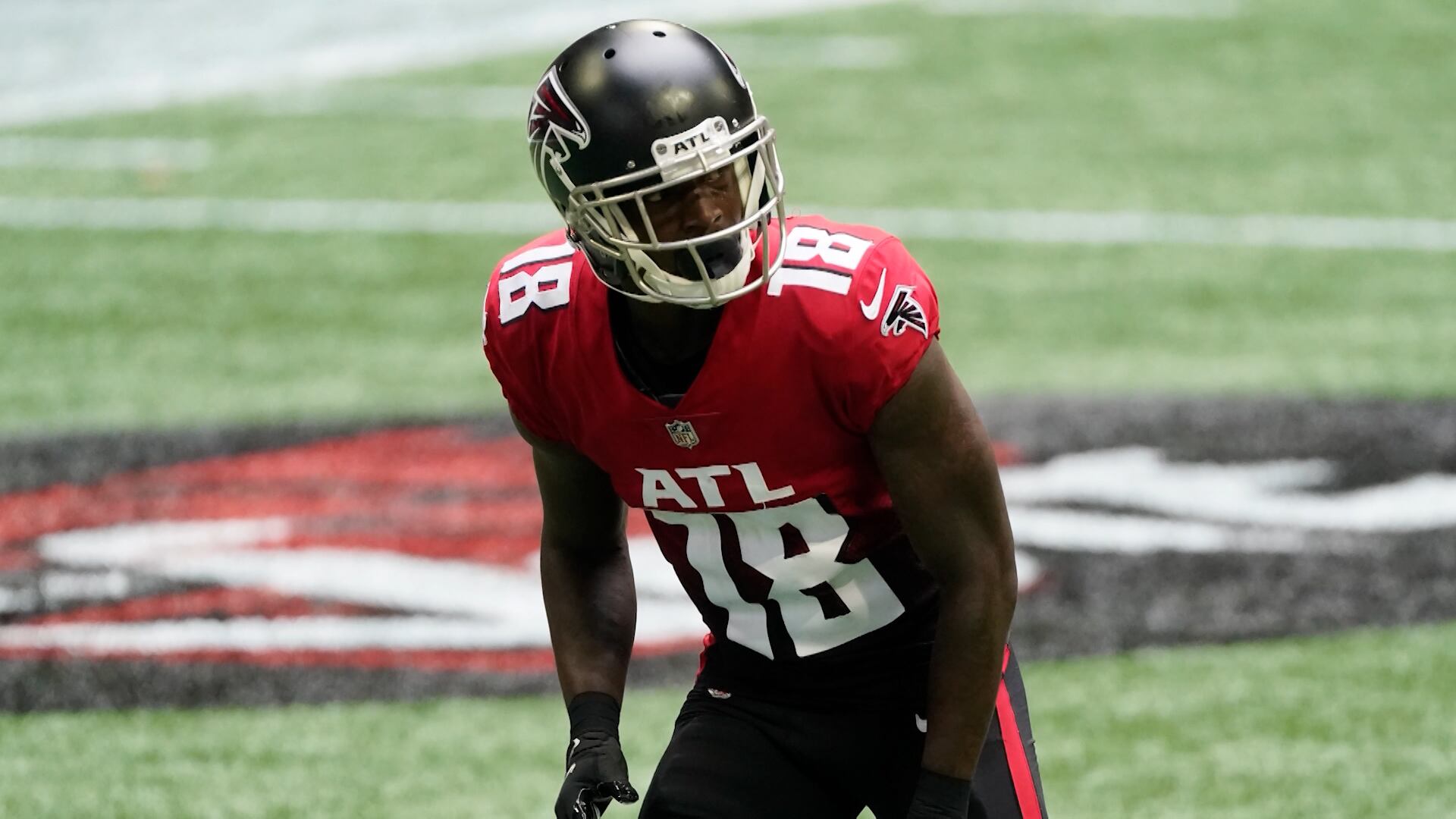
One NFL player got caught gambling on his own team, and now it's going to cost him. The NFL announced Monday that Atlanta Falcons wide receiver Calvin Ridley will be suspended for at least the entire 2022 season. The league said Ridley bet on NFL games during a five-day period last November. Frank Shwab, NFL and Betting Reporter at Yahoo Sports, joins Cheddar News' Closing Bell to discuss.
Adam Johnson, Portfolio Manager at Adviser Investments, joins Cheddar News' Closing Bell, where he explains why he believes we saw markets jump during Wednesday's session, and adds that investors have already priced in 'every possible kind of bad news we could have.'
President Joe Biden on Wednesday signed a long-awaited executive order on cryptocurrencies, striking a careful balance between highlighting the risks of digital assets and touting their potential benefits.