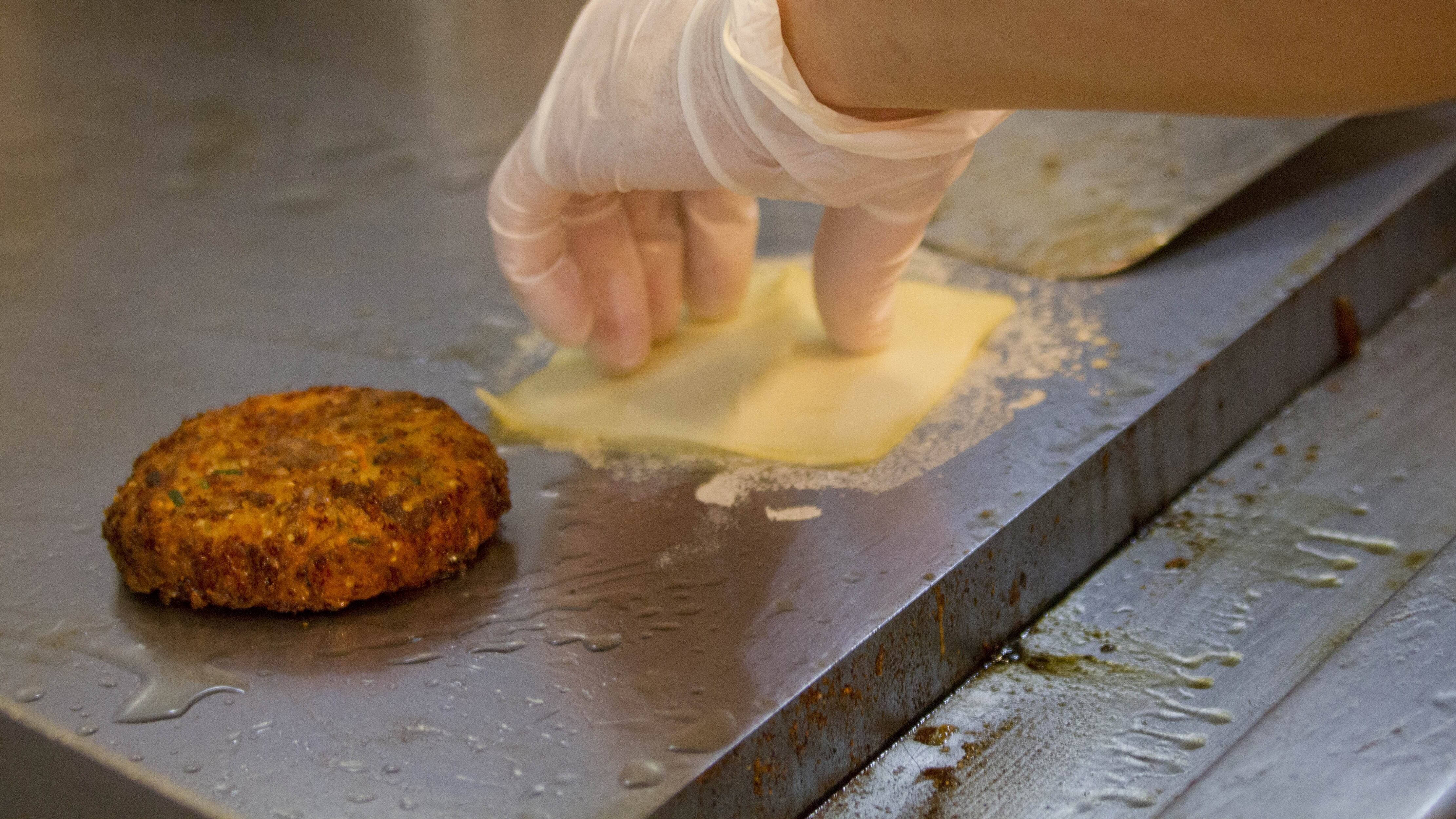
In this file photo from Tuesday, Jan. 27, 2015, a BurgerFi restaurant employee prepares to add cheese to a veggie burger as she grills an order at the Aventura, Fla., restaurant. (AP Photo/Wilfredo Lee)
Plant-based products that do not contain meat can continue to be labeled “sausages” or “burgers,” European lawmakers said Friday, when they rejected a proposal back by the meat industry to ban the terms.
In votes on issues relating to agricultural products, the European Parliament said that so-called veggie burgers, soy steaks and vegan sausages can continue to be sold as such in restaurants and shops across the union.
Europe’s largest farmers' association, Copa-Cogeca, had supported a ban, arguing that labeling vegetarian substitutes with designations bringing meat to mind was misleading for consumers.
On the opposite side of the debate, a group of 13 organizations including Greenpeace and WWF urged lawmakers to reject the proposed amendments, arguing that a ban would have not only exposed the EU “to ridicule," but also damaged its environmental credibility.
They said promoting a shift toward more plant-based diet is in line with the EU Commission's ambition to tackle global warming. Losing the ability to use the terms steak or sausage might make those plant-based products more obscure for consumers.
After the vote, the European Consumer Organization, an umbrella group bringing together consumers' associations, praised the MEPs for their “common sense."
“Consumers are in no way confused by a soy steak or chickpea-based sausage, so long as it is clearly labeled as vegetarian or vegan," the group said in a statement. “Terms such as ‘burger’ or ‘steak’ on plant-based items simply make it much easier for consumers to know how to integrate these products within a meal."
Together with Greenpeace, the group regretted that lawmakers accepted further restrictions on the naming of alternative products containing no dairy. Terms like ‘almond milk’ and ‘soy yogurt’ are already banned in Europe after the bloc's top court ruled in 2017 that purely plant-based products can't be marketed using terms such as milk, butter or cheese, which are reserved for animal products.
The Federal Reserve announced that it will raise its interest for the first time in more than three years to fight record inflation. Cheddar News spoke with Mark Hamrick, Senior Economic Analyst at Bankrate how the move will impact the wallets of everyday Americans.
Paul T. Murray, president at PTM Wealth Management, joined Cheddar News to break down the implications of the Starbucks CEO shakeup, as the coffee company faces issues of unionization and pandemic-related closures. "Well, shareholders love Howard Schultz returning. I mean he's an iconic CEO, a visionary, a guy who made coffee as American as apple pie and shareholders are gonna continue to love that," Murray continued. "But he's got an uphill battle, frankly, because, this unionization push has now spread to 26 states, 100 stores, and the COVID pandemic is going to continue to be a headwind, especially in China where Johnson really made a lot of headway."
Social audio app Clubhouse reached $1 billion valuation milestone this January, and Fadia Kader, head of strategic media partnerships at Clubhouse, joined Cheddar News to talk about what its been doing to keep the drive going. "We are the category first leaders. We are 100 percent focused on social audio. It's not just a feature that we've just like bottled up and put on there. We are a medium that is 100 percent focused on community and social audio," she said.
European antitrust regulators gave Amazon approval for its MGM acquisition deal. Amazon expects MGM's collection of content will help it compete in the increasingly crowded world of streaming services.
Online retailer Boxed reported a significant growth in its latest earnings, and CEO Chieh Huang joined Cheddar News to talk about its Q4 report, what's upcoming for the company, and how the business avoided the mass labor shortages dubbed the great resignation. "We've been really lucky when it comes to what we're known about as a company. Half of what comes up if you search us on the internet is how we treat our frontline team even before, I guess, it was the kind of soup du jour to do so," he said. "We treat them extraordinarily well."