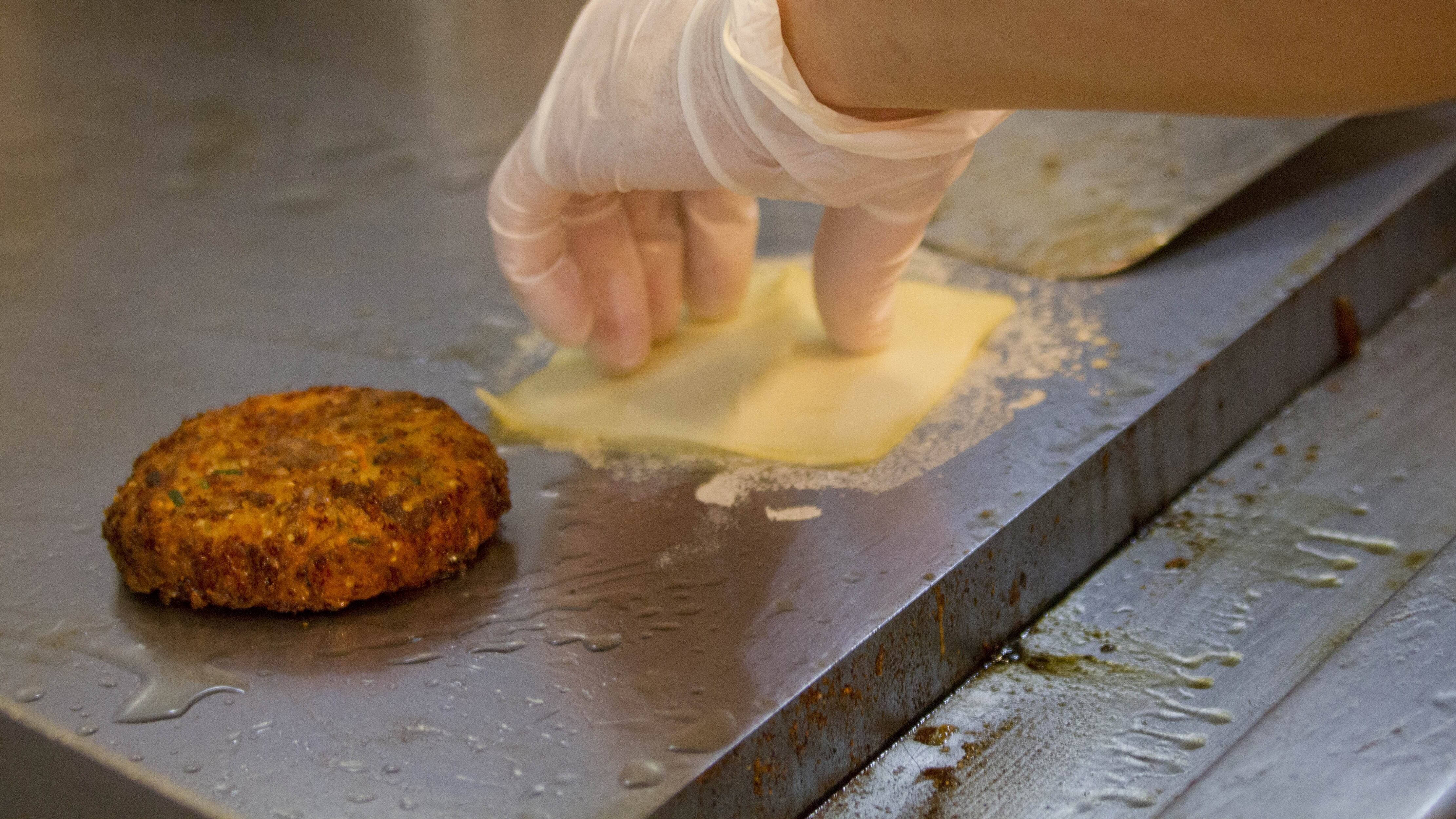
In this file photo from Tuesday, Jan. 27, 2015, a BurgerFi restaurant employee prepares to add cheese to a veggie burger as she grills an order at the Aventura, Fla., restaurant. (AP Photo/Wilfredo Lee)
Plant-based products that do not contain meat can continue to be labeled “sausages” or “burgers,” European lawmakers said Friday, when they rejected a proposal back by the meat industry to ban the terms.
In votes on issues relating to agricultural products, the European Parliament said that so-called veggie burgers, soy steaks and vegan sausages can continue to be sold as such in restaurants and shops across the union.
Europe’s largest farmers' association, Copa-Cogeca, had supported a ban, arguing that labeling vegetarian substitutes with designations bringing meat to mind was misleading for consumers.
On the opposite side of the debate, a group of 13 organizations including Greenpeace and WWF urged lawmakers to reject the proposed amendments, arguing that a ban would have not only exposed the EU “to ridicule," but also damaged its environmental credibility.
They said promoting a shift toward more plant-based diet is in line with the EU Commission's ambition to tackle global warming. Losing the ability to use the terms steak or sausage might make those plant-based products more obscure for consumers.
After the vote, the European Consumer Organization, an umbrella group bringing together consumers' associations, praised the MEPs for their “common sense."
“Consumers are in no way confused by a soy steak or chickpea-based sausage, so long as it is clearly labeled as vegetarian or vegan," the group said in a statement. “Terms such as ‘burger’ or ‘steak’ on plant-based items simply make it much easier for consumers to know how to integrate these products within a meal."
Together with Greenpeace, the group regretted that lawmakers accepted further restrictions on the naming of alternative products containing no dairy. Terms like ‘almond milk’ and ‘soy yogurt’ are already banned in Europe after the bloc's top court ruled in 2017 that purely plant-based products can't be marketed using terms such as milk, butter or cheese, which are reserved for animal products.
Mario Stefanidis, Vice President of Research at Roundhill Investments, joins Cheddar News' Closing Bell, where he explains why shares of GameStop soared on Wall Street despite mixed results. Stefanidis also breaks down GameStop's NFT plans, which the company is expected to launch over this summer.
Neonvest is a platform connecting startups and entrepreneurs with experts in the VC space. The startup says it's in the process of raising a seed round of approximately $2.5 million from a mix of angel and institutional investors. Aakash Shah, co-founder of NeonVest, joins Cheddar News' Closing Bell to discuss.
The Russia-Ukraine conflict is becoming a global one: as the West isolates Russia's economy with sanctions and China contemplates an alliance of sorts with Russia, global trade relationships and globalization as we know it could change dramatically. John Leer, Chief Economist at Morning Consult, joins Closing Bell to discuss what the invasion means for globalization, global trade and growth, the U.S. economy and consumer, and more.
March Madness kicked off this month as more and more states are legalizing sports betting — and some major upsets almost immediately busting many a bracket. Jay Croucher, the director of trading at the sportsbook PointsBet, joined Cheddar News to talk about the tournament and the current top picks. "There's not too much difference in terms of the busiest days of the year between the Super Bowl and the first day of March Madness," he said.
The Bill Gates-founded Breakthrough Energy company invested $80 million in Verdox Inc. to facilitate efficient, lower-cost technolog to remove carbon from the air and emission sources. CEO of Verdox, Brian Baynes, joined Cheddar News to discuss the investment, how the company's tech works, and where he sees it going. "We anticipate that with technologies like ours, we potentially can get to the scale of about a million tons per year within 5-10 years," he said. "And then ultimately we need to be doing this at the scales of billions of tons per year and ultimately about 10 billion tons per year in the year 2050."
Amazon closed its deal to buy MGM's many content brands for $8.5 billion, and Michael Pachter, a managing director at Wedbush Securities, joined Cheddar News to discuss the e-commerce giant's second-largest acquisition to date and how he thinks it will all pay off. "To make a movie today, you just can't even think about it for less than 30 million bucks, so 4,000 movies, I mean that's several billion dollars worth of assets," he said, noting how it would also add to Amazon's little-known ad-supported IMDb TV service. "I don't know that the IMDb TV guys actually talk to the Amazon Prime Video guys, but a lot of content, it makes the value of a Prime subscription much, much greater, and people are far, far less likely to churn even if they're only buying one package every three months."
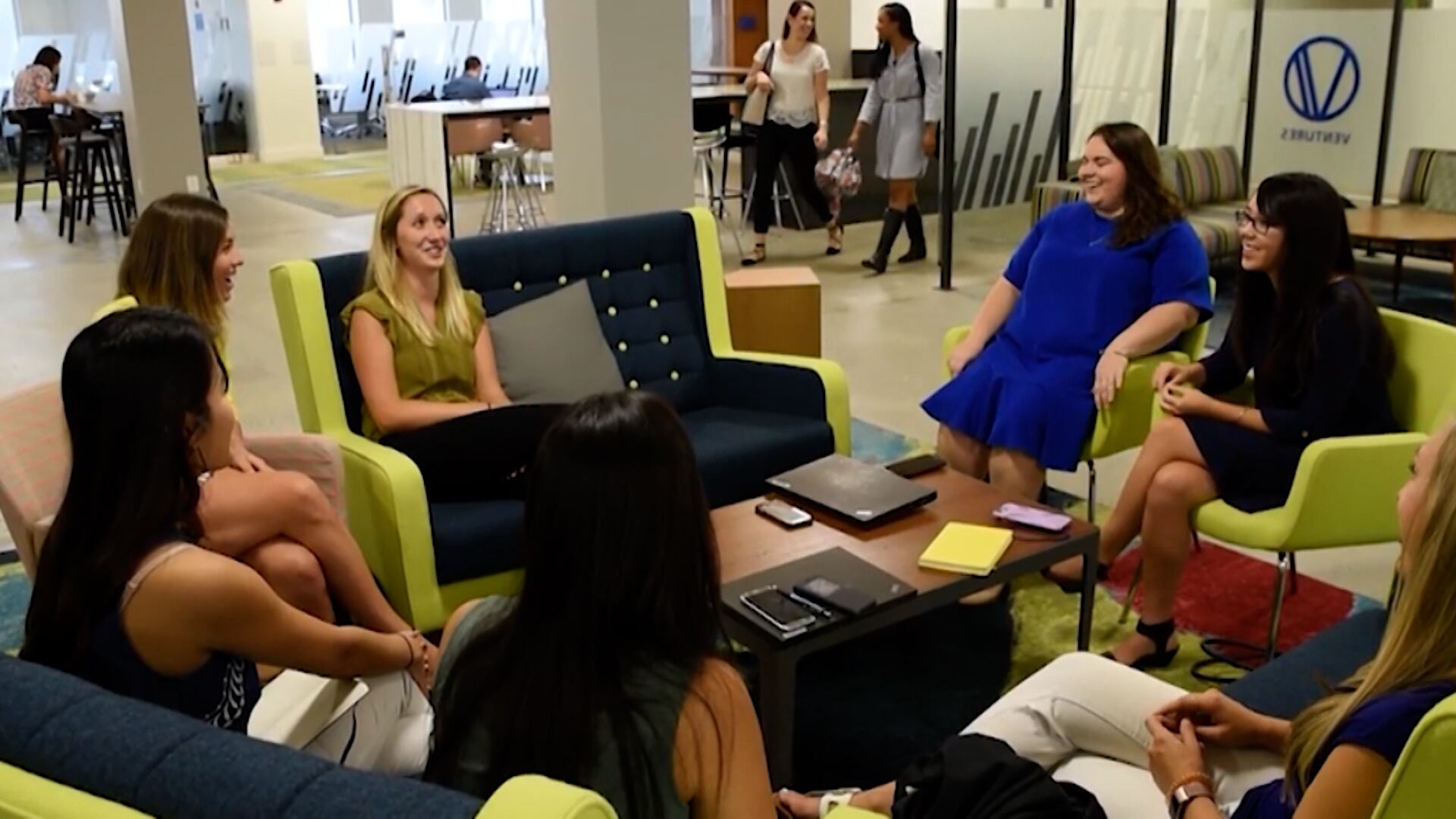
Rachel Thomas, the co-founder and CEO of the non-profit Lean In, joined Cheddar amid Women's History Month, to discuss how the organization is taking on issues that continue to impact the workplace through its Circles program. "These are a program that brings women together in small groups, usually 8 to 12, for support, camaraderie, and to learn together," she said. "We also we have a lot of curriculum so women can learn how to navigate workplace biases, how to negotiate with women." Thomas also applauded President Biden's recent call to action on equal pay for women, noting that businesses must do more to be cognizant of inherent gender and racial biases.
From Wall Street to Silicon Valley, these are the top stories that moved markets and had investors, business leaders, and entrepreneurs talking this week on Cheddar.
Beer brand Heineken recently revealed its foray into the metaverse was something of a joke, but how serious are brands taking the latest craze in general? Cheddar's Alex Vuocolo takes a closer look.