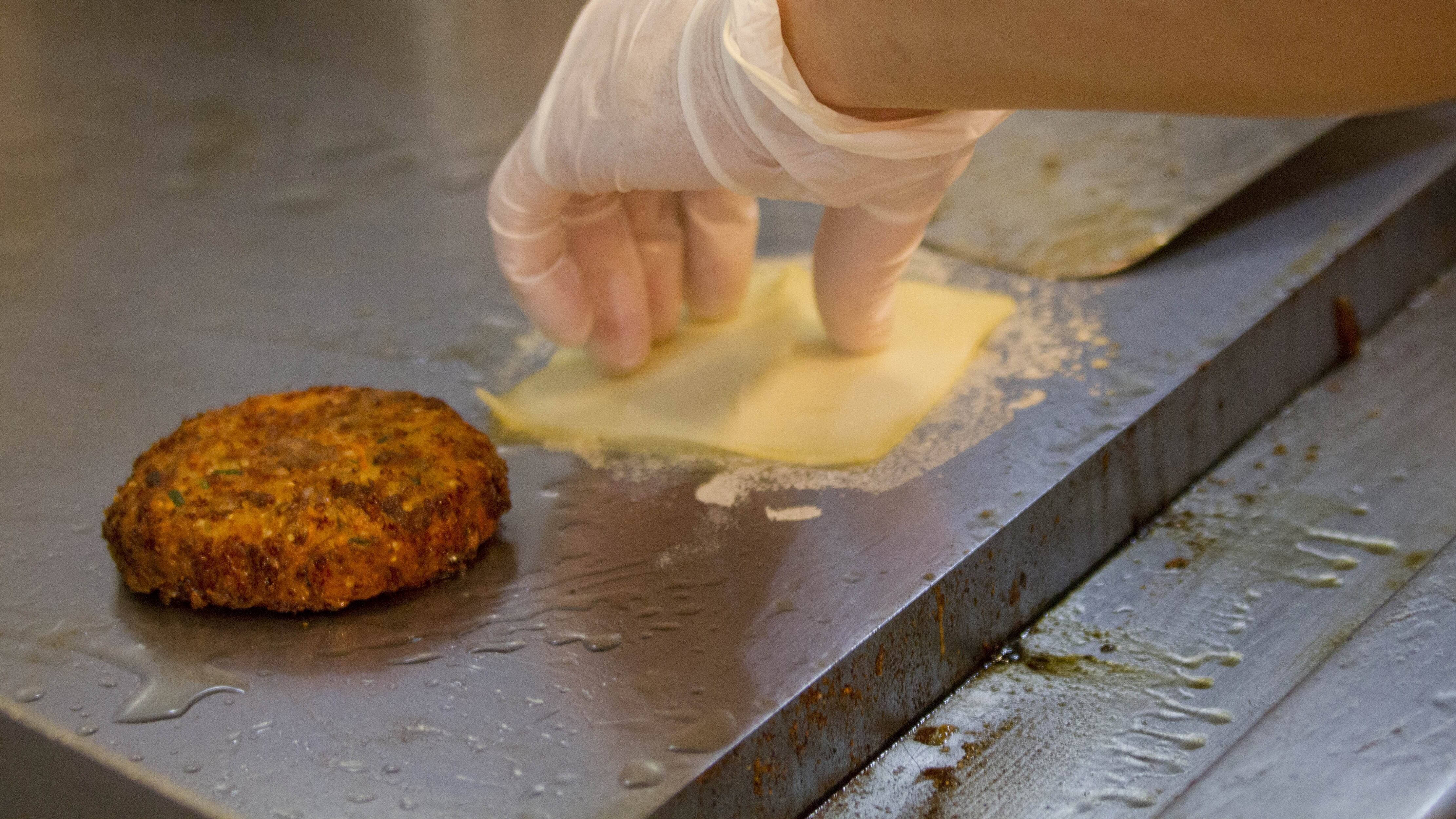
In this file photo from Tuesday, Jan. 27, 2015, a BurgerFi restaurant employee prepares to add cheese to a veggie burger as she grills an order at the Aventura, Fla., restaurant. (AP Photo/Wilfredo Lee)
Plant-based products that do not contain meat can continue to be labeled “sausages” or “burgers,” European lawmakers said Friday, when they rejected a proposal back by the meat industry to ban the terms.
In votes on issues relating to agricultural products, the European Parliament said that so-called veggie burgers, soy steaks and vegan sausages can continue to be sold as such in restaurants and shops across the union.
Europe’s largest farmers' association, Copa-Cogeca, had supported a ban, arguing that labeling vegetarian substitutes with designations bringing meat to mind was misleading for consumers.
On the opposite side of the debate, a group of 13 organizations including Greenpeace and WWF urged lawmakers to reject the proposed amendments, arguing that a ban would have not only exposed the EU “to ridicule," but also damaged its environmental credibility.
They said promoting a shift toward more plant-based diet is in line with the EU Commission's ambition to tackle global warming. Losing the ability to use the terms steak or sausage might make those plant-based products more obscure for consumers.
After the vote, the European Consumer Organization, an umbrella group bringing together consumers' associations, praised the MEPs for their “common sense."
“Consumers are in no way confused by a soy steak or chickpea-based sausage, so long as it is clearly labeled as vegetarian or vegan," the group said in a statement. “Terms such as ‘burger’ or ‘steak’ on plant-based items simply make it much easier for consumers to know how to integrate these products within a meal."
Together with Greenpeace, the group regretted that lawmakers accepted further restrictions on the naming of alternative products containing no dairy. Terms like ‘almond milk’ and ‘soy yogurt’ are already banned in Europe after the bloc's top court ruled in 2017 that purely plant-based products can't be marketed using terms such as milk, butter or cheese, which are reserved for animal products.
Michael Cassau, Founder and CEO of Grover, joins Cheddar News' Closing Bell, where he explains how Grover is establishing itself in the tech marketplace with its subscription-based offering and how he plans to deploy the $330 million in new funding.
Michael Chime, Co-Founder and CEO of Prepared, joins Cheddar News' Closing Bell, where he explains how his platform is bringing the emergency call system into today's tech-driven era and discusses how his company plans to utilize $9.8 million it just raised in new funding.
Christine McDaniel, Senior Research Fellow at the Mercatus Center, joined Cheddar News' Closing Bell to break down the long list of sanctions that the U.S. has levied against Russia since its invasion of Ukraine, and the impact - or lack thereof - they are having on Russia.
Art Hogan, Managing Director and Chief Market Strategist at National Securities, joined Cheddar's Closing Bell to break down Jamie Dimon's letter to shareholders, which revealed fears about growth due to the pandemic, inflation and the Russian invasion of Ukraine.
Seth Schachner, a digital business executive and the managing director of the consultancy Strat Americas, joined Closing Bell to talk all about the mega-merger between WarnerMedia and Discovery, combining to form Warner Bros. Discovery (Nasdaq: WBD), and what it means for the streaming space going forward. “I think unlike some of the other mergers that you've seen out there. I think this one has actually got a real chance to be successful and to really further the cause of streaming," he said.
With the New York International Auto show set to get underway for the first time in two years, Stephan Winkelmann, global CEO of Lamborghini, joined Cheddar News to talk about what to expect from the luxury sports car maker from the Big Apple, including a look at new car models and its esports, and NFT plans. "All of this for sure creating a buzz for the younger generations," he said. "We are directing them into our brand because this is important for us, that there is a close connection between the digital world and the real world we are living in by developing, producing, and selling cars." Winkelmann also discussed the company's outlook amid the pandemic and the war in Ukraine.
Stefanie O'Connell Rodriguez joined Cheddar's Opening Bell to discuss her newest mini-series on REAL SIMPLE's Money Confidential podcast, called 'Taxes in 10.'
As the Russian invasion of Ukraine continues, social media giant Meta said that it's using its technology to help the beleaguered nation Erin Egan, chief privacy officer, and Andrew Schroeder, vice president of research and analysis for direct relief, joined Cheddar News to discuss using data towards humanitarian relief. "Our goal with the program is to help organizations on the ground by sharing privacy-protected data sets to enable them to respond to crisis," Egan explained.