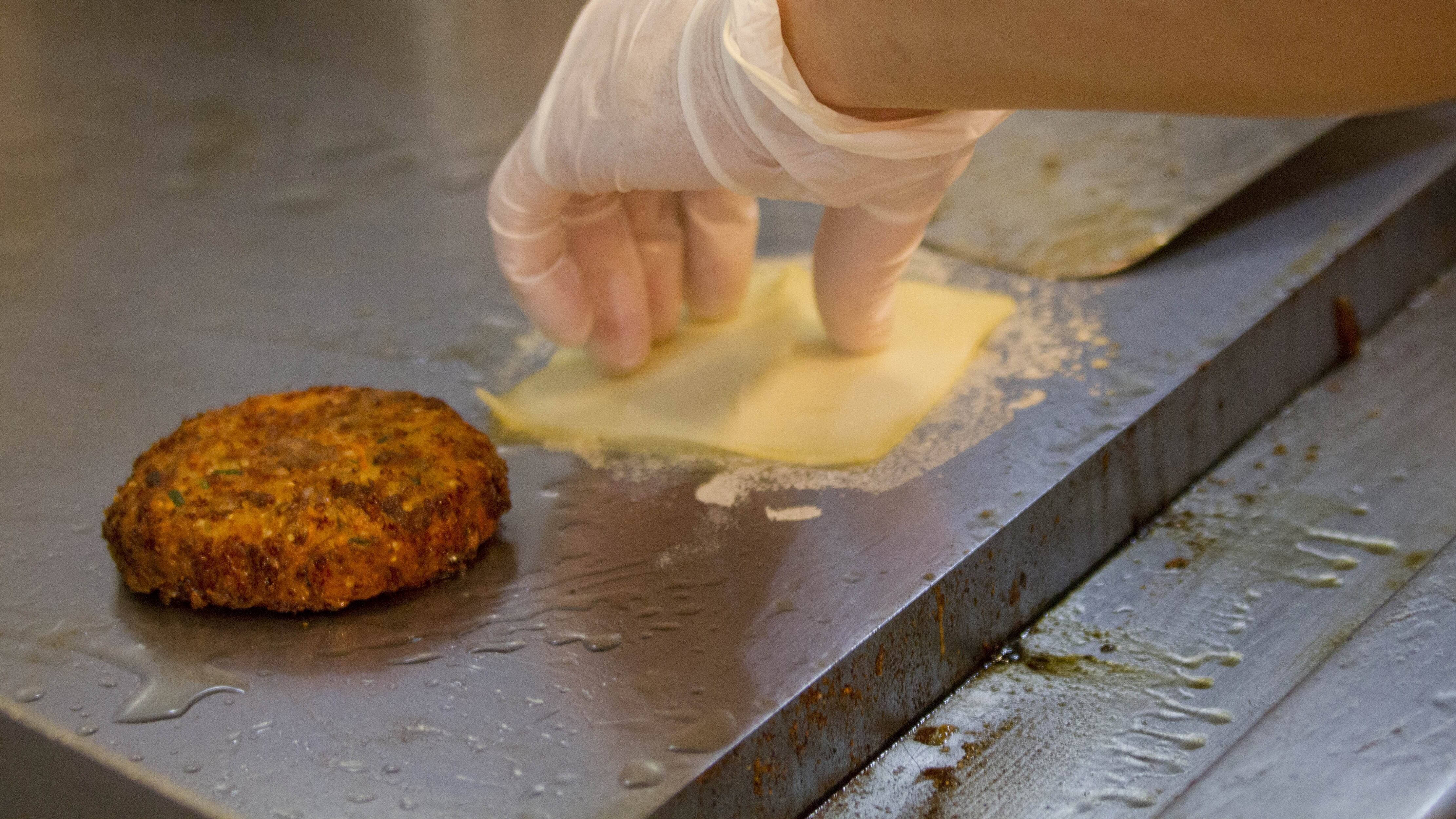
In this file photo from Tuesday, Jan. 27, 2015, a BurgerFi restaurant employee prepares to add cheese to a veggie burger as she grills an order at the Aventura, Fla., restaurant. (AP Photo/Wilfredo Lee)
Plant-based products that do not contain meat can continue to be labeled “sausages” or “burgers,” European lawmakers said Friday, when they rejected a proposal back by the meat industry to ban the terms.
In votes on issues relating to agricultural products, the European Parliament said that so-called veggie burgers, soy steaks and vegan sausages can continue to be sold as such in restaurants and shops across the union.
Europe’s largest farmers' association, Copa-Cogeca, had supported a ban, arguing that labeling vegetarian substitutes with designations bringing meat to mind was misleading for consumers.
On the opposite side of the debate, a group of 13 organizations including Greenpeace and WWF urged lawmakers to reject the proposed amendments, arguing that a ban would have not only exposed the EU “to ridicule," but also damaged its environmental credibility.
They said promoting a shift toward more plant-based diet is in line with the EU Commission's ambition to tackle global warming. Losing the ability to use the terms steak or sausage might make those plant-based products more obscure for consumers.
After the vote, the European Consumer Organization, an umbrella group bringing together consumers' associations, praised the MEPs for their “common sense."
“Consumers are in no way confused by a soy steak or chickpea-based sausage, so long as it is clearly labeled as vegetarian or vegan," the group said in a statement. “Terms such as ‘burger’ or ‘steak’ on plant-based items simply make it much easier for consumers to know how to integrate these products within a meal."
Together with Greenpeace, the group regretted that lawmakers accepted further restrictions on the naming of alternative products containing no dairy. Terms like ‘almond milk’ and ‘soy yogurt’ are already banned in Europe after the bloc's top court ruled in 2017 that purely plant-based products can't be marketed using terms such as milk, butter or cheese, which are reserved for animal products.
As life inches toward a post-pandemic world, many people are trying to navigate how to transition from their work-from-home look to a new back-to-office style for the first time in two years. Dina Scherer, the owner of Modnitsa Styling, joined Cheddar News to provide some styling suggestions for those returning to the office. 'I do hear this from a lot of my clients that they just have no idea how to transition from sweat pants, athleisure, into a work office environment outfit that's both appropriate and comfortable,' she noted.
Kelly Johnson, Portfolio Strategist, Charles Schwab, joins Cheddar News' Closing Bell, where he breaks down the results of the 2022 Ariel-Schwab Black Investor Survey. In doing so, he dives into why White American investing activity is at an all-time low and why more Black Americans are gravitating toward cryptocurrencies.
U.S. stocks closed Friday's session mostly lower to end the first full trading week of April. For the week, the S& 500 dropped 1.26%, the Dow fell 0.27%, and the Nasdsaq saw a more significant decline of 3.86%. Melissa Armo, founder and owner of The Stock Swoosh, joined Cheddar News' Closing Bell to discuss.
U.S. stocks saw a jump in the final hour of Thursday's session, and ultimately closed slightly higher for the day. Tim Pagliara, Chief Investment Officer of CapWealth, joined Cheddar News' Closing Bell to discuss. "The markets have had to digest a lot of action from the federal reserve this quarter and it's affecting everything from mortgage rates to how they value stocks," he said.
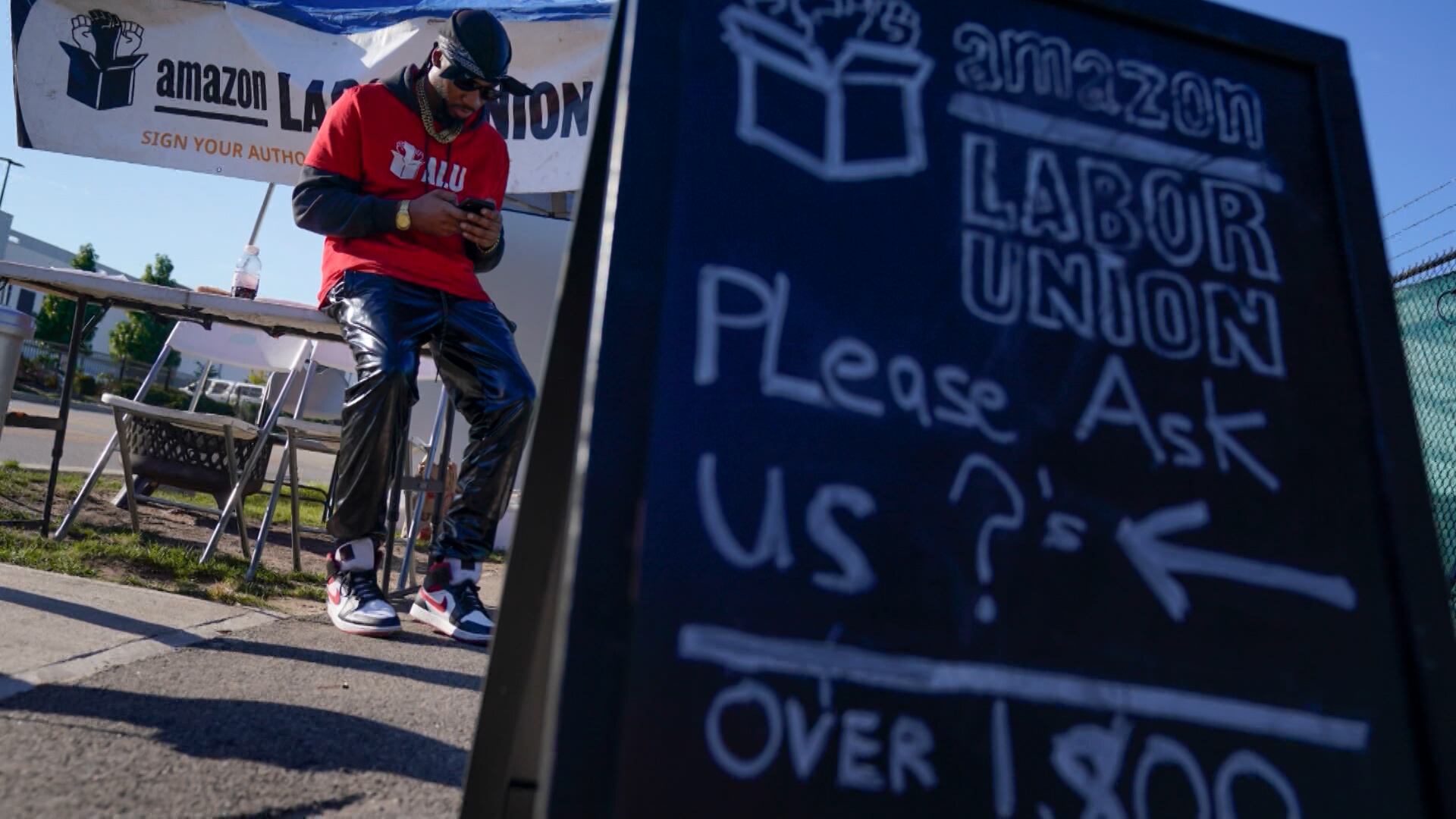
Herold Meyerson, Editor at Large of 'The American Prospect,' joined Closing Bell to discuss the recent uptick in unionization efforts across the U.S. and what it might mean for large corporations like Amazon and Starbucks, where workers are increasingly pushing to unionize.
Alma Angotti, a former SEC Enforcement Attorney and Global Regulatory Risk Leader at the consulting firm Guidehouse, joined Closing Bell to discuss the SEC probe of Amazon's business practices related to third-party seller data, and whether it will have any impact.
The month of April is also known as financial literacy month, and Investopdia marked the occasion this year by surveying 4,000 U.S. adults - 1,000 each from Generation Z, millennial, Generation X, and baby boomer generations - to try to get a better sense of where each generation stands when it comes to their understanding of all things money. The survey found that while many Americans have invested in crypto, most have much more to learn about digital currency. Investopedia Editor in Chief Caleb Silver joins Cheddar News' Closing Bell to discuss.