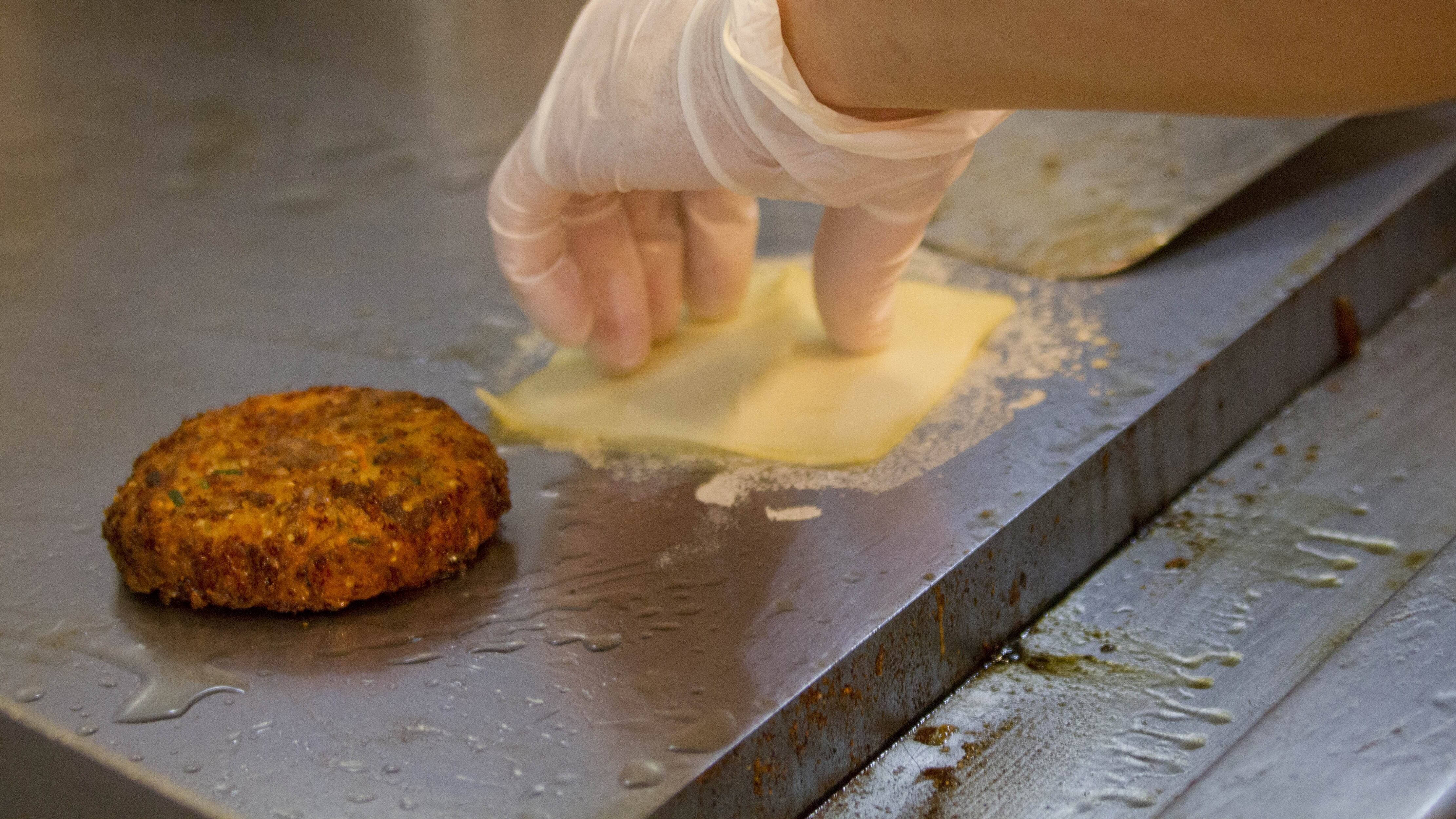
In this file photo from Tuesday, Jan. 27, 2015, a BurgerFi restaurant employee prepares to add cheese to a veggie burger as she grills an order at the Aventura, Fla., restaurant. (AP Photo/Wilfredo Lee)
Plant-based products that do not contain meat can continue to be labeled “sausages” or “burgers,” European lawmakers said Friday, when they rejected a proposal back by the meat industry to ban the terms.
In votes on issues relating to agricultural products, the European Parliament said that so-called veggie burgers, soy steaks and vegan sausages can continue to be sold as such in restaurants and shops across the union.
Europe’s largest farmers' association, Copa-Cogeca, had supported a ban, arguing that labeling vegetarian substitutes with designations bringing meat to mind was misleading for consumers.
On the opposite side of the debate, a group of 13 organizations including Greenpeace and WWF urged lawmakers to reject the proposed amendments, arguing that a ban would have not only exposed the EU “to ridicule," but also damaged its environmental credibility.
They said promoting a shift toward more plant-based diet is in line with the EU Commission's ambition to tackle global warming. Losing the ability to use the terms steak or sausage might make those plant-based products more obscure for consumers.
After the vote, the European Consumer Organization, an umbrella group bringing together consumers' associations, praised the MEPs for their “common sense."
“Consumers are in no way confused by a soy steak or chickpea-based sausage, so long as it is clearly labeled as vegetarian or vegan," the group said in a statement. “Terms such as ‘burger’ or ‘steak’ on plant-based items simply make it much easier for consumers to know how to integrate these products within a meal."
Together with Greenpeace, the group regretted that lawmakers accepted further restrictions on the naming of alternative products containing no dairy. Terms like ‘almond milk’ and ‘soy yogurt’ are already banned in Europe after the bloc's top court ruled in 2017 that purely plant-based products can't be marketed using terms such as milk, butter or cheese, which are reserved for animal products.
Despite Elon Musk making the deal to buy Twitter, it's still unclear as to what all of his plans might be for it. Tesla’s stock dropped on Tuesday, potentially due to concerns over what the situation might mean for the EV maker going forward. Hatem Dhiab, a managing partner at Gerber Kawasaki Wealth & Investment Management, and Bruce Goldfarb, the president and CEO of Okapi Partners, joined Cheddar News to talk about the ramifications of the acquisition for both Tesla and Twitter stockholders. "I think people are scared because the deal has some leverage that's tied to Tesla stock, and people are worried that maybe Elon will sell some of his stock," Dhiab said about the purchase. "But I don't think that that's likely."
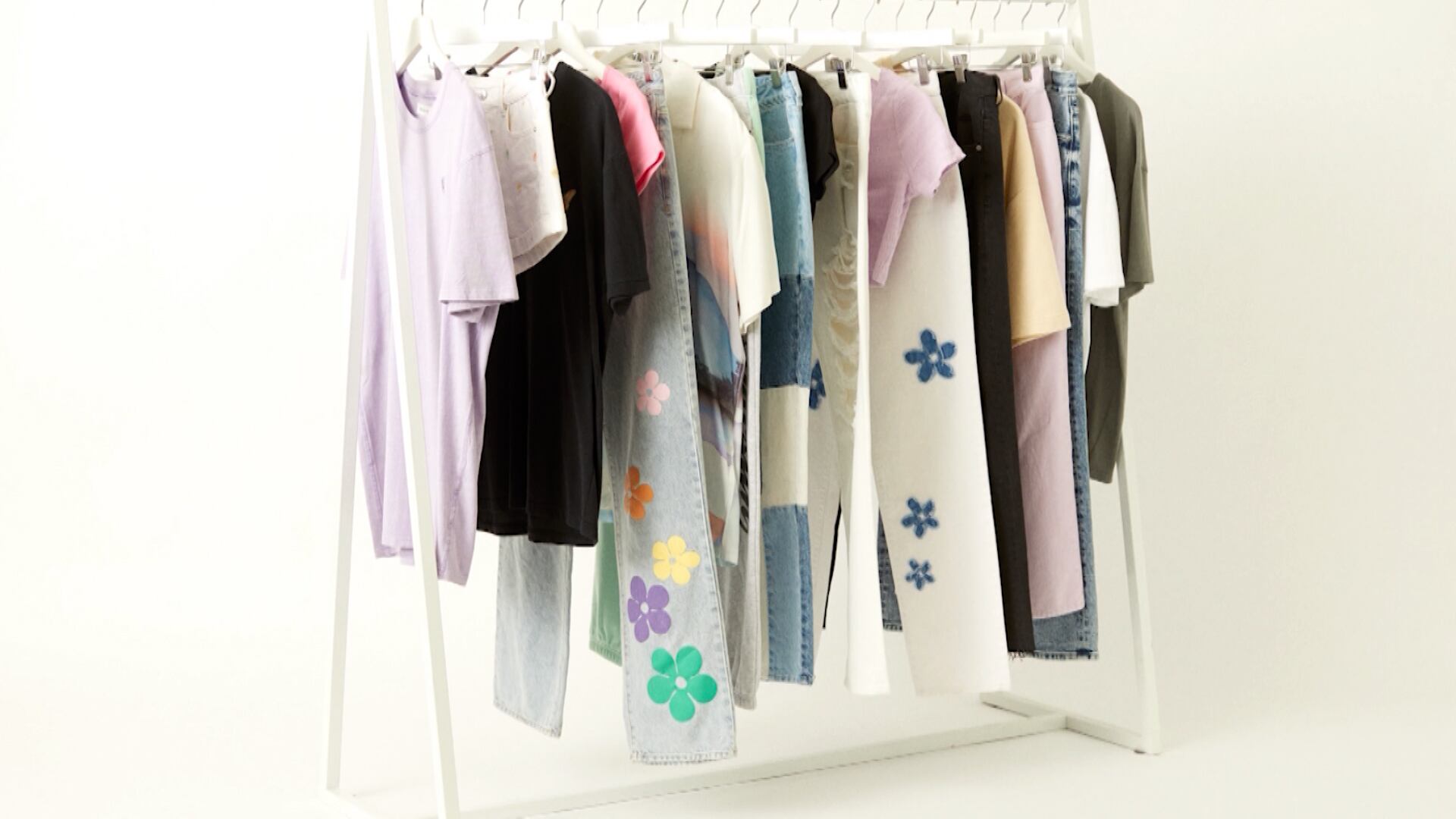
Clothing brand PacSun and online thrift retailer thredUP are partnering up for "Pre-Loved Pac," a 360-resale program allowing PacSun customers to clean out their closets for credit and shop for gently used clothing directly through PacSun's website. Pacsun co-CEO Alfred Chang and thredUP CEO James Reinhart joined Cheddar News to talk about their collaboration. "The latest research shows that over 50 percent of this generation has engaged in either selling or purchasing something at resale," Chang said. "It's important to them and it's important obviously to the world in terms of what we can do in terms of recycling clothes."
New Jersey has legalized recreational marijuana. The state missed cannabis holiday 4/20 by just a day. Cannabis giant Curaleaf operates three dispensaries in New Jersey. The company's CEO Joe Bayern joins Cheddar to recap the big day.
According to the Morning Consult, consumer spending in March was significantly impacted by inflation even as habits changed from purchasing goods to services as pandemic restrictions ebbed. Kayla Bruun, an economic analyst for the Morning Consult, joined Cheddar News to talk about the findings."Consumers are getting more and more concerned about paying for gas, paying for groceries — all these prices that are rising so quickly for things that they really don't have the choice but to buy," she said. "They're starting to cut back on the things that are a little bit more discretionary, realizing with prices as high as they are, it's maybe not the best time to be booking a vacation or upgrading their kitchen."