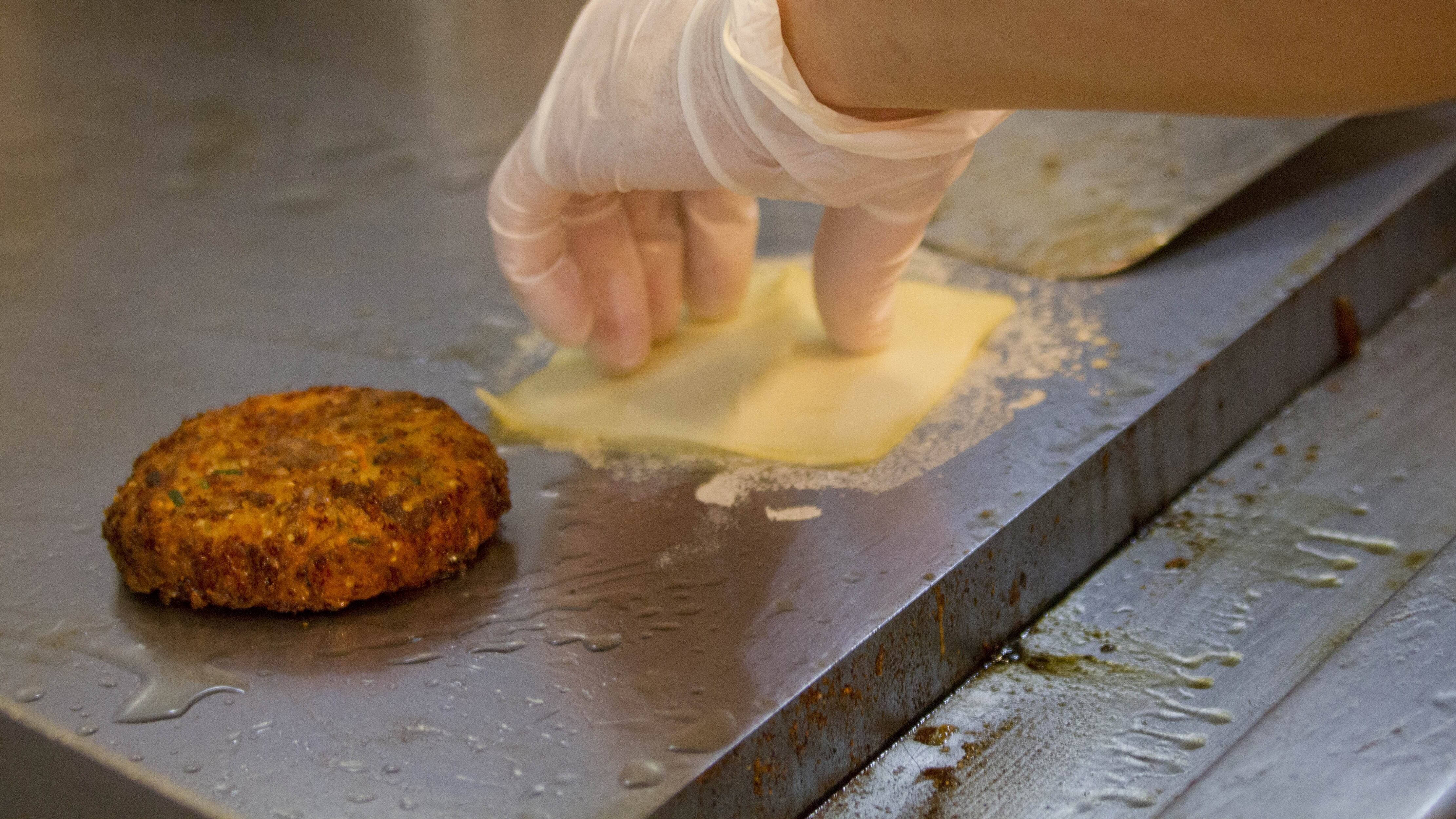
In this file photo from Tuesday, Jan. 27, 2015, a BurgerFi restaurant employee prepares to add cheese to a veggie burger as she grills an order at the Aventura, Fla., restaurant. (AP Photo/Wilfredo Lee)
Plant-based products that do not contain meat can continue to be labeled “sausages” or “burgers,” European lawmakers said Friday, when they rejected a proposal back by the meat industry to ban the terms.
In votes on issues relating to agricultural products, the European Parliament said that so-called veggie burgers, soy steaks and vegan sausages can continue to be sold as such in restaurants and shops across the union.
Europe’s largest farmers' association, Copa-Cogeca, had supported a ban, arguing that labeling vegetarian substitutes with designations bringing meat to mind was misleading for consumers.
On the opposite side of the debate, a group of 13 organizations including Greenpeace and WWF urged lawmakers to reject the proposed amendments, arguing that a ban would have not only exposed the EU “to ridicule," but also damaged its environmental credibility.
They said promoting a shift toward more plant-based diet is in line with the EU Commission's ambition to tackle global warming. Losing the ability to use the terms steak or sausage might make those plant-based products more obscure for consumers.
After the vote, the European Consumer Organization, an umbrella group bringing together consumers' associations, praised the MEPs for their “common sense."
“Consumers are in no way confused by a soy steak or chickpea-based sausage, so long as it is clearly labeled as vegetarian or vegan," the group said in a statement. “Terms such as ‘burger’ or ‘steak’ on plant-based items simply make it much easier for consumers to know how to integrate these products within a meal."
Together with Greenpeace, the group regretted that lawmakers accepted further restrictions on the naming of alternative products containing no dairy. Terms like ‘almond milk’ and ‘soy yogurt’ are already banned in Europe after the bloc's top court ruled in 2017 that purely plant-based products can't be marketed using terms such as milk, butter or cheese, which are reserved for animal products.
Gov. Daniel McKee breaks down the economic benefits of having a COVID 'test-to-treat' clinic in the state and shares his take on how to quell gun violence in the U.S.
Jonathan Fansmith, Asst. VP of Government Relations at American Council on Education, talks about the factors attributing to lower college enrolments and what institutes are doing to incentive attendees.
Scammers are cashing in on the crypto craze. According to a new report from the FTD, fraudsters have stolen more than $1 billion in crypto from 46,000 people since 2021. That's $1 out of every $4 reported lost to scammers paid in cryptocurrency, more than any other payment method. Chris Pierson, the founder and CEO of BlackCloak, gives tips on how to protect yourself from scammers.
Inflation is forcing many Americans to put their retirement plans on hold. According to a new survey from BMO Harris Bank, 25% of people will need to delay their retirement because of rising prices, and 21% of respondents are saving less money for retirement to keep up with the growing costs. Paul Dilda, Head of Consumer Strategy at BMO Harris Bank, breaks down the survey and gives some tips on how to keep up with rising prices.
The labor market continues to be hot, with job openings at record highs and jobless claims dropping by the thousands. While that's good news for workers, experts say it can add to inflation risks and make the Fed's job even harder when it comes to cooling inflation. José Torres, Senior Economist at Interactive Brokers, breaks down what a tight labor market means for the economy.
Amazon's stock split officially takes effect today. It's a 20-for-1 split, meaning if you own one share of the e-commerce giant, you'll have 20 shares after the split, with each costing about 1/20th of the previous price. Jeff Zananiri, the head trading strategist at Joy of the Trade, breaks down what the stock split means for investors.
The labor market continues to be strong. The U.S. added 390,000 jobs in May, while the unemployment rate held steady at 3.6%. Julia Pollak, Chief Economist for ZipRecruiter, breaks down the latest data and what it means for the economy.
In another round of sweeping sanctions against Russia for its war on Ukraine, European Union leaders have agreed to ban the vast majority of Russian oil by the end of the year. But, the embargo covers only Russian oil brought in by sea, allowing an exemption for fuel imported via pipeline. Christine McDaniel, a senior fellow with the Mercatus Center, discusses just how significant this deal is, and what impact it might have on the global energy sector.