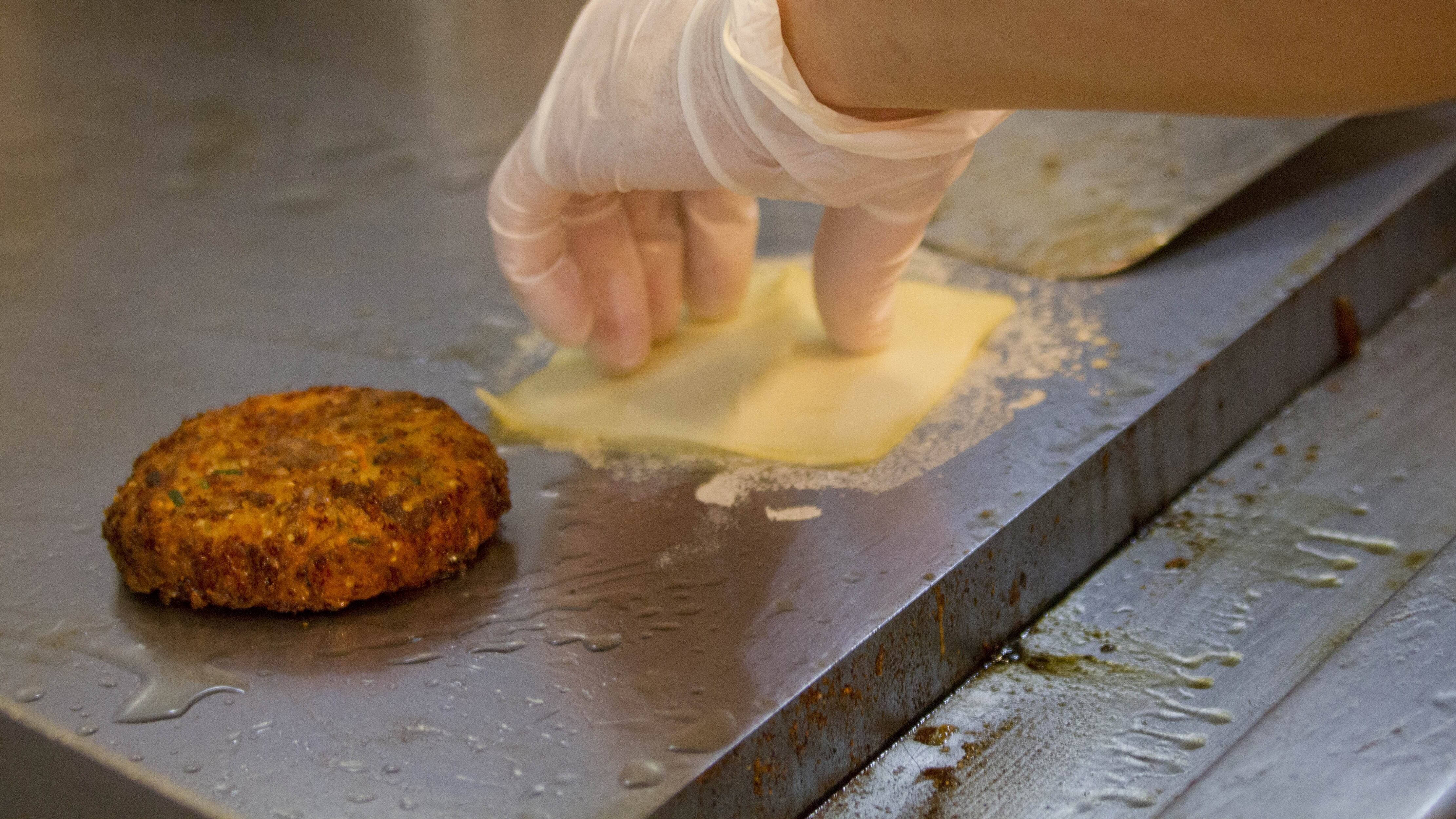
In this file photo from Tuesday, Jan. 27, 2015, a BurgerFi restaurant employee prepares to add cheese to a veggie burger as she grills an order at the Aventura, Fla., restaurant. (AP Photo/Wilfredo Lee)
Plant-based products that do not contain meat can continue to be labeled “sausages” or “burgers,” European lawmakers said Friday, when they rejected a proposal back by the meat industry to ban the terms.
In votes on issues relating to agricultural products, the European Parliament said that so-called veggie burgers, soy steaks and vegan sausages can continue to be sold as such in restaurants and shops across the union.
Europe’s largest farmers' association, Copa-Cogeca, had supported a ban, arguing that labeling vegetarian substitutes with designations bringing meat to mind was misleading for consumers.
On the opposite side of the debate, a group of 13 organizations including Greenpeace and WWF urged lawmakers to reject the proposed amendments, arguing that a ban would have not only exposed the EU “to ridicule," but also damaged its environmental credibility.
They said promoting a shift toward more plant-based diet is in line with the EU Commission's ambition to tackle global warming. Losing the ability to use the terms steak or sausage might make those plant-based products more obscure for consumers.
After the vote, the European Consumer Organization, an umbrella group bringing together consumers' associations, praised the MEPs for their “common sense."
“Consumers are in no way confused by a soy steak or chickpea-based sausage, so long as it is clearly labeled as vegetarian or vegan," the group said in a statement. “Terms such as ‘burger’ or ‘steak’ on plant-based items simply make it much easier for consumers to know how to integrate these products within a meal."
Together with Greenpeace, the group regretted that lawmakers accepted further restrictions on the naming of alternative products containing no dairy. Terms like ‘almond milk’ and ‘soy yogurt’ are already banned in Europe after the bloc's top court ruled in 2017 that purely plant-based products can't be marketed using terms such as milk, butter or cheese, which are reserved for animal products.
E-scooter company Lime is gearing up to launch an IPO after raising $523 million in debt financing. CEO Wayne Ting joined Cheddar to talk about the decision behind the future public offering citing the fundraise as a sign of investor confidence, despite a massive drop-off in ridership amid the pandemic. He noted that some of the funds will not only be used to pay down debts but to also upgrade the company's fleet of e-bikes and scooters. "We're going to be investing $20 million of this funding towards our mission to get to net-zero on carbon by 2030," he said.
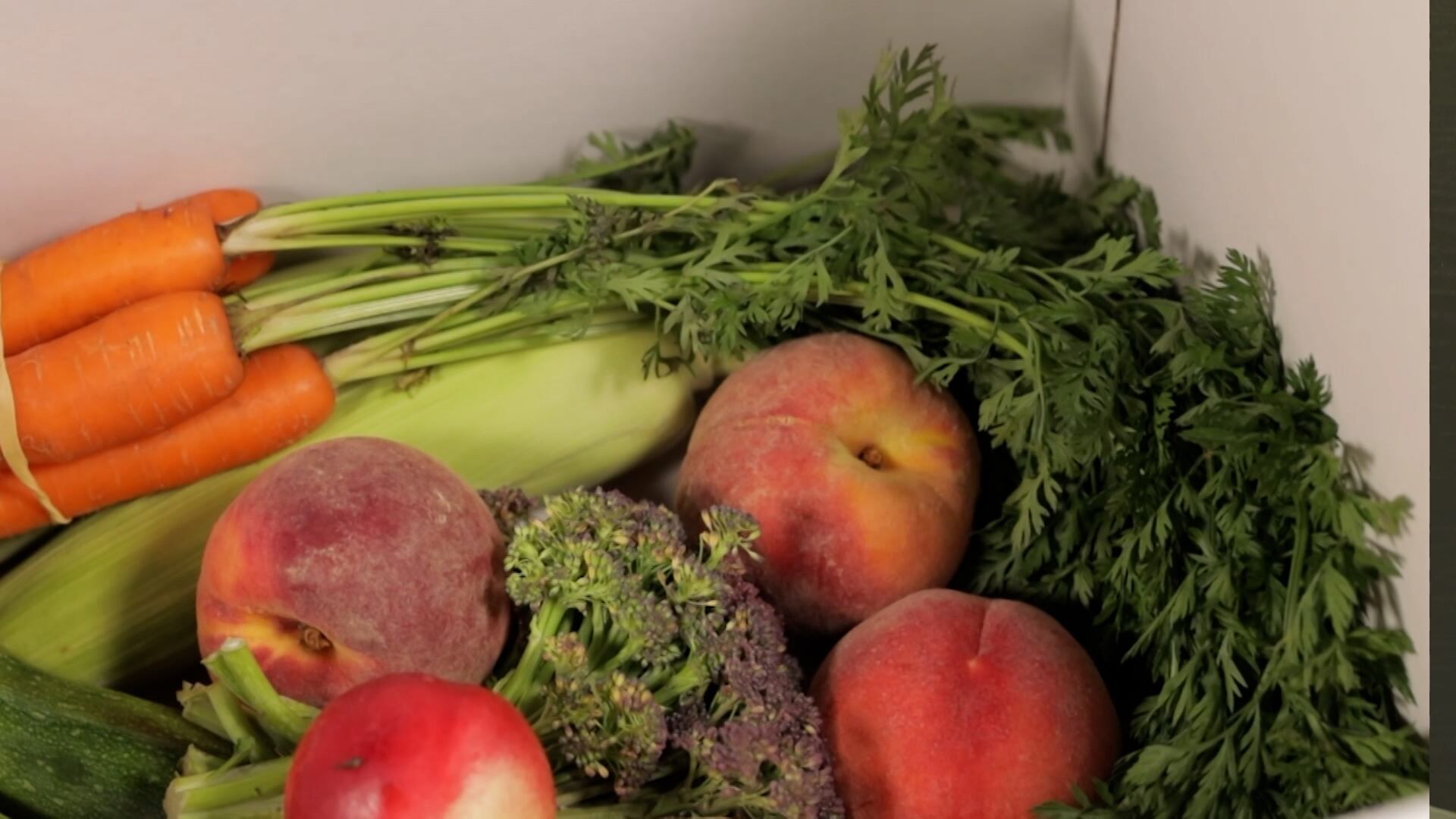
Weekly grocery delivery startup MilkRun raised $6 million in Series A funding on Friday, and Julia Niiro, CEO and founder, joined Cheddar to discuss what distinguishes MilkRun's grocery delivery model from the competition, explaining the service connects customers with local farmers being able to provide items not found in the typical stores. Niiro also talked about the impact that supply chain bottlenecks have had on the business. "This was a moment when people needed local food production," she said of MilkRun seizing the opportunity to expand to other markets amid the global food distribution issues.
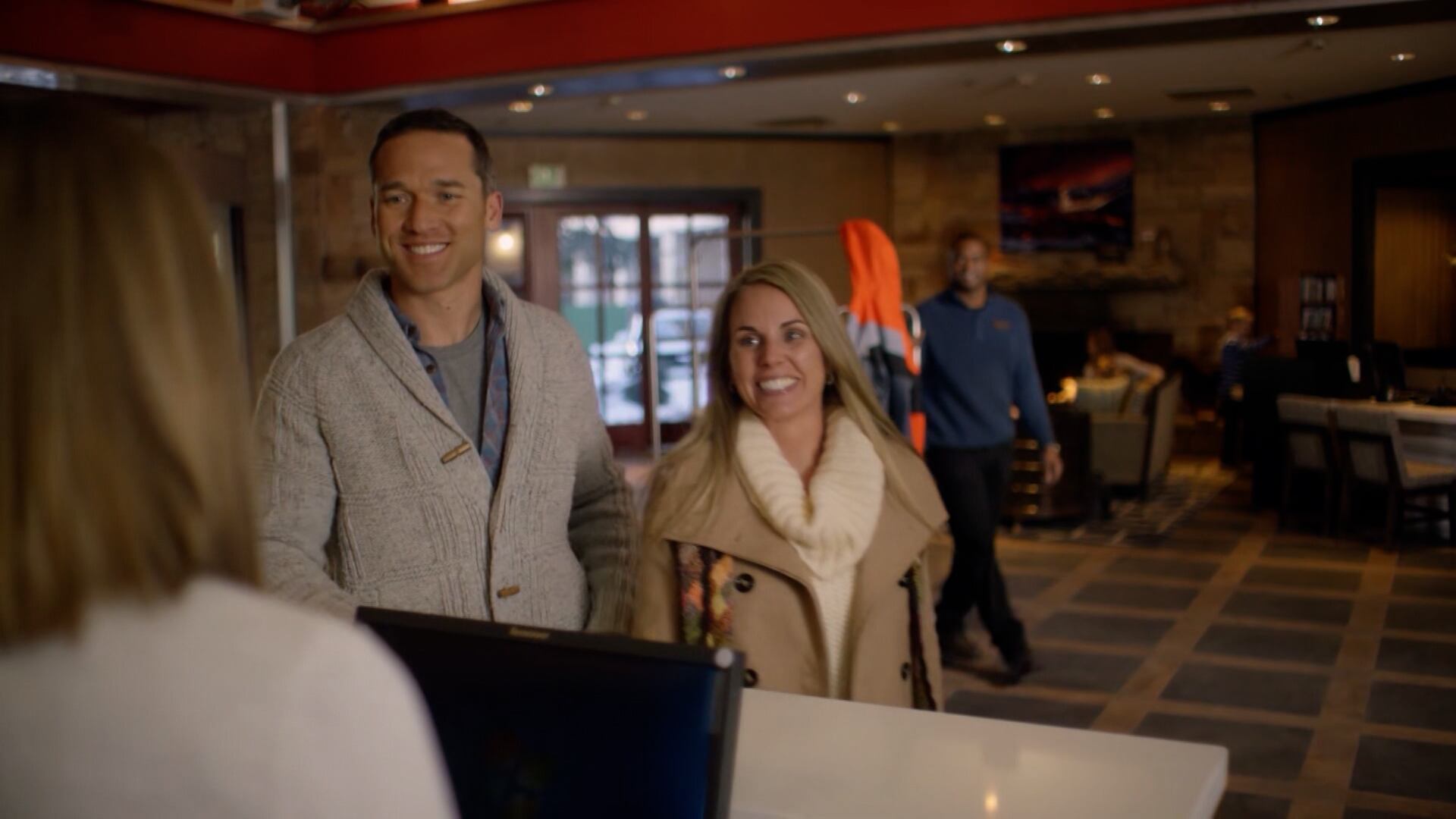
With vaccinated international travelers being admitted into the United States, the service and hospitality industry could experience a boom. John Geller, president of Marriott Vacations Worldwide, joined Cheddar to talk about the gradual increase in stays at Marriott properties and noted that occupancy has reached near pre-pandemic levels. Regarding the holiday season, he said, "people love to travel, so I wouldn't be surprised if, in most of our resorts, we're not pushing close to a high 90 percent occupancy."
The pandemic caused chaos in the wedding industry after ceremonies were postponed last year. But now couples face a new problem as they look toward their big day: supply chain issues. Tim Chi, CEO at The Knot, joined Cheddar to provide some additional details about the supply constraints affecting everything from venues to flowers. Chi also talked about The Knot celebrating its 25th anniversary and how the business has transformed over the years.
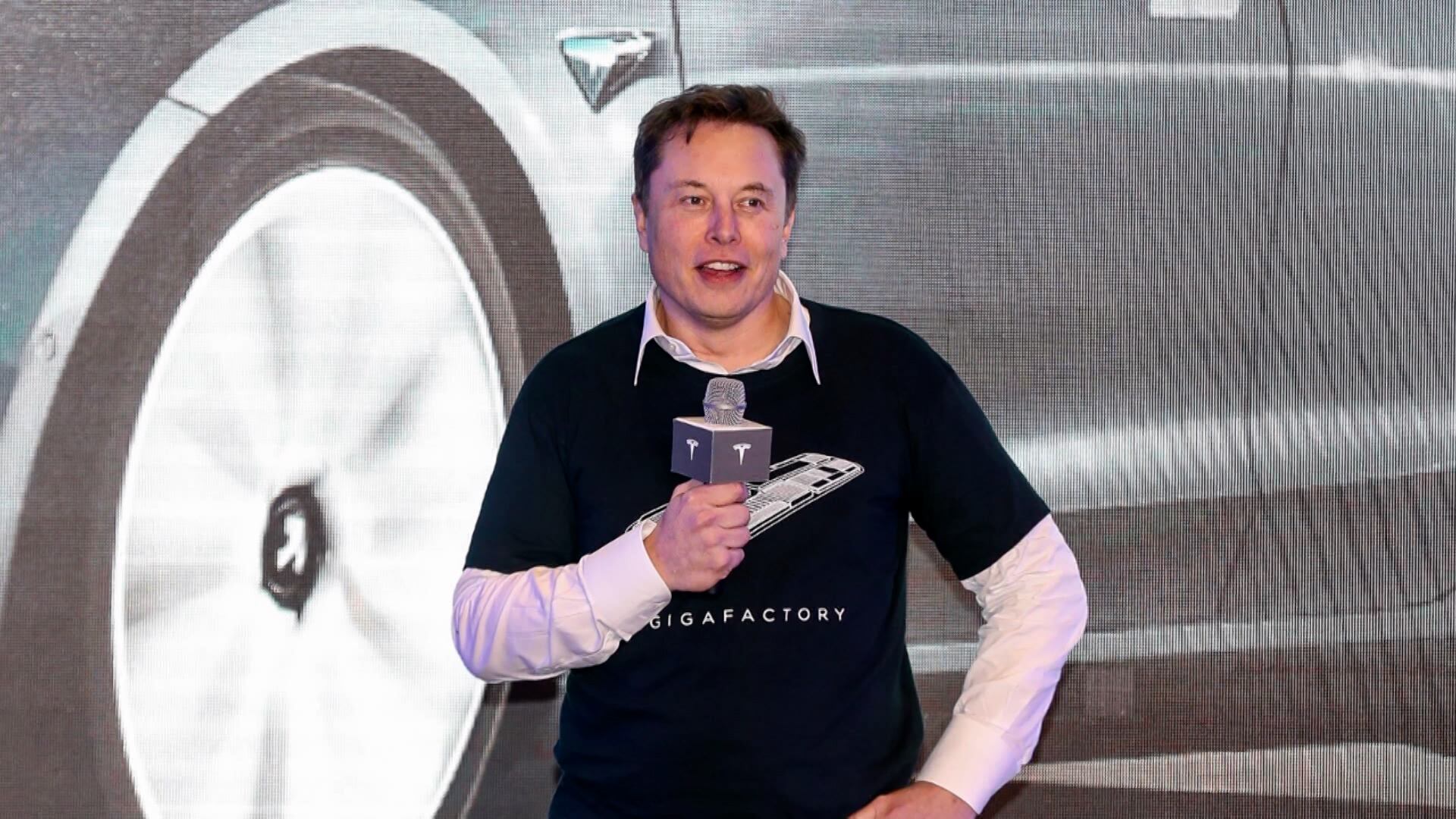
Elon Musk asked Twitter if he should sell about $20 billion worth of his Tesla stock and about 58 percent of those who answered said yes. The Tesla CEO pledged to abide by the results of the poll, whichever way it went. Arun Sundararajan, NYU Stern professor & author of "The Sharing Economy: The End of Employment and the Rise of Crowd-Based Capitalism," joined Cheddar to discuss what the Twitter poll says about America's attitude towards billionaires and the nation's tax system.
David Ewalt, Editor in Chief of Gizmodo, joins 'Fast Forward' to paint a picture of what a metaverse-driven future looks like, and how it will propel the future of work and education.
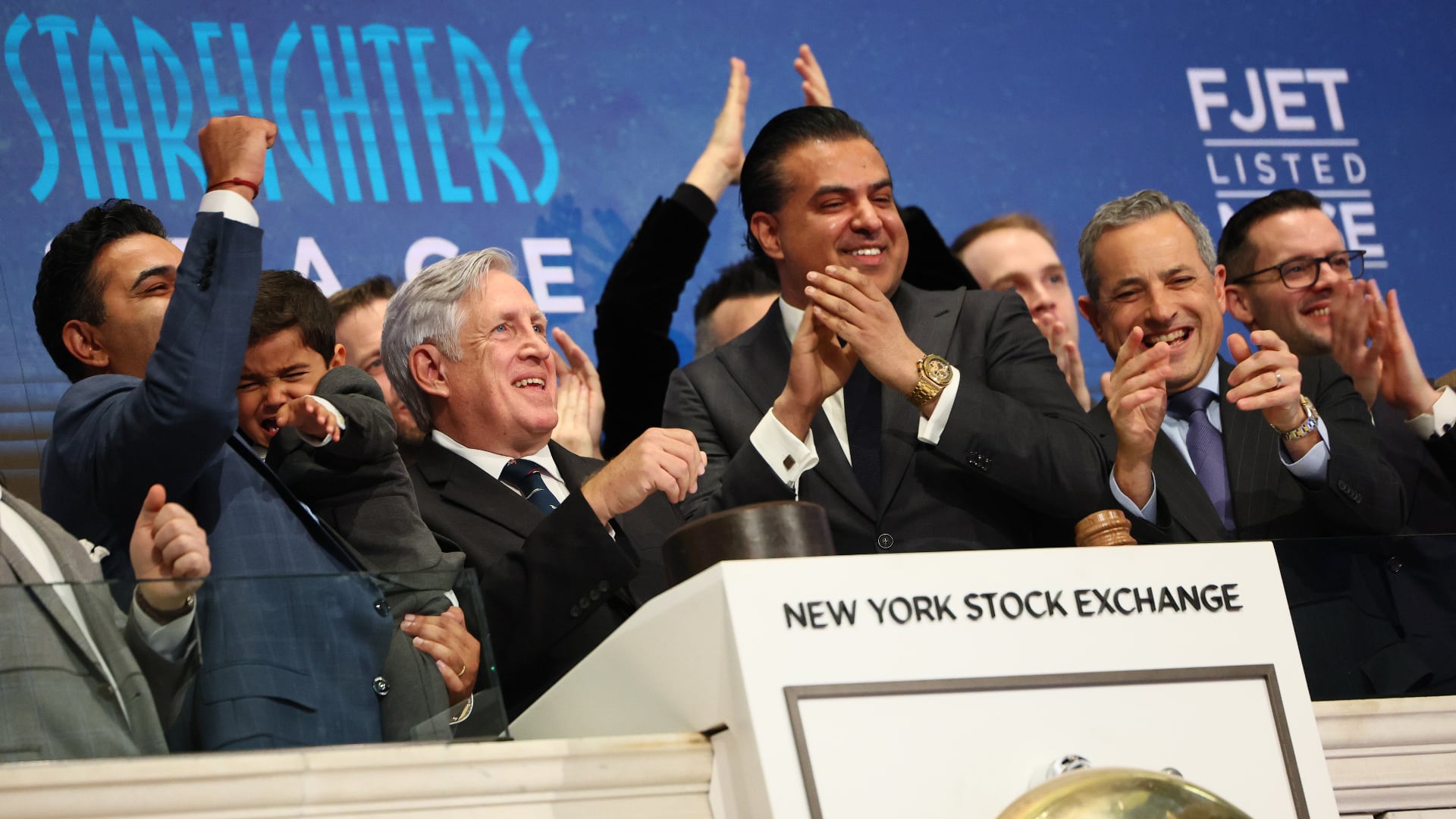
Hyperlocal social networking platform Nextdoor made its public debut on the NYSE via a SPAC merger with Khosla Ventures Acquisition Co. II on Monday. CEO Sarah Friar joined Cheddar's "Opening Bell" to talk about what drove the company to a public offering and growing the platform on a global scale. "This allows us to not go back after investing and growing the neighborhood," Friar said. She also talked about the app's pandemic success and the fact that people have stuck around as businesses reopened on a larger scale.