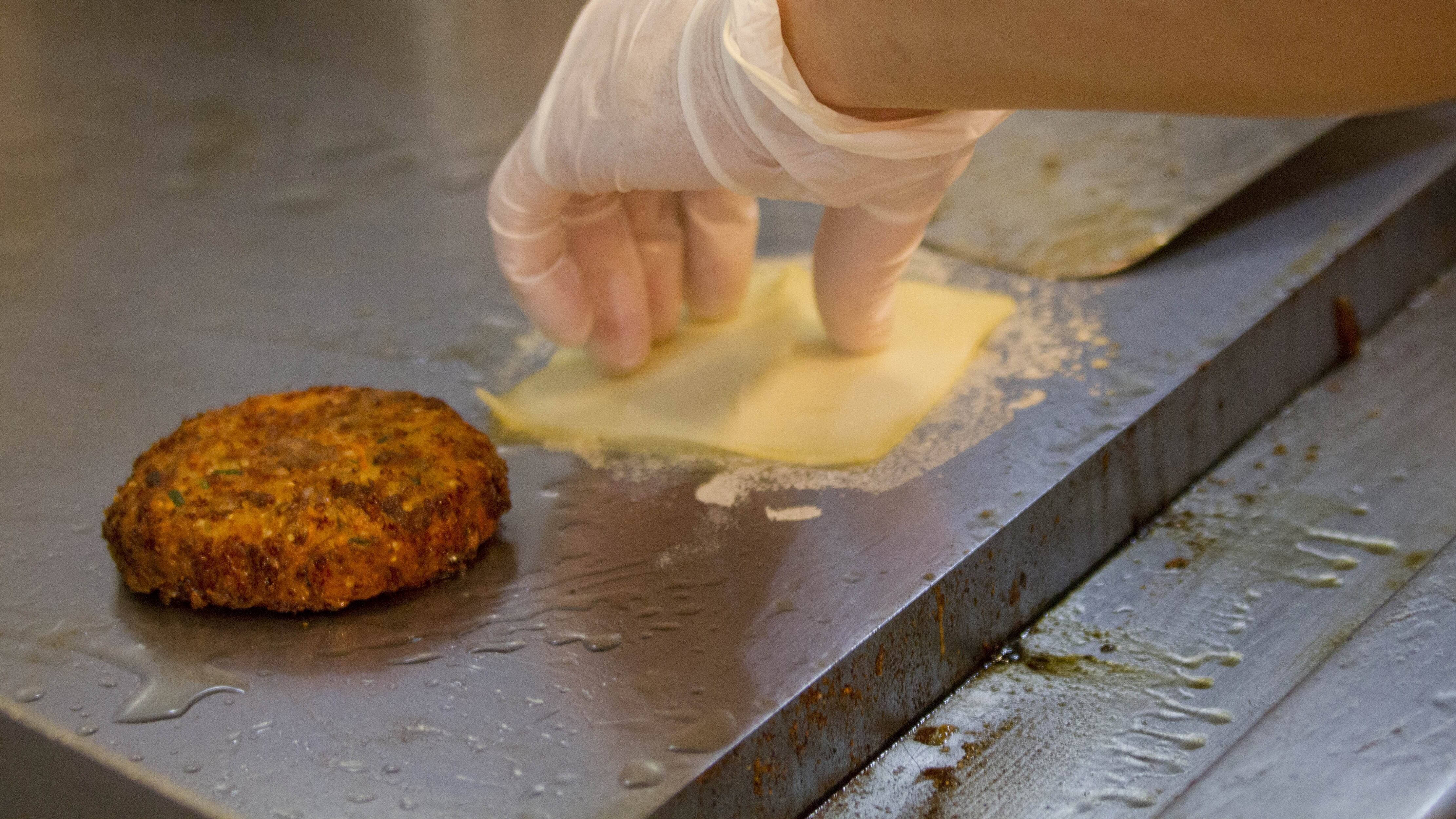
In this file photo from Tuesday, Jan. 27, 2015, a BurgerFi restaurant employee prepares to add cheese to a veggie burger as she grills an order at the Aventura, Fla., restaurant. (AP Photo/Wilfredo Lee)
Plant-based products that do not contain meat can continue to be labeled “sausages” or “burgers,” European lawmakers said Friday, when they rejected a proposal back by the meat industry to ban the terms.
In votes on issues relating to agricultural products, the European Parliament said that so-called veggie burgers, soy steaks and vegan sausages can continue to be sold as such in restaurants and shops across the union.
Europe’s largest farmers' association, Copa-Cogeca, had supported a ban, arguing that labeling vegetarian substitutes with designations bringing meat to mind was misleading for consumers.
On the opposite side of the debate, a group of 13 organizations including Greenpeace and WWF urged lawmakers to reject the proposed amendments, arguing that a ban would have not only exposed the EU “to ridicule," but also damaged its environmental credibility.
They said promoting a shift toward more plant-based diet is in line with the EU Commission's ambition to tackle global warming. Losing the ability to use the terms steak or sausage might make those plant-based products more obscure for consumers.
After the vote, the European Consumer Organization, an umbrella group bringing together consumers' associations, praised the MEPs for their “common sense."
“Consumers are in no way confused by a soy steak or chickpea-based sausage, so long as it is clearly labeled as vegetarian or vegan," the group said in a statement. “Terms such as ‘burger’ or ‘steak’ on plant-based items simply make it much easier for consumers to know how to integrate these products within a meal."
Together with Greenpeace, the group regretted that lawmakers accepted further restrictions on the naming of alternative products containing no dairy. Terms like ‘almond milk’ and ‘soy yogurt’ are already banned in Europe after the bloc's top court ruled in 2017 that purely plant-based products can't be marketed using terms such as milk, butter or cheese, which are reserved for animal products.
The popular online gaming platform for kids, Roblox, is reportedly expanding its offerings into the educational space. Ayal Shmilovich, managing partner at Gerber Kawasaki Wealth Investment Management, joined Cheddar to provide some insight into the report from the Wall Street Journal and how Roblox plans to incorporate the metaverse concept into schools. "I definitely think it helps them expand their market to a much broader audience," Shmilovich added. He also noted that Minecraft has 35 million users on its educational platform and was even more optimistic about Roblox's prospects.
Stocks closed higher as the retail sector showed continued strength - including higher retail sales data in October and strong earnings for big-box retailers Walmart and Home Depot, which lifted the Dow. Lance Ippolito, head trader at the Future Of Wealth, joins Cheddar News' Closing Bell to discuss today's close, where investors should look for growth, and how the electric vehicle space will drive markets.
Bitcoin hit a new high last week, rising above $68,000. But the coin has tumbled since, and it's not the only coin under pressure. Crypto is down today across the board. Bobby Zagotta, CEO of Bitstamp USA, joins Cheddar News' Closing Bell to discuss the possible reasons why Bitcoin has slumped, how President Joe Biden's new crypto tax clause will impact investors, and more.
The Green Bay Packers are selling shares of their stock for just the sixth time in its 102-year history. The Packers are the only major professional sports team in the U.S. that is publicly owned and not-for-profit. Now, it is offering 300,000 shares at $300 apiece; however, fans who become shareholders will not have much power, as the Packers' stock is not technically a stock. Washington Post sports reporter Des Bieler joins Cheddar News' Closing Bell to discuss.
Katie Thomas, lead at Kearney Consumer Institute, joined Cheddar to talk about Walmart's Q3 earnings beat and what it means for the larger retail industry ahead of the gift-giving season. "Getting strong numbers from Walmart and from the retail sector overall is good news going into the holiday season. It shows that even though despite some of the news around supply constraints, consumers are still getting out there and shopping," she said. With the holiday rush nearly setting in, Thomas said a clearer view of the economy will be found after Q4 results are posted, giving some time to account for how well businesses were able to maintain amid supply constraints.
Inflation has risen to its highest level in 31 years, sending consumer prices on everything from groceries to gas to rent surging. For many businesses, that's good news as inflation typically means better profit margins. According to data from FactSet, nearly two out of three of the biggest U.S. publicly traded companies have reported fatter profit margins so far this year compared to the same stretch of 2019, before the pandemic. Gregory Daco, chief U.S. economist for Oxford Economics, breaks down how the top businesses are reaping the benefits of inflation, and when consumers can expect inflation to ease.
As the U.S. opens its borders to vaccinated international travelers after months of restrictions, the hospitality industry is preparing for a comeback. Radha Arora, President and Co-Chief Development Officer, Rosewood Hotel Group joined Cheddar's Opening Bell to discuss his outlook for the broader travel industry.
Dominick Reuter, Senior Reporter at Insider, breaks down the challenges within the labor market, and how unionization and inflation are impacting the future of work.
Roblox is getting into education. The gaming platform is investing $10 million into developing educational video games for middle schools, high schools, and colleges across the country. This marks the first time Roblox is putting money into developing games for the platform, and it comes as Roblox also plans to build a stake in the metaverse. Sarah Needleman, technology reporter for The Wall Street Journal, breaks it all down for Cheddar.