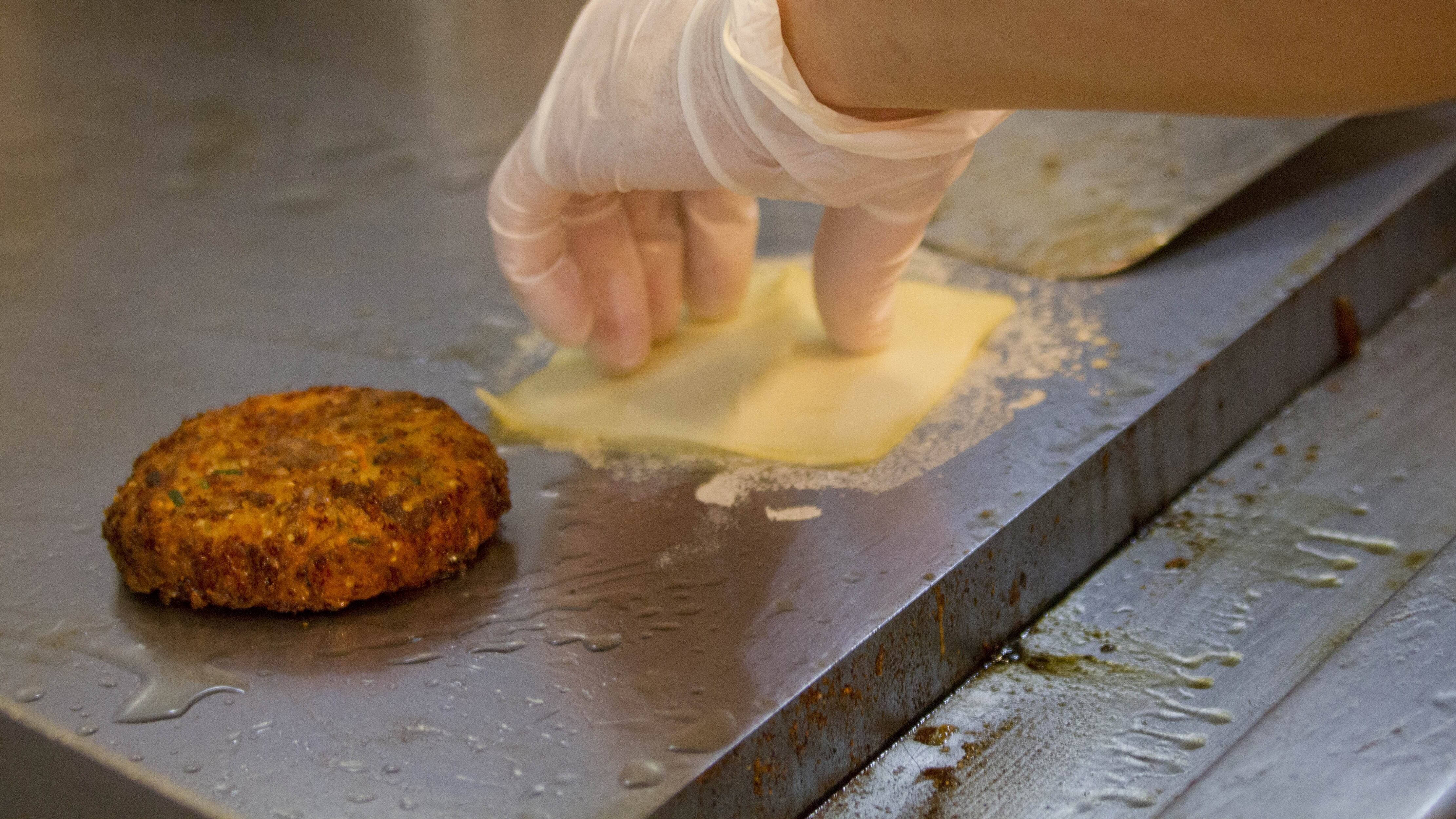
In this file photo from Tuesday, Jan. 27, 2015, a BurgerFi restaurant employee prepares to add cheese to a veggie burger as she grills an order at the Aventura, Fla., restaurant. (AP Photo/Wilfredo Lee)
Plant-based products that do not contain meat can continue to be labeled “sausages” or “burgers,” European lawmakers said Friday, when they rejected a proposal back by the meat industry to ban the terms.
In votes on issues relating to agricultural products, the European Parliament said that so-called veggie burgers, soy steaks and vegan sausages can continue to be sold as such in restaurants and shops across the union.
Europe’s largest farmers' association, Copa-Cogeca, had supported a ban, arguing that labeling vegetarian substitutes with designations bringing meat to mind was misleading for consumers.
On the opposite side of the debate, a group of 13 organizations including Greenpeace and WWF urged lawmakers to reject the proposed amendments, arguing that a ban would have not only exposed the EU “to ridicule," but also damaged its environmental credibility.
They said promoting a shift toward more plant-based diet is in line with the EU Commission's ambition to tackle global warming. Losing the ability to use the terms steak or sausage might make those plant-based products more obscure for consumers.
After the vote, the European Consumer Organization, an umbrella group bringing together consumers' associations, praised the MEPs for their “common sense."
“Consumers are in no way confused by a soy steak or chickpea-based sausage, so long as it is clearly labeled as vegetarian or vegan," the group said in a statement. “Terms such as ‘burger’ or ‘steak’ on plant-based items simply make it much easier for consumers to know how to integrate these products within a meal."
Together with Greenpeace, the group regretted that lawmakers accepted further restrictions on the naming of alternative products containing no dairy. Terms like ‘almond milk’ and ‘soy yogurt’ are already banned in Europe after the bloc's top court ruled in 2017 that purely plant-based products can't be marketed using terms such as milk, butter or cheese, which are reserved for animal products.
It's being called the next big trend in crypto. A decentralized autonomous organization, or DAO, is an internet community of different types of groups and businesses. The purpose is to allow people to commit funds to a specific cause in a safe way. Now, one social platform is creating a do-it-yourself kit for those who want to step into the space. Upstream Collective just launched the beta mode of its platform with the goal of putting all facets of running a DAO in one place. Alex Taub, co-founder and CEO of Upstream, joins Cheddar News to discuss.
Walmart and Zipline have teamed up to launch a drone delivery service in Pea Ridge, Arkansas. The service delivers products to customers within a 50-mile radius of the store. Liam O'Connor, COO of Zipline, joins Cheddar News to talk more about the partnership.
President Joe Biden announced that the U.S. will tap into its strategic oil reserve in coordination with other nations and release 50 million barrels in an effort to lower energy prices.
On this episode of Cheddar Reveals, Yair Nechmad, Nayax CEO, discusses the future of cashless payments, and how cashless payments give retailers a competitive edge and allow merchants to scale business; Jason Thomas, Global CEO of Tappit, breaks down how the pandemic accelerated the transition to cash-free live events, and why that trend is here to stay; Cheddar gets a look at Curiosity Steam's 'Blockchain Revolution.'
Not long ago, banning cash at a large public event would have been seen as a crazy idea that would deter sales. But our cash-free future is getting closer with the use of contactless payments being implemented in sports venues, music festivals, concerts, and more. Jason Thomas, Global CEO of Tappit, joins Cheddar Reveals to break down how the pandemic accelerated the transition to cash-free live events, and why that trend is here to stay.
Yair Nechmad, Nayax CEO, joins Cheddar Reveals to discuss the future of cashless payments, and how cashless payments give retailers a competitive edge and allow merchants to scale business.
Bentley aims to become end-to-end carbon neutral by 2030. The luxury car brand has outlined steps to achieve this goal, including switching its entire model range to plug-in hybrid or battery electric vehicles by 2026 and become fully electric by 2030. Christophe Georges, president & CEO of Bentley Americas, joined Cheddar to discuss this new pledge and what consumers can expect from future models.