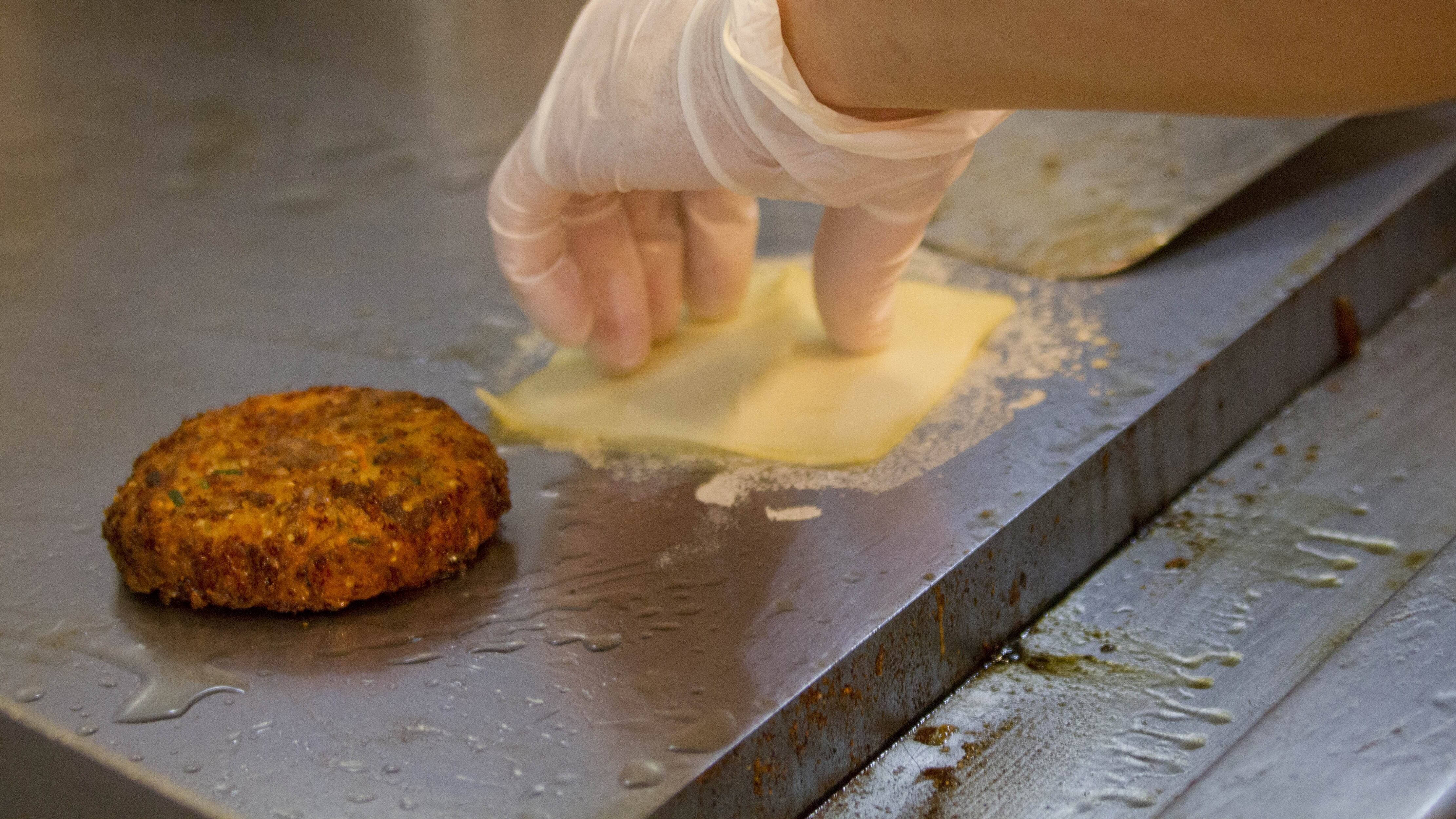
In this file photo from Tuesday, Jan. 27, 2015, a BurgerFi restaurant employee prepares to add cheese to a veggie burger as she grills an order at the Aventura, Fla., restaurant. (AP Photo/Wilfredo Lee)
Plant-based products that do not contain meat can continue to be labeled “sausages” or “burgers,” European lawmakers said Friday, when they rejected a proposal back by the meat industry to ban the terms.
In votes on issues relating to agricultural products, the European Parliament said that so-called veggie burgers, soy steaks and vegan sausages can continue to be sold as such in restaurants and shops across the union.
Europe’s largest farmers' association, Copa-Cogeca, had supported a ban, arguing that labeling vegetarian substitutes with designations bringing meat to mind was misleading for consumers.
On the opposite side of the debate, a group of 13 organizations including Greenpeace and WWF urged lawmakers to reject the proposed amendments, arguing that a ban would have not only exposed the EU “to ridicule," but also damaged its environmental credibility.
They said promoting a shift toward more plant-based diet is in line with the EU Commission's ambition to tackle global warming. Losing the ability to use the terms steak or sausage might make those plant-based products more obscure for consumers.
After the vote, the European Consumer Organization, an umbrella group bringing together consumers' associations, praised the MEPs for their “common sense."
“Consumers are in no way confused by a soy steak or chickpea-based sausage, so long as it is clearly labeled as vegetarian or vegan," the group said in a statement. “Terms such as ‘burger’ or ‘steak’ on plant-based items simply make it much easier for consumers to know how to integrate these products within a meal."
Together with Greenpeace, the group regretted that lawmakers accepted further restrictions on the naming of alternative products containing no dairy. Terms like ‘almond milk’ and ‘soy yogurt’ are already banned in Europe after the bloc's top court ruled in 2017 that purely plant-based products can't be marketed using terms such as milk, butter or cheese, which are reserved for animal products.
While people have been spending more time on their phones throughout the pandemic, a new report shows they were also spending more money as well. A review from Sensor Tower on the global app ecosystem this year found that the app economy will see record consumer spending in 2021, up nearly 20% from 2020. Sensor Tower director of sales and financial institutions Anthony Bartolacci joins Cheddar News' Closing Bell to break down the report.
Megan Horneman, Director of Portfolio Strategy at Verdence Capital Advisors, joins Cheddar News' Closing Bell, where she says there is some profit-taking ahead of the upcoming Fed meeting, and elaborates on some of the topics investors will be watching for more closely this week.
Markets closed higher Friday, with the S&P 500 notching a record close, even amid data this morning showing inflation rising at a fast pace. Jay Hatfield, CEO of Infrastructure Capital Advisors, joins Cheddar News' Closing Bell to discuss today's market close, why markets are shrugging off November's hot inflation data, how the Fed will take CPI into consideration, and more.
The future of gambling in Florida recently suffered a major setback after a federal appeals court rejected a request from the state and the Seminole Tribe to allow online sports betting in the state. Now, the tribe has been forced to stop taking bets on its Hard Rock sportsbook app. ESPN gaming writer David Purdum joins Cheddar News' Closing Bell to discuss what this could mean for the future of sports betting in Florida.
Apple is on the verge of becoming the world's first publicly-traded $3 trillion company. The iPhone maker's stock needs to hit $182.86 to surpass the $3 trillion mark. CFRA Research senior industry analyst Angelo Zino joins Cheddar News' Closing Bell to discuss.
Lance Ippolito, Head Trader at the Future Of Wealth, joins Cheddar News' Closing Bell where he discusses the factors that have contributed to the recent slide of major cryptocurrencies like Bitcoin and Ether.
Web3 software startup Thirdweb has raised $5 million in a funding round, coming from a group of high-profile investors, including Gary Vaynerchuk and Mark Cuban. Thirdweb says it is paving the way for the revolution surrounding the new iteration of the internet known as web3, by offering users free tools to build their own web3 projects. Thirdweb's co-founders Steven Bartlett and Furqan Rydhan join Cheddar News' Closing Bell to discuss.
Decentralized talent network Braintrust recently closed an atypical equity deal that involved investors buying $100 million in Braintrust tokens, the company's cryptocurrency. Braintrust's talent network is built on blockchain technology, which the company says allows it to be owned and built by users, instead of a centrally-controlled corporation. Braintrust users can also earn tokens for their contributions to the network and its growth. Braintrust co-founder Adam Jackson joins Cheddar News' Closing Bell to discuss.
Blue Origin launched its third manned mission over the weekend with 'Good Morning America' host Michael Strahan and Laura Shepard Churchley, daughter of astronaut Alan Shepard on board, alongside several Blue Origin investors.
This comes after the spaceflight firm launched two successful missions to the edge of space earlier this year. How will these missions set up Blue Origin for success as it competes with SpaceX and other companies for space tourism domination and more? Joey Roulette, space reporter at The New York Times, joins Cheddar News' Closing Bell to discuss.