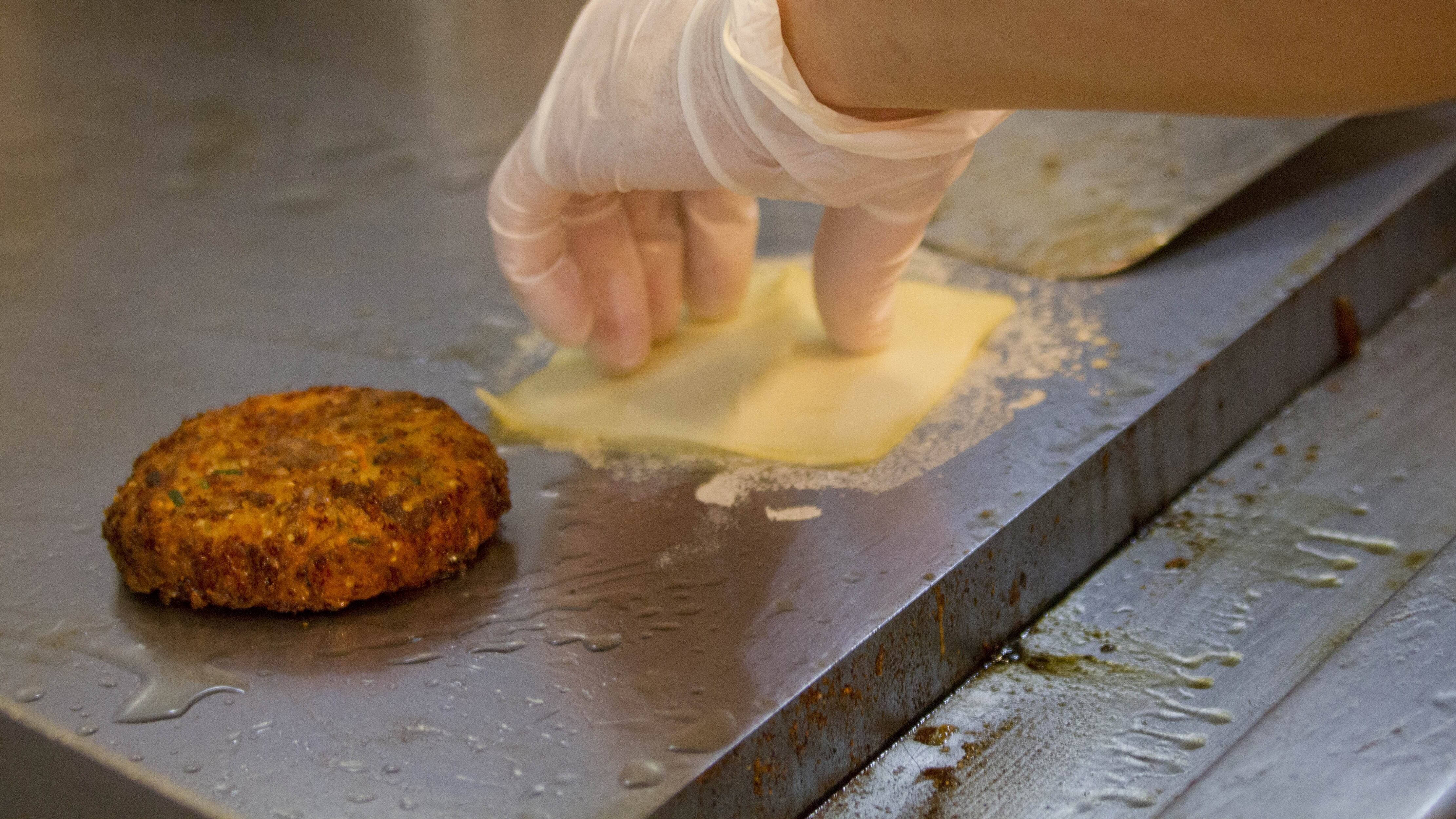
In this file photo from Tuesday, Jan. 27, 2015, a BurgerFi restaurant employee prepares to add cheese to a veggie burger as she grills an order at the Aventura, Fla., restaurant. (AP Photo/Wilfredo Lee)
Plant-based products that do not contain meat can continue to be labeled “sausages” or “burgers,” European lawmakers said Friday, when they rejected a proposal back by the meat industry to ban the terms.
In votes on issues relating to agricultural products, the European Parliament said that so-called veggie burgers, soy steaks and vegan sausages can continue to be sold as such in restaurants and shops across the union.
Europe’s largest farmers' association, Copa-Cogeca, had supported a ban, arguing that labeling vegetarian substitutes with designations bringing meat to mind was misleading for consumers.
On the opposite side of the debate, a group of 13 organizations including Greenpeace and WWF urged lawmakers to reject the proposed amendments, arguing that a ban would have not only exposed the EU “to ridicule," but also damaged its environmental credibility.
They said promoting a shift toward more plant-based diet is in line with the EU Commission's ambition to tackle global warming. Losing the ability to use the terms steak or sausage might make those plant-based products more obscure for consumers.
After the vote, the European Consumer Organization, an umbrella group bringing together consumers' associations, praised the MEPs for their “common sense."
“Consumers are in no way confused by a soy steak or chickpea-based sausage, so long as it is clearly labeled as vegetarian or vegan," the group said in a statement. “Terms such as ‘burger’ or ‘steak’ on plant-based items simply make it much easier for consumers to know how to integrate these products within a meal."
Together with Greenpeace, the group regretted that lawmakers accepted further restrictions on the naming of alternative products containing no dairy. Terms like ‘almond milk’ and ‘soy yogurt’ are already banned in Europe after the bloc's top court ruled in 2017 that purely plant-based products can't be marketed using terms such as milk, butter or cheese, which are reserved for animal products.
On this episode of ChedHER: CEO of The Lactation Network breaks down how they are expanding access to lactation support for families nationwide; CEO of Vanta explains the importance of a security team for startups; Midwest Divison Area Manager at JPMorgan Chase discusses the perks of having a business mentor.
The global oil benchmark has crossed the $100 per barrel mark for the first time since 2014. Oil prices have surged nearly 10 percent since Russia's invasion of Ukraine. Russia is the number two oil producer in the world, and it comes at a time when global oil supplies have already been constrained over the course of the past year. Rob Thummel, portfolio manager at Tortoise, joined Cheddar Movers to discuss.
Russia's economy is falling on hard times as businesses throughout the world continue to shut out the country after its invasion of Ukraine. Cheddar News was joined by Christine McDaniel, Senior Research Fellow at the Mercatus Center, to learn more about the situation.
Tech companies such as Google, Apple, and Twitter are the latest to announce back-to-office plans. Google has asked its employees to return starting on April 4th. Heidi Brooks, senior lecturer in organizational behavior at Yale University School of Management, joins Cheddar News to discuss.
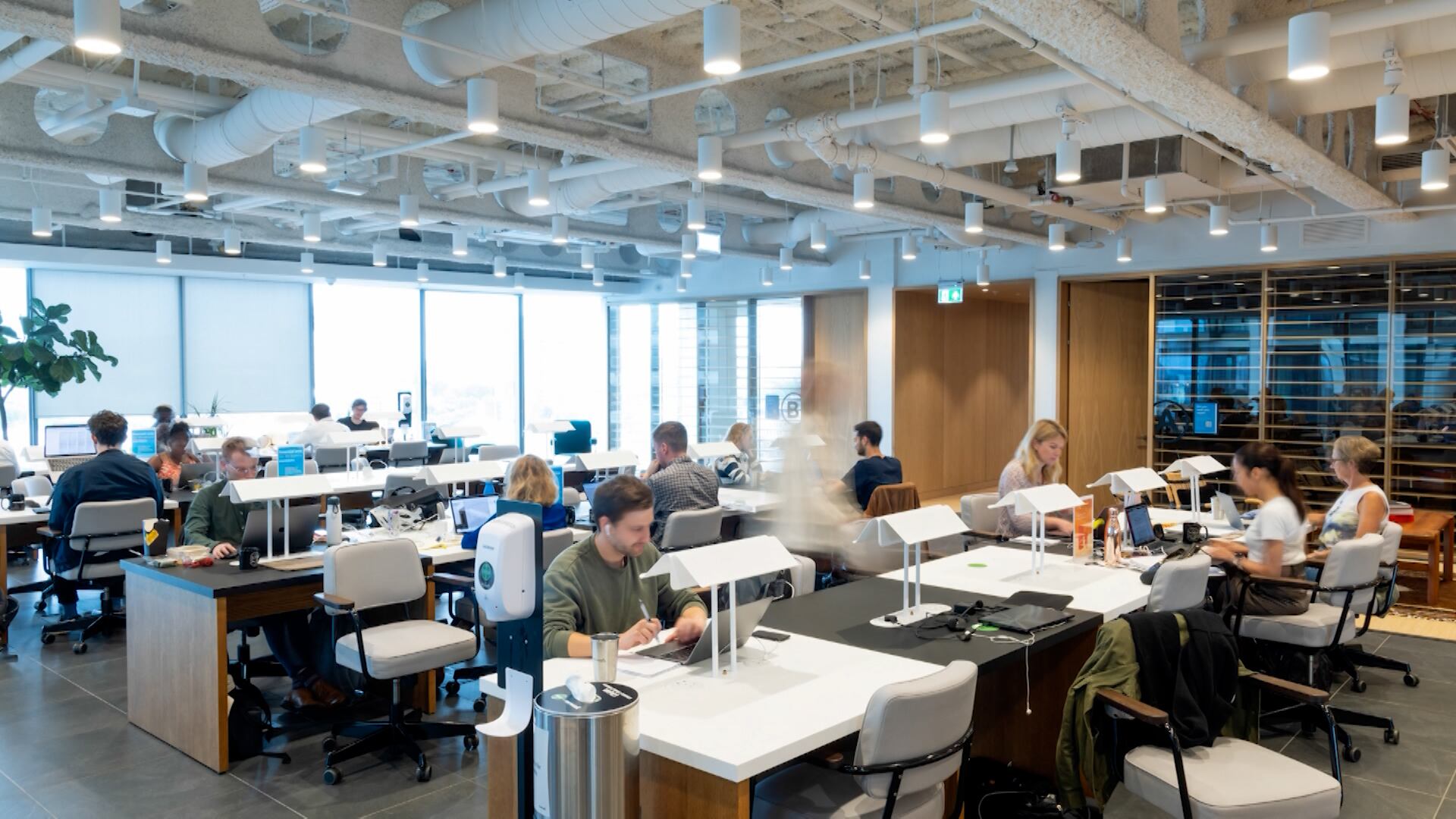
Businesses face more challenges for building a positive work environment as offices reopen. Workplace tech platform Envoy's At Work Report showed that hybrid work is currently in vogue, featuring focused work in both the office and at home. Annette Reavis, chief people officer for Envoy, joined Cheddar to discuss how employers can smooth the rough edges for their returning employees. "It is about hybrid though, it's really important for the future that we change our mindset from five days a week," she said. "Those are days of the past to working hybrids. So when you're in the office, you're focused, you're working cross-functionally."
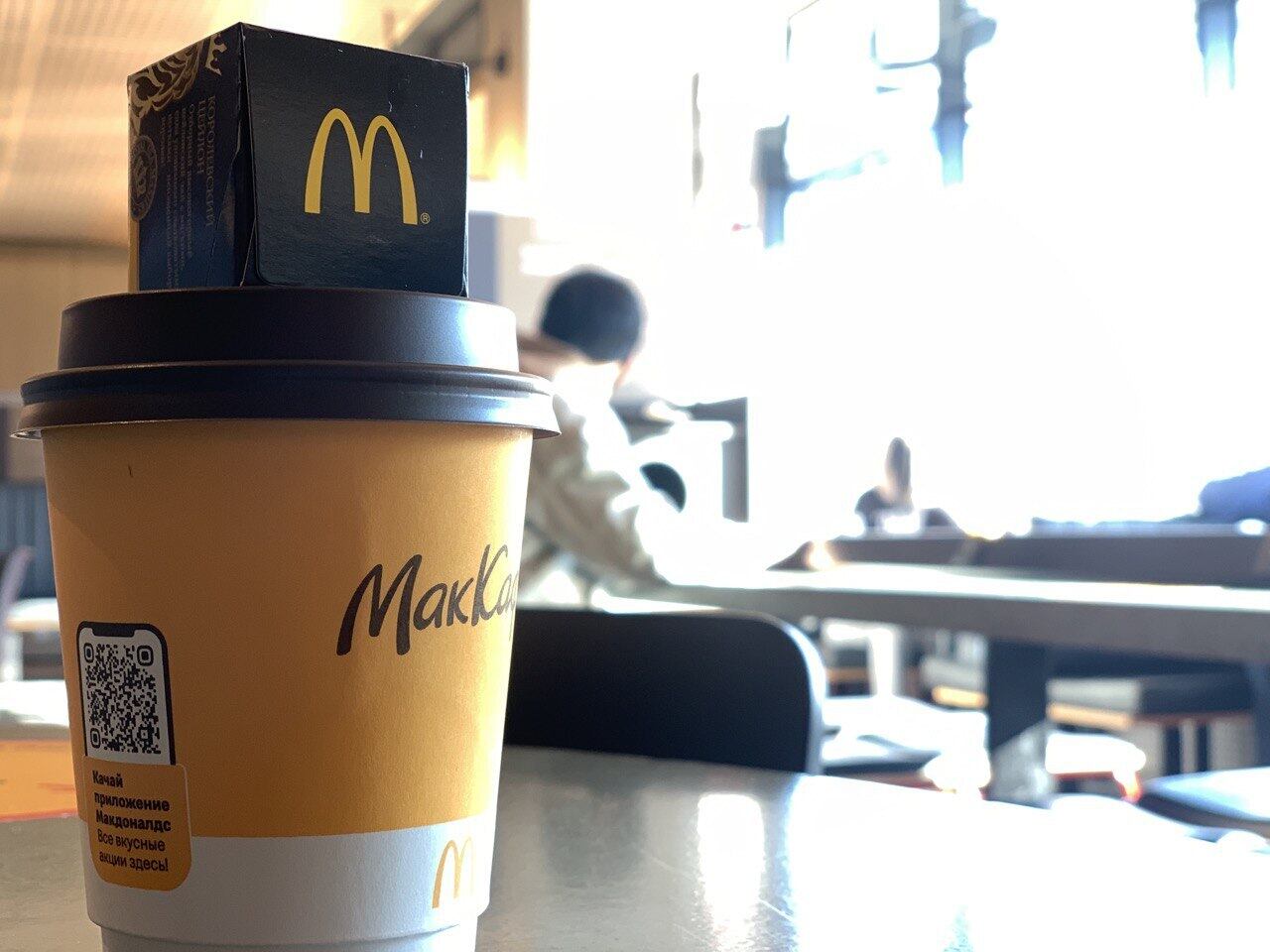
Following the invasion of Ukraine, a multitude of Western companies have paused doing business with Russia. PepsiCo, Coca-Cola, McDonald's, and Starbucks are the most recent companies to temporarily cease operations in Russia. Dean of Miami Herbert Business School at the University of Miami, John Quelch, joined Cheddar News to discuss what message this sends to Russia and the Russian consumer. “I would not underestimate the collective strength of all of these multinational companies, essentially coming together to make their collective statement in support of the political statements that have come out of Washington," he said.
Cristyl Kimbrough, real estate attorney and star of 'Ladies Who List: Atlanta,' joins Cheddar News to discuss her new show on OWN and breaking into Atlanta's luxury real estate space.