By Matthew Lee and Tara Copp and Seung Min Kim
The U.S. has already begun delivering critically needed munitions and military equipment to Israel, the White House said Monday, as the Pentagon reviews its inventories to see what else can be sent quickly to boost its ally in the three-day-old war with Hamas.
John Kirby, a spokesman for the National Security Council, confirmed Monday evening that the first batch of military aid in the wake of the violent assault by Hamas militants is “making its way” to Israel.
The delivery came as President Joe Biden prepared to give formal remarks on the attacks from the White House on Tuesday afternoon, after he confirmed that at least 11 Americans were killed in the violence over the weekend.
“We fully expect there will be additional requests for security assistance for Israel as they continue to expend munitions in this fight,” Kirby said. "We will stay in lockstep with them, making sure that we’re filling their needs as best we can and as fast as we can.”
Also on Monday, a senior Defense Department official warned that the U.S. is closely watching Hezbollah and other Iranian-backed groups, noting that the decision to shift American ships in the region was to deter any of these groups from entering or expanding the conflict against Israel. The official briefed reporters on condition of anonymity to discuss sensitive shipments.
The official said the U.S. is “flooding the zone” with calls and other messages so that extremist groups and other nations know they should not question America's commitment to supporting the defense of Israel. The official, however, would not comment on whether U.S. military forces would be used at all, and Kirby later emphasized that “there is no intention to put U.S. boots on the ground.”
Meanwhile, Kirby said U.S. officials have yet to identify a direct link from the Hamas militants who executed this weekend's deadly attacks to Iran itself, although the country has a “degree of complicity” considering its long support for the group.
While the Pentagon official said the U.S. has the ability to supply weapons to Ukraine and Israel and maintain security for America, the rapid delivery of munitions to the new war has raised concerns.
Army Secretary Christine Wormuth said Congress must pass more funding quickly for the U.S. to be able to give both Israel and Ukraine the weapons and munitions they both now need.
“The intent is to lean forward in support of Israel,” she said. "But in particular with munitions and the ability to support Israel and Ukraine simultaneously, additional funding is needed to increase our capacity to expand production and then also pay for the munitions themselves.”
At the White House, officials were more cautious, emphasizing that the U.S. government has existing funding to support Israel for the time being. But it was becoming clear that the administration is now facing potentially competing requests from Israel and Ukraine for additional weaponry.
“If we need — and it's an ‘if’, but — if we need to go back to Capitol Hill for additional funding support for Israel, we will absolutely do that," Kirby said. Referring to Israel and Ukraine, he added, “We are a large enough, big enough, economically viable and vibrant enough country to be able to support both.”
On Capitol Hill, both Republican and Democratic lawmakers expressed support for Israel, although immediate congressional action was virtually impossible with the House remaining without a speaker and the Senate out of Washington until next week. Also uncertain is whether the debate over further assistance to Ukraine, which is opposed by a group of hard-right Republicans, will complicate efforts to pass assistance for Israel.
Wormuth, speaking at the annual Association of the United States Army conference in Washington, said the administration is still “in the early stage of the process of evaluating our ability to support what the IDF needs,” referring to the Israel Defense Forces. She did not provide details, but Doug Bush, the Army's assistant secretary for acquisition, told reporters at the conference that conversations are underway about what the U.S. can provide. He said it likely will be a wide range of equipment, from small arms to sophisticated munitions.
Most of the weaponry sent already to help Ukraine has come from Army stocks and defense contractors at a rate that has challenged the global supply chain, and while the Army has recently ramped up production of some critical lines, such as 155 mm ammunition for howitzers, they are not yet at full speed.
With a new ground offensive in Gaza imminent following the Saturday surprise attack by Hamas, Army officials said Monday they were concerned about the ability to meet additional demand for ground munitions and Congress needed to act quickly to provide help in time.
In addition to the 11 American citizens whose deaths Biden confirmed, an undetermined number remain unaccounted for. It was not yet clear if the missing are dead, in hiding, or had been taken hostage.
Biden said the U.S. believes it is likely that American citizens may be among those being held hostage by Hamas, but officials are working to confirm that.
“I have directed my team to work with their Israeli counterparts on every aspect of the hostage crisis, including sharing intelligence and deploying experts from across the United States government to consult with and advise Israeli counterparts on hostage recovery efforts,” Biden said in a statement.
To underscore U.S. solidarity with Israel, the White House was lit in the blue and white colors of the Israeli flag on Monday night.
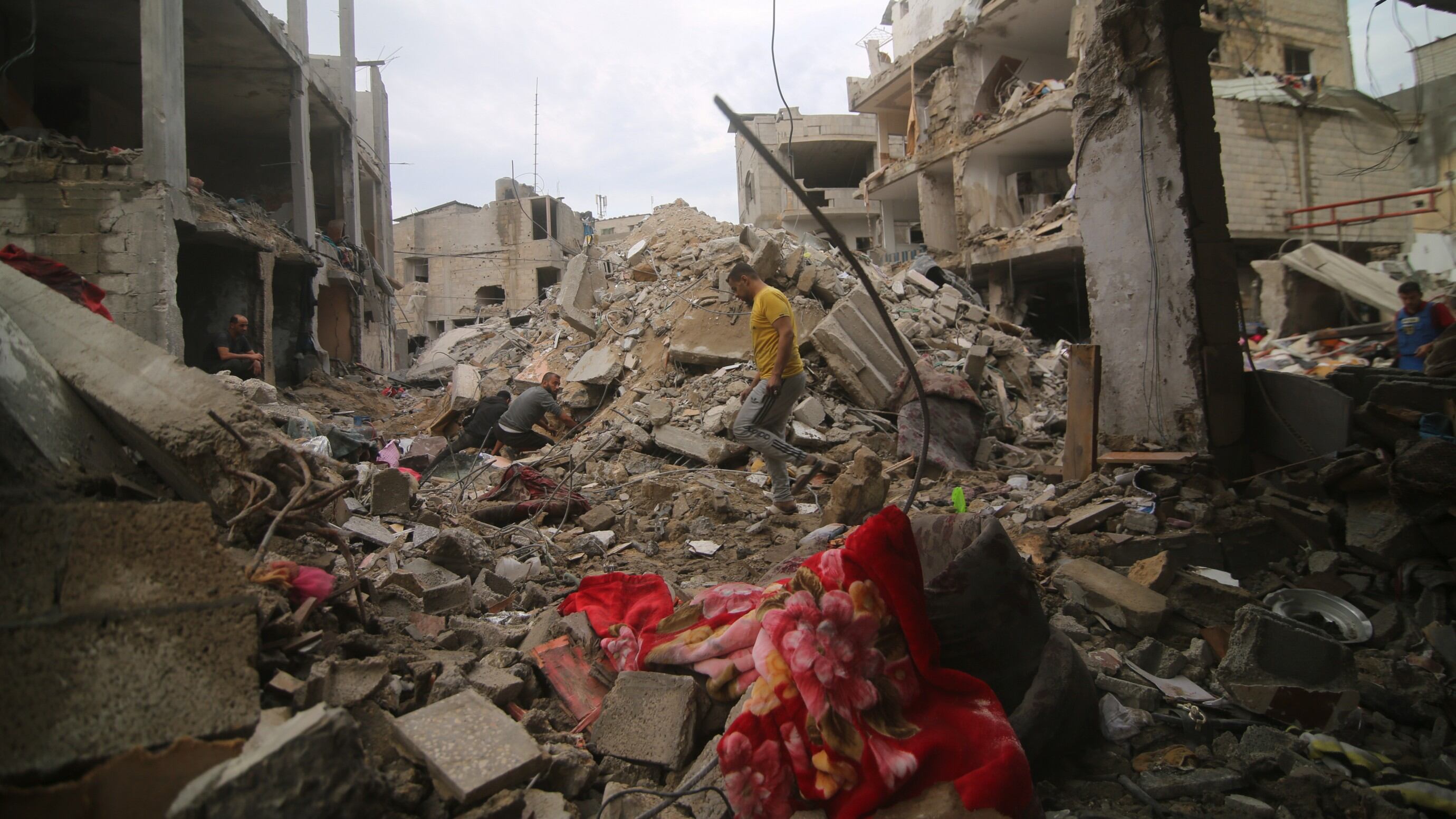
The attack by Hamas and Israel's retaliation have left more than 1,600 dead and thousands wounded on both sides.
In the aftermath of the Hamas attack, the White House has asked Senate leaders to fast track confirmation of President Joe Biden’s nominee to be the next ambassador to Israel, former Obama-era Treasury Secretary and White House chief of staff Jack Lew, according to a U.S. official who was not authorized to comment publicly and requested anonymity. The White House has received assurances that the Senate Foreign Relations Committee will push forward hearings for Lew, the official added. The U.S. has been without an ambassador since the departure of Ambassador Tom Nides in July.
Defense Secretary Lloyd Austin said Sunday he has ordered the Ford carrier strike group to sail to the Eastern Mediterranean to be ready to assist Israel. The USS Gerald R. Ford, the Navy’s newest and most advanced aircraft carrier, and its approximately 5,000 sailors and deck of warplanes will be accompanied by cruisers and destroyers in a show of force that is meant to be ready to respond to anything, from possibly interdicting additional weapons from reaching Hamas and conducting surveillance.
The senior Defense Department official said worries about Hezbollah opening a second front of violence against Israel was the main reason for moving the ships to the Eastern Mediterranean. The official said the U.S. is deeply concerned Hezbollah and other Iranian-backed groups will make the wrong decision to try to “pile on” and widen the war.
The Norfolk, Virginia-based carrier strike group already was in the Mediterranean. Last week it was conducting naval exercises with Italy in the Ionian Sea. The carrier is in its first full deployment.
Associated Press writer Aamer Madhani contributed to this report.
Updated at 9:55 a.m. Oct. 10 to correct typo in headline.