By Jon Gambrell
The U.S. Navy announced Sunday it seized an arms shipment of thousands of assault weapons, machines guns and sniper rifles hidden aboard a ship in the Arabian Sea, apparently bound for Yemen to support the country's Houthi rebels.
An American defense official told The Associated Press that the Navy's initial investigation found the vessel came from Iran, again tying the Islamic Republic to arming the Houthis despite a United Nations arms embargo. Iran's mission to the U.N. did not immediately respond to a request for comment, though Tehran has denied in the past giving the rebels weapons.
The seizure, one of several amid the yearslong war in Yemen, comes as the U.S. and others try to end a conflict that spawned one of the world's worst humanitarian disasters. The arms shipment, described as sizeable, shows that the war may still have far to run.
The guided-missile cruiser USS Monterey discovered the weapons aboard what the Navy described as a stateless dhow, a traditional Mideast sailing ship, in an operation that began Thursday in the northern reaches of the Arabian Sea off Oman and Pakistan. Sailors boarded the vessel and found the weapons, most wrapped in green plastic, below deck.
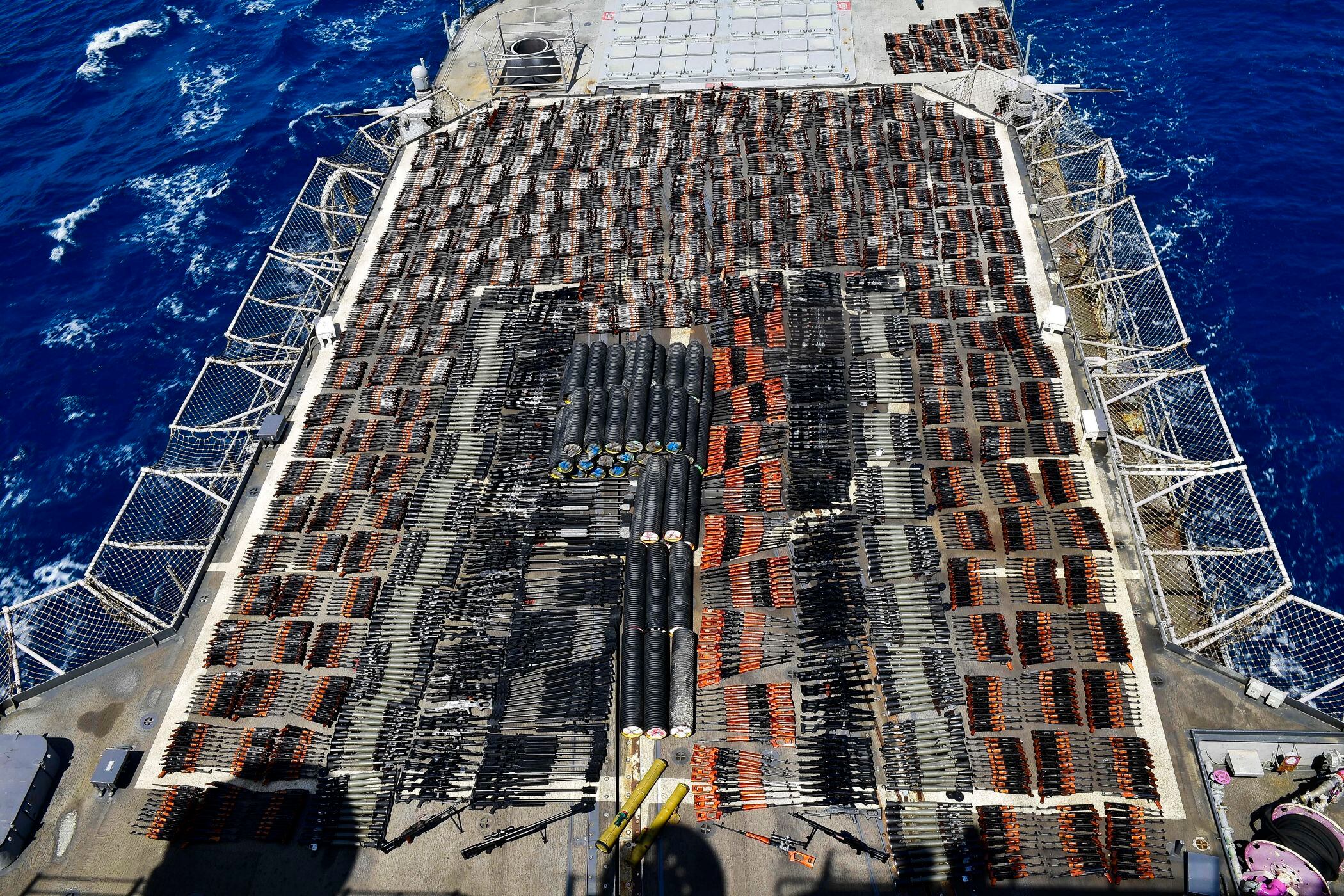
When laid out on the deck of the Monterey, the scale of the find came into focus. Sailors found nearly 3,000 Chinese Type 56 assault rifles, a variant of the Kalashnikov. They recovered hundreds of other heavy machine guns and sniper rifles, as well as dozens of advanced, Russian-made anti-tank guided missiles. The shipments also included several hundred rocket-propelled grenade launchers and optical sights for weapons.
The Navy's Mideast-based 5th Fleet did not identify where the weapons originated, nor where they were going. However, an American defense official said the weapons resembled those of other shipments interdicted bounded for the Houthis.
Based on interviews with the crew and material investigated on board, the sailors determined the vessel came from Iran, said the official, who spoke on condition of anonymity to discuss the ongoing investigation.
“After all illicit cargo was removed, the dhow was assessed for seaworthiness, and after questioning, its crew was provided food and water before being released,” the 5th Fleet said in a statement.
The seizure marks just the latest in the Arabian Sea or Gulf of Aden involving weapons likely bound to Yemen. The seizures began in 2016 and have continued intermittently throughout the war, which has seen the Houthis fire ballistic missiles and use drones later linked to Iran. Yemen is awash with small arms that have been smuggled into poorly controlled ports over years of conflict.
This recent seizure appeared to be among the biggest. Tim Michetti, an investigative researcher who studies the illicit weapon trade, also said the shipment bore similarities to the others.
“The unique blend of materiel recovered by the USS Monterey appears to be consistent with the materiel from previous interdictions, which have been linked to Iran,” he said.
Yemen’s war began in September 2014, when the Houthis seized Sanaa and began a march south to try to seize the entire country. Saudi Arabia, along with the United Arab Emirates and other countries, entered the war alongside Yemen’s internationally recognized government in March 2015. Iran backed the Houthis, who harass Saudi Arabia with missile fire and drone attacks.
The war has killed some 130,000 people, including over 13,000 civilians slain in targeted attacks, according to the Armed Conflict Location & Event Project.
The war has seen atrocities from all sides. Saudi airstrikes using American-made bombs killed school children and civilians. The UAE paid off local al-Qaida fighters to avoid fighting and controlled prisons where torture and sexual abuse was rampant. The Houthis employ child soldiers and indiscriminately lay landmines.
Since 2015, the U.N. Security Council has imposed an arms embargo on the Houthis. Despite that, U.N. experts warn “an increasing body of evidence suggests that individuals or entities in the Islamic Republic of Iran supply significant volumes of weapons and components to the Houthis.”
___
Follow Jon Gambrell on Twitter at www.twitter.com/jongambrellAP.