By Jon Gambrell

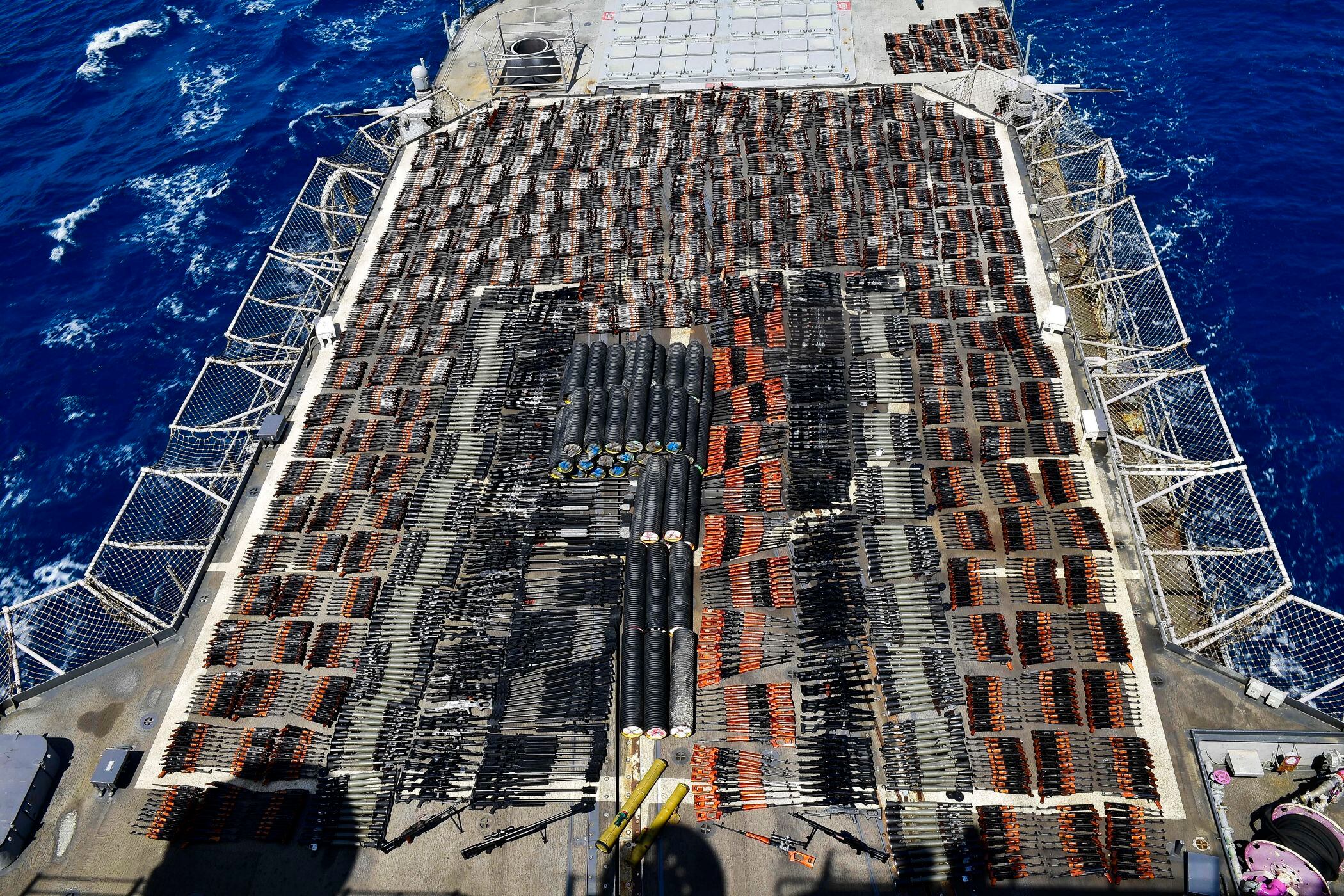
The U.S. Navy announced Sunday it seized an arms shipment of thousands of assault weapons, machines guns and sniper rifles hidden aboard a ship in the Arabian Sea, apparently bound for Yemen to support the country's Houthi rebels.

An American defense official told The Associated Press that the Navy's initial investigation found the vessel came from Iran, again tying the Islamic Republic to arming the Houthis despite a United Nations arms embargo. Iran's mission to the U.N. did not immediately respond to a request for comment, though Tehran has denied in the past giving the rebels weapons.

The seizure, one of several amid the yearslong war in Yemen, comes as the U.S. and others try to end a conflict that spawned one of the world's worst humanitarian disasters. The arms shipment, described as sizeable, shows that the war may still have far to run.

The guided-missile cruiser USS Monterey discovered the weapons aboard what the Navy described as a stateless dhow, a traditional Mideast sailing ship, in an operation that began Thursday in the northern reaches of the Arabian Sea off Oman and Pakistan. Sailors boarded the vessel and found the weapons, most wrapped in green plastic, below deck.

When laid out on the deck of the Monterey, the scale of the find came into focus. Sailors found nearly 3,000 Chinese Type 56 assault rifles, a variant of the Kalashnikov. They recovered hundreds of other heavy machine guns and sniper rifles, as well as dozens of advanced, Russian-made anti-tank guided missiles. The shipments also included several hundred rocket-propelled grenade launchers and optical sights for weapons.

The Navy's Mideast-based 5th Fleet did not identify where the weapons originated, nor where they were going. However, an American defense official said the weapons resembled those of other shipments interdicted bounded for the Houthis.

Based on interviews with the crew and material investigated on board, the sailors determined the vessel came from Iran, said the official, who spoke on condition of anonymity to discuss the ongoing investigation.

“After all illicit cargo was removed, the dhow was assessed for seaworthiness, and after questioning, its crew was provided food and water before being released,” the 5th Fleet said in a statement.

The seizure marks just the latest in the Arabian Sea or Gulf of Aden involving weapons likely bound to Yemen. The seizures began in 2016 and have continued intermittently throughout the war, which has seen the Houthis fire ballistic missiles and use drones later linked to Iran. Yemen is awash with small arms that have been smuggled into poorly controlled ports over years of conflict.

This recent seizure appeared to be among the biggest. Tim Michetti, an investigative researcher who studies the illicit weapon trade, also said the shipment bore similarities to the others.

“The unique blend of materiel recovered by the USS Monterey appears to be consistent with the materiel from previous interdictions, which have been linked to Iran,” he said.

Yemen’s war began in September 2014, when the Houthis seized Sanaa and began a march south to try to seize the entire country. Saudi Arabia, along with the United Arab Emirates and other countries, entered the war alongside Yemen’s internationally recognized government in March 2015. Iran backed the Houthis, who harass Saudi Arabia with missile fire and drone attacks.

The war has killed some 130,000 people, including over 13,000 civilians slain in targeted attacks, according to the Armed Conflict Location & Event Project.

The war has seen atrocities from all sides. Saudi airstrikes using American-made bombs killed school children and civiliansThe UAE paid off local al-Qaida fighters to avoid fighting and controlled prisons where torture and sexual abuse was rampantThe Houthis employ child soldiers and indiscriminately lay landmines.

Since 2015, the U.N. Security Council has imposed an arms embargo on the Houthis. Despite that, U.N. experts warn “an increasing body of evidence suggests that individuals or entities in the Islamic Republic of Iran supply significant volumes of weapons and components to the Houthis.”

___

Follow Jon Gambrell on Twitter at www.twitter.com/jongambrellAP.

Share:
More In Politics
Snap, Youtube, TikTok to Face Questioning from Lawmakers
Later today House Republicans will grill Snap, Tiktok and Youtube on how their products affect the mental health of teenagers. It comes after a report revealed that Facebook's photo sharing platform, Instagram, can be harmful to teen's mental health. Rishi Bharwani, Director of Partnerships and Policy, Accountable Tech joined Cheddar's Opening Bell to discuss.
Paid Family Leave Program in Flux
As the White House and Congressional leaders work towards finalizing the legislative framework of the Build Back Better budget deal, paid family leave, one of the hallmarks of President Joe Biden's Social Safety Net agenda, still stands in flux. Molly Day, Executive Director, Paid Leave for the U.S. joined Cheddar's Opening Bell to discuss why the finalization of this bill is imperative.
New York City Workers Protest Vaccine Mandate
Marjorie Mesidor, Esq., Partner, Phillips and Associates, PLLC and Dr. Anthony Santela, professor of health administration and university covid coordinator at the University of New Haven join J.D. Durkin and None Of The Above to talk about the expected fallout from New York City's vaccine mandate.
COP26 Summit In Glasglow Officially Underway
Leaders around the world have come together to discuss plans to bring action towards the Paris Agreement along with solutions on how to solve the evolving climate change crisis at the COP26 Summit. President and CEO of Center for International Environmental Law Carroll Muffett, joined Cheddar to discuss more.
What's Next for World Leaders After COP26 Commitments to Abate Climate Change
Rachel Cleetus, the policy director and lead economist of the climate and energy program for the Union of Concerned Scientists, joined Cheddar to break down some of the key goals from the COP26 summit and why leaders must focus on the science of climate change instead of getting bogged down by petty politics and the fossil fuel industry. "The main thing they have to do, make sure we're cutting our emissions sharply within this decade because the science shows that we have to cut global emissions in half by 2030 if we're going to meet our goals of averting some of the most catastrophic impacts of climate change," she said.
Election Day, Climate Pledges & Cautionary TV Tale
Carlo and Baker cover the big races to watch on this off-cycle Election Day, the concrete pledges starting to come out of COP26, Jeffrey Epstein keeps causing CEOs to lose their jobs, and Ryan Murphy's TV hit that wasn't.
November Begins with Record Closes, Clorox Reports Earnings
The Dow, S&P, and Nasdaq begin November by not only ending Monday's session higher but with a record close as well. Melissa Armo, Founder and Owner of The Stock Swoosh, has her eye on major economic storylines and joins Cheddar News' Closing Bell to discuss what role the news could play on Wall Street.
Climate-Focused Investing in Focus at COP26
The UN climate change conference kicked off on Sunday with about 120 world leaders and delegates gathering in Glasgow, Scotland this week, as experts continue to warn about the harms of heightened emissions and the effects on climate change. The topic of ESG investing is expected to be a top priority at the summit. Jefferies global head of ESG and sustainability research Aniket Shah joined Cheddar News' Closing Bell to discuss.
Schools Reconsider Gifted and Talented Programs Amid Race, Class Disparities
Gifted and talented education programs in schools throughout the United States are falling under greater scrutiny as the race and class divide in the programs remain wide. Marcia Gentry, a professor of educational studies and the director of the Gifted Education Research and Resource Institute at Purdue University, joined Cheddar to weigh in on if advanced tracking for students can also be equitable for lower income students and students of color.
Supreme Court Weighs in on Texas Abortion Law
The Supreme Court is now weighing in on one of the nation's most restrictive abortion laws. The Texas law, which was enacted on September 1, bans abortions after six weeks of pregnancy. In addition, it allows any private citizen to sue anyone who helps a woman get an abortion. Jimmy Hoover, Supreme Court Editor-At-Large at Law360, joined Cheddar News to discuss more.
Load More