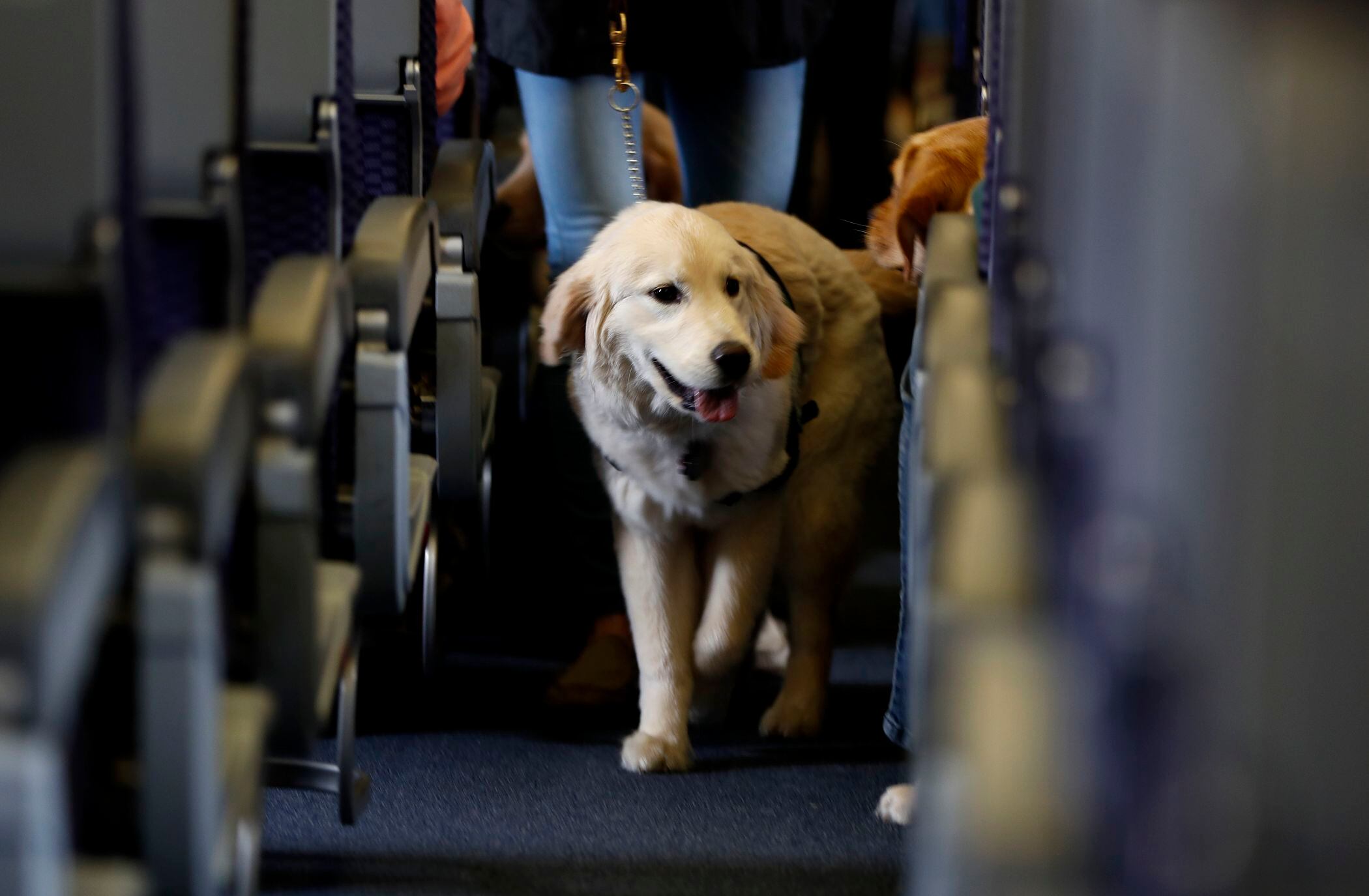
A service dog strolls through the isle inside a United Airlines plane at Newark Liberty International Airport while taking part of a training exercise, Saturday, April 1, 2017, in Newark, N.J. (AP Photo/Julio Cortez)
The government has decided that when it comes to air travel, only dogs can be service animals, and companions used for emotional support don't count.
The Transportation Department issued a final rule Wednesday that aims to settle years of tension between airlines and passengers who bring their pets on board for free by saying they need them for emotional support.
Under the final rule, which takes effect in 30 days, a service animal is a dog trained to help a person with a disability.
For years, the department required airlines to allow animals with passengers who had a doctor's note saying they needed the animal for emotional support. Airlines believed passengers abused the rule to bring a menagerie of animals on board including cats, turtles, pigs, and in one case, a peacock.
The new rule will likely force those passengers to check their animals into the cargo hold — for a fee — or leave them at home.
The rule requires airlines to treat dogs trained to help people with psychiatric issues the same as other service animals. Advocates for veterans and others had pushed for that.
Airlines will be able to require owners to vouch for the dog's health, behavior, and training. Airlines can require people with a service dog to turn in paperwork up to 48 hours before a flight, but they can't bar those travelers from checking in online like other passengers.
Airlines can require service dogs to be leashed at all times, and they can bar dogs that show aggressive behavior. There have been incidents of emotional-support animals biting passengers.
Lila Snyder, CEO of Bose, joins Cheddar News anchor Hena Doba to discuss her journey to the top of the corporate world, the business of selling top of the line speakers, and how new technologies such as machine learning are shaking up the industry.
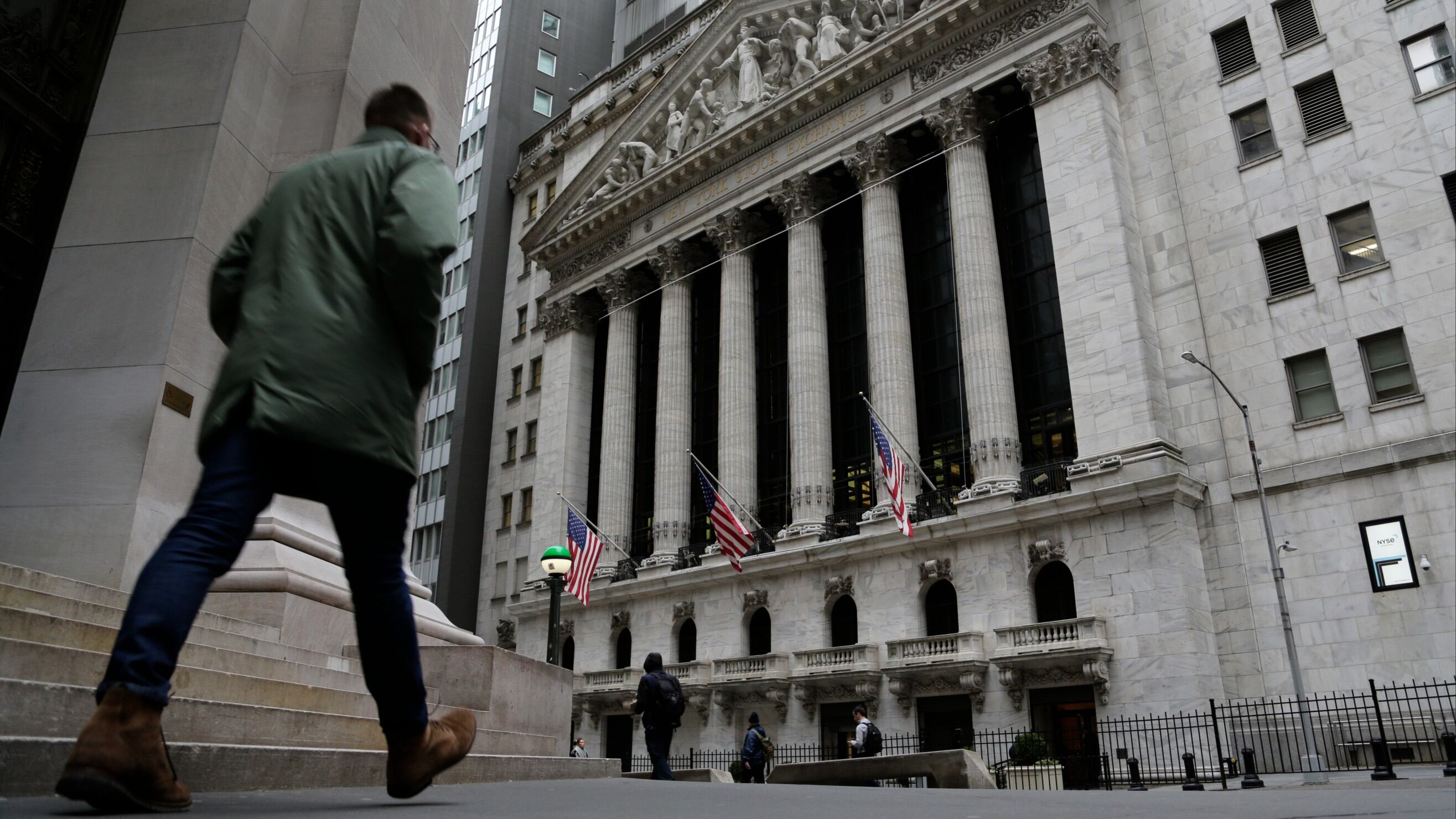
Stocks drifted ahead of reports that could offer clues on questions that have kept Wall Street at a standstill, including on where the economy and corporate profits are heading.
Aidan McClean, co-founder and CEO of UFODRIVE, joined Cheddar News to discuss how his company plans to shake up the car rental market with a digital experience. "There are no lines, there are no paperwork, there is no key collection ... no pushy insurance or pushy fuel options," he said. "You simply arrive for your electric car, use your smartphone and drive away."
Nearly half of Americans report having to side hustle to make ends meet, according to a survey from LendingTree. Jane Oates, president of WorkingNation, joined Cheddar News to discuss the state of play as families are having a difficult time with inflation and high-interest rates.
Melissa Armo, founder and owner of The Stock Swoosh, joined Cheddar News to discuss this week's markets which were little changed in trading as investors digested the latest corporate earnings results as concerns over a coming recession grow.
Peter Krull, a partner and director of sustainable investing at Prime Capital Investment Advisors company Earth Equity Advisors, joined Cheddar News to give some tips on green investments.
Investment in space was down 53% over the first three months of the year, according to a report from investment fund Space Capital. Chad Anderson, founder and managing partners of Space Capital, joined Cheddar News to discuss the funding downturn that's hit the lowest level in 14 quarters for the space industry.