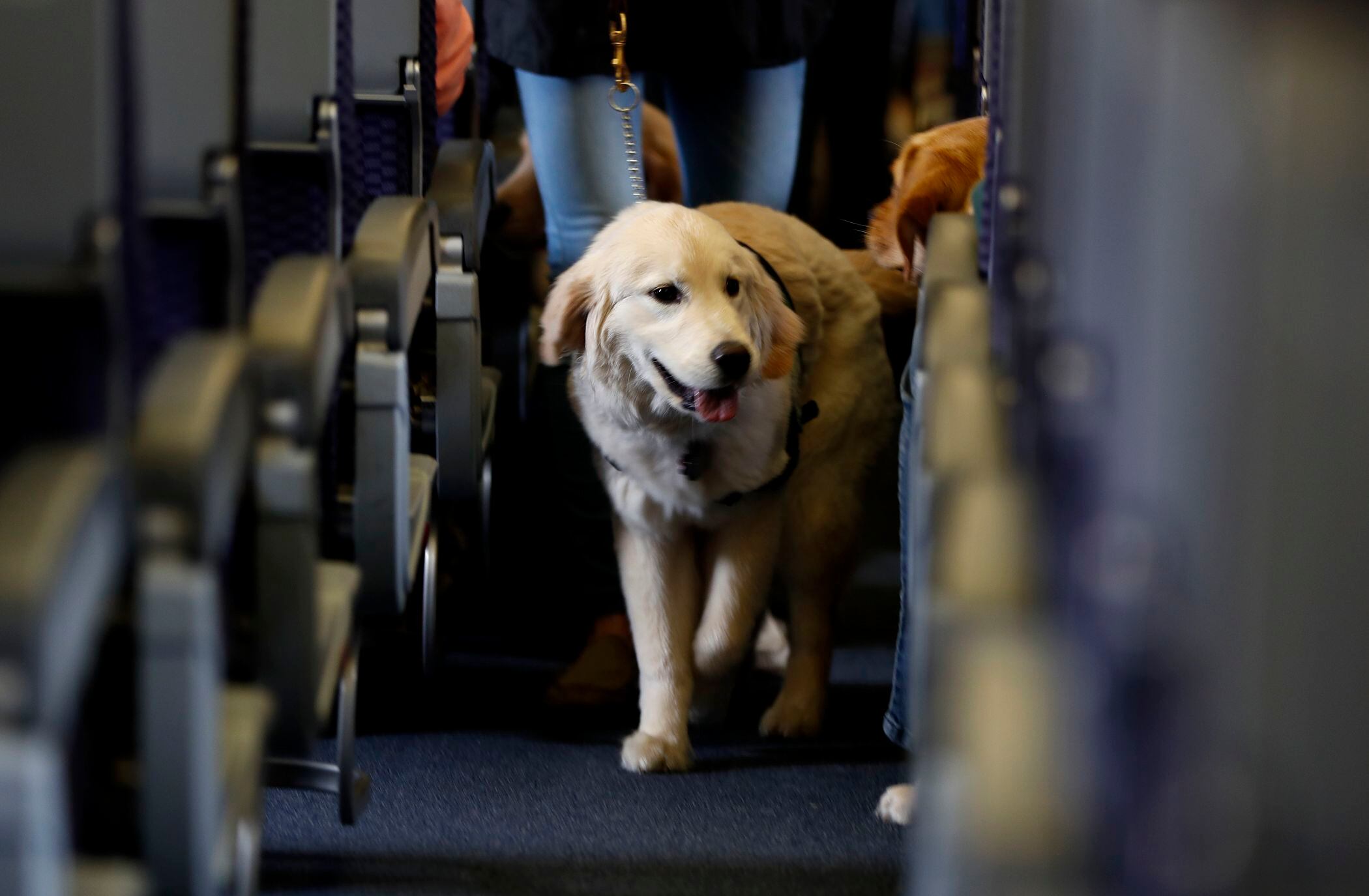
A service dog strolls through the isle inside a United Airlines plane at Newark Liberty International Airport while taking part of a training exercise, Saturday, April 1, 2017, in Newark, N.J. (AP Photo/Julio Cortez)
The government has decided that when it comes to air travel, only dogs can be service animals, and companions used for emotional support don't count.
The Transportation Department issued a final rule Wednesday that aims to settle years of tension between airlines and passengers who bring their pets on board for free by saying they need them for emotional support.
Under the final rule, which takes effect in 30 days, a service animal is a dog trained to help a person with a disability.
For years, the department required airlines to allow animals with passengers who had a doctor's note saying they needed the animal for emotional support. Airlines believed passengers abused the rule to bring a menagerie of animals on board including cats, turtles, pigs, and in one case, a peacock.
The new rule will likely force those passengers to check their animals into the cargo hold — for a fee — or leave them at home.
The rule requires airlines to treat dogs trained to help people with psychiatric issues the same as other service animals. Advocates for veterans and others had pushed for that.
Airlines will be able to require owners to vouch for the dog's health, behavior, and training. Airlines can require people with a service dog to turn in paperwork up to 48 hours before a flight, but they can't bar those travelers from checking in online like other passengers.
Airlines can require service dogs to be leashed at all times, and they can bar dogs that show aggressive behavior. There have been incidents of emotional-support animals biting passengers.
Most members of the Federal Reserve’s interest-rate setting committee supported further reductions to its key interest rate this year, minutes from last month’s meeting showed.
Sinead O’Sullivan breaks down Taylor Swift’s genius marketing for The Life of a Showgirl, which just set the record for most albums sold in a single week.
Markets are emerging from a turbulent Q3. Horizon’s Mike Dickson shares insights on interest rates, small caps, and where investors should look in Q4 and beyond
Bambu Ventures's Kyle Pretsch dives into Lemonaid’s $10M buyout, down from 23andMe’s $400M price tag, and what’s next after Chrome Co.’s dramatic pivot.
Former Cisco Systems CEO John Chambers learned all about technology’s volatile highs and lows as a veteran of the internet’s early boom days during the late 1990s and the ensuing meltdown that followed the mania. And now he is seeing potential signs of the cycle repeating with another transformative technology in artificial intelligence. Chambers is trying take some of the lessons he learned while riding a wave that turned Cisco into the world's most valuable company in 2000 before a crash hammered its stock price and apply them as an investor in AI startups. He recently discussed AI's promise and perils during an interview with The Associated Press.
Grove Collaborative’s CEO shares how the company is reinventing everyday goods with sustainability at the core and working toward a plastic-free future.
Atlanta Mayor Andre Dickens shares plans for affordable housing, community-led growth, and why private and public grocery stores could be key to food equity.