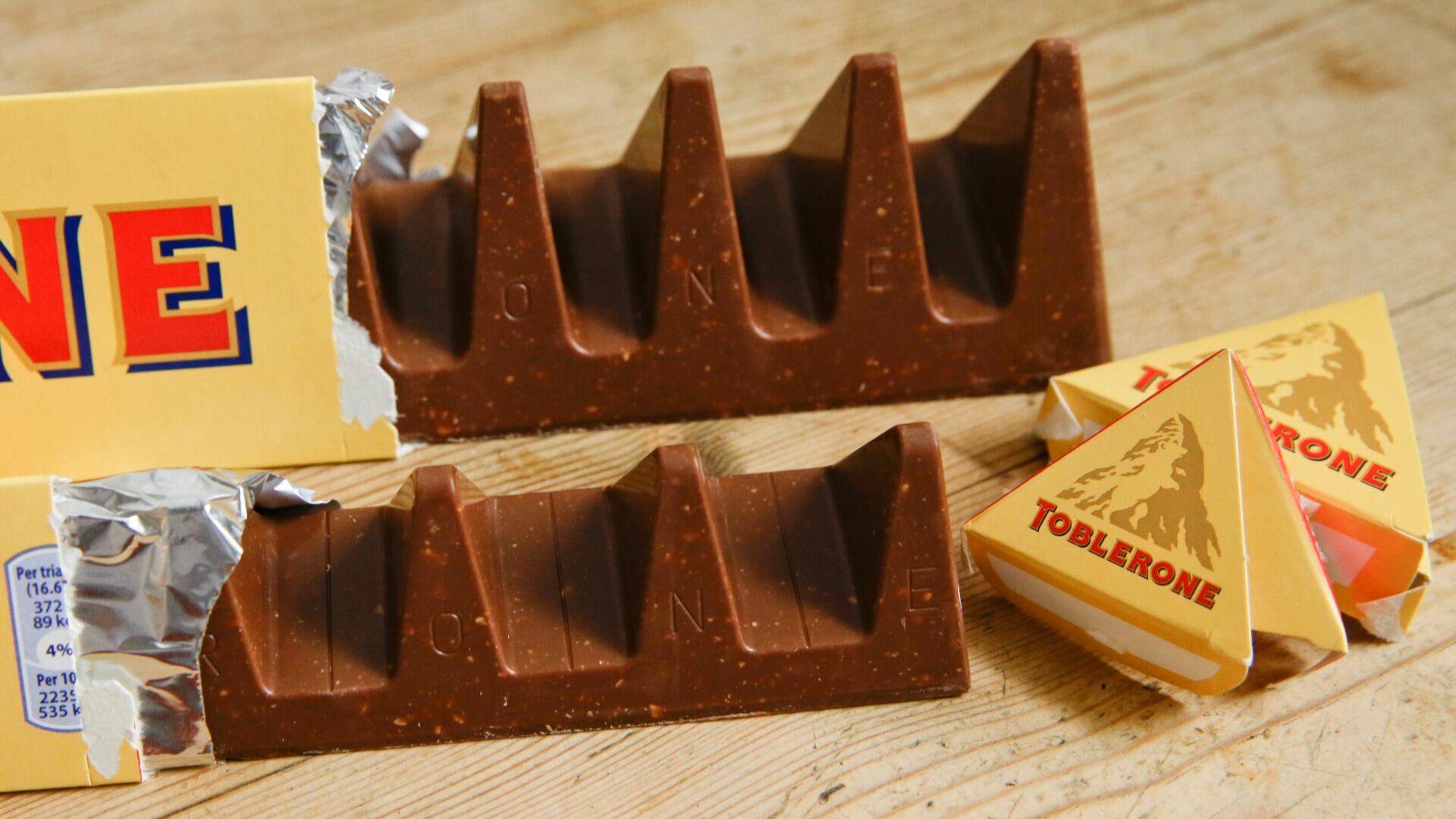
Two bars of the Toblerone Swiss chocolate are shown, at front is the new style 150 gram bar showing the reduction in triangular pieces, in the background is the older style 360 gram bar, pictured in London, on Nov. 8, 2016. The makers of Toblerone are stripping images of Switzerland's famed Matterhorn and the Swiss flag from the packaging of the milk-chocolate treat to comply with “Swissness” legislation, largely because some of its production is being outsourced to Slovakia. Mondelez International of Deerfield, Illinois, which owns the Swiss-born brand, said Monday March 6, 2023, it's in the process of adapting the packaging of Toblerone products to conform with Swiss law. (AP Photo/Alastair Grant, File)
The makers of Toblerone are stripping images of Switzerland's famed Matterhorn and the Swiss flag from the packaging of the milk-chocolate treat as they move some production to Slovakia.
Mondelez International of Deerfield, Illinois, which owns the Swiss-born brand, said Monday that it's in the process of adapting the packaging of Toblerone products to conform with strict rules in Switzerland about how products qualify for the coveted “Swissness” moniker — perceived by some as a standard of quality.
“The redesign of the packaging introduces a modernized and streamlined mountain logo that is consistent with the geometric and triangular aesthetic,” Mondelez spokeswoman Livia Kolmitz said in an email.
In June, the company announced plans to outsource production of some Toblerone chocolates later this year to Bratislava, the Slovak capital — where wages and the cost of living are far lower than in wealthy, expensive Switzerland.
The packaging change affects 35- and 50-gram (1.2- to 1.8-ounce) bars that will be made in Slovakia: Larger, 100-gram “tablets” will still be produced in Bern, the Swiss capital, the company says.
A law on “Swissness” of products was adopted in 2017 and aims to protect the cachet of Swiss manufacturing. When it comes to foods, two criteria have to be met: At least four-fifths of the raw materials that go into the product have to come from Switzerland, and the processing that gives a product its “essential characteristics” must be carried out in Switzerland.
The chocolate bar, made of honey and almond nougat, is distinctive for its triangular “peak” shape that evokes a mountain range and matching triangular packaging — sold in scores of countries and duty-free shops around the globe.
Toblerone has already been produced in other countries — notably late into the last century. The treat was invented 115 years ago by Swiss confectioner Theodor Tobler, with the brand name a fusion of the family name and the Italian word “torrone” — nougat.
Mondelez has already run into blowback from its changes to Toblerone in the past: A move years ago to widen the gaps between the chocolate peaks — reducing the weight of the bars but keeping the price the same, known as “shrinkflation” — fanned outrage in Britain, where the change mostly took effect.
China's largest ride-hailing company will no longer be listed on the world's largest stock exchange. Didi shareholders voted on Monday to delist from the New York Stock Exchange, less than a year after launching a $4.4 billion IPO with the most significant U.S. share offering by a Chinese company since Alibaba debuted in 2014. Since going public in June of last year, around $70 billion has been wiped from Didi's market value and shares of the company have dropped nearly 90%. Now, Didi is expected to begin preparations to list in Hong Kong. Kevin T. Carter, founder and Chief Investment Officer of EMQQ Global, joins Cheddar News' Closing Bell to discuss.
Ahead of the Meta shareholder meeting, more than five hundred doctors have jointly sent a letter to investors to hold the Facebook parent accountable for the risks its platforms have posed to the public and mental health. Dr. Rob Davidson, a West Michigan ER physician and executive director of the Committee to Protect Health Care, joined Cheddar News to discuss how medical professionals are coming together to highlight the social media giant's spread of misinformation, especially during the pandemic. "We've seen the direct impacts of misinformation and disinformation that spreads like wildfire on the social media platforms," he said. "Our goal with this letter is to try to get the shareholders of Meta to convince leadership that they need to do a better job."
Snap downgraded its earnings and revenue expectations for the second quarter, saying the "macroeconomic environment" has deteriorated faster than the company anticipated. The warning sent shockwaves through the digital ad industry, dragging down a handful of other tech stocks, including Pinterest, Meta, and Twitter. Daniel Cobb, CEO and Chief Strategy Officer of Daniel Brian Advertising, joined Cheddar to discuss the reason behind this warning, and why it's bringing so many social media stocks down.
Pamela Rucker, CIO Advisor and Instructor for Harvard Professional Development, joins Cheddar to discuss how perceptions of Environmental, Social, and Governance–or ESG–changed over the past couple of years, and how using machine learning and artificial intelligence could pave the way to a more sustainable future.
Bob Lockett, Chief Diversity & Talent Officer, ADP, joins Cheddar to break down why offering more flexibility at work is a top way to retain talent at work, and how strong DEI policies help encourage employee loyalty.