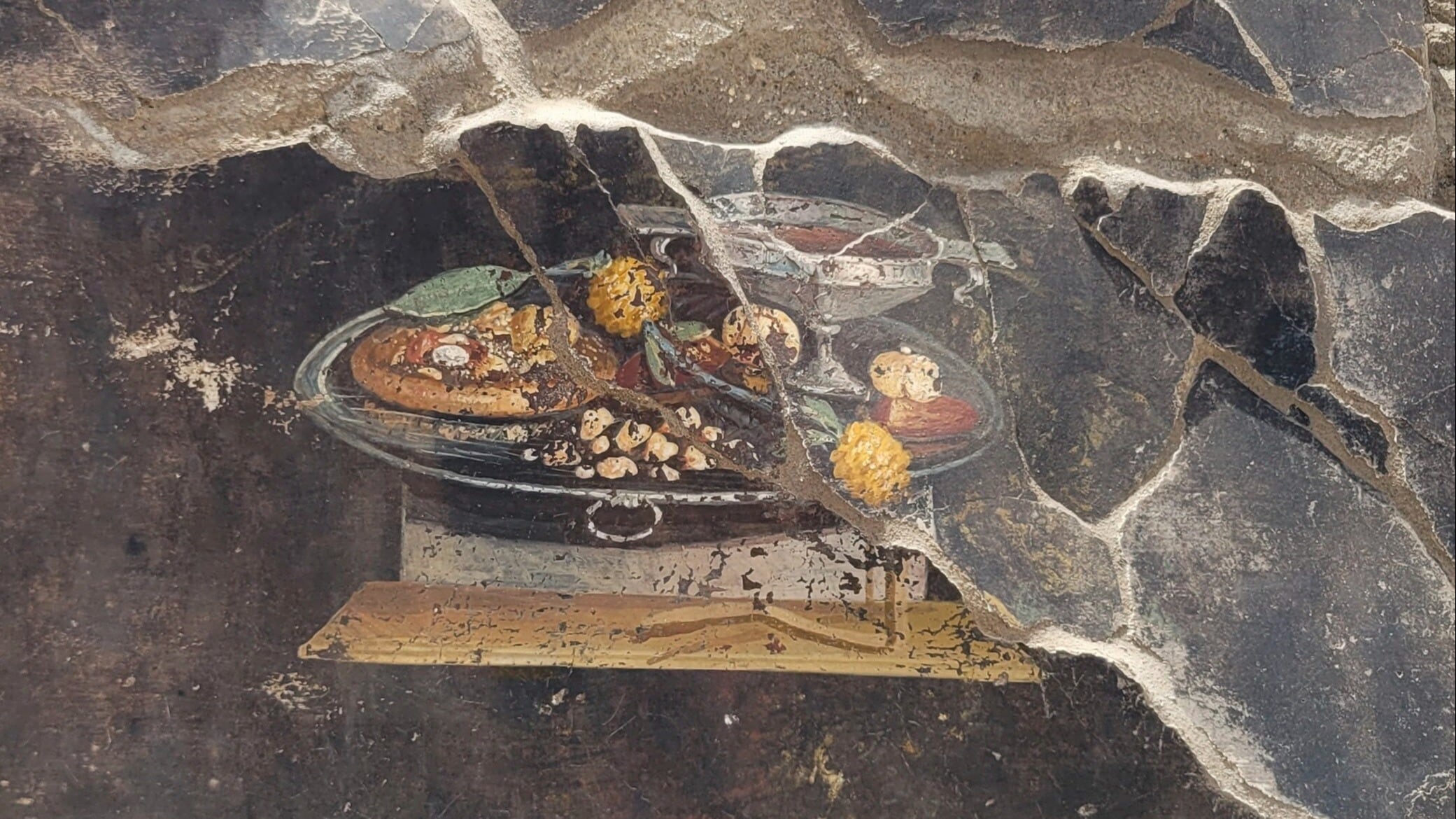
A still-life fresco discovered recently in the Pompeii archaeological site looks like a pizza, but it's not, experts at the archaeological site said Tuesday.
They noted that key ingredients needed to make Italy's iconic dish — tomatoes and mozzarella — were not available when the fresco was painted some 2,000 years ago.
Tomatoes were only introduced to Europe from the Americas a few centuries ago, and some histories have it that the discovery of mozzarella led directly to the invention of pizza in nearby Naples in the 1700s.
The image is instead believed to be a focaccia covered with fruit, including pomegranate and possibly dates, finished with spices or a type of pesto, experts said. In the fresco, it is served on a silver plate and a wine chalice stands next to it.
The contrast of the frugal meal served in a luxurious setting, denoted by the silver tray, is not unlike modern-day pizza, “born as a poor-man’s dish in southern Italy, which has won over the world and is served even in starred restaurants," said Gabriel Zuchtriegel, director of the Pompeii archaeological site.
The ancient Roman city of Pompeii was destroyed in the eruption of nearby Mount Vesuvius in 79 A.D. The sudden and deadly event left much of the structure intact, embalmed in volcanic ash, and the site is now a major archaeological project and tourist attraction.
The Coldiretti ag lobby immediately seized on the discovery of the fresco to promote pizza — invented as a quick meal for the working poor — as a national treasure. Today, pizza represents one-third of the food budget of foreign visitors and generates total annual revenues of 15 billion euros ($16.4 billion) in Italy.
The art of the Neapolitan pizzamaker was put on UNESCO’s intangible cultural heritage list in 2017, recognized for its four phases of dough preparation and for being baked exclusively in a wood oven at 485 degrees Celsius (905 degrees Fahrenheit.)
On this episode of "The Deep End," we're venturing outside. Whether it's spending time in a national park, turning streets into public spaces to relax in, or having an outside date near the beach, there's plenty to do in the great outdoors.
In this episode of "The Deep End," Cheddar News is taking a closer look at something that we are all intimately familiar with: food. Whether it's a sign of cultural identity, the foundation of many businesses, or simply as a means of nourishing our bodies, food is an essential part of what it means to be human.
From Broadway to NFT art to TikTok, the world is getting more creative. On this episode of "The Deep End," Cheddar News explores the world of entertainment.
In this episode of "The Deep End," Cheddar News explores the social justice movements defining the start of a new decade. From systemic racism and climate change to police brutality and women's rights, these are just a few of the harsh realities America has reckoned with amid the COVID-19 pandemic. We're taking a closer look at where the nation stands today.
On this episode of "The Deep End," Cheddar News takes a closer look at taboo topics. Some people call them vices, while other people call them hobbies. But what we do know is the line between what is accepted and what is illicit is getting blurred more and more each day.
Two zebras running loose since they escaped a Maryland farm about four months ago have been caught.
Former Minneapolis police Officer Derek Chauvin has pleaded guilty to a federal charge of violating George Floyd’s civil rights.
Carlo and Baker cover the latest data showing the Omicron wave has likely started, Pfizer's Covid pill, Jan. 6 and a box office rescue attempt courtesy of Spider-Man.
The Hollywood Foreign Press Association announced the nominees for the 79th Annual Golden Globe awards. The ceremony is set to take place on January 9, 2022. Gerrad Hall, senior awards editor at Entertainment Weekly, joins Cheddar News to discuss the nominations.
A University of Chicago Harris School of Public Policy and The Associated Press-NORC Center for Public Affairs Research poll finds that 35% of mothers report doing more than their partner for each of eight specified household responsibilities.