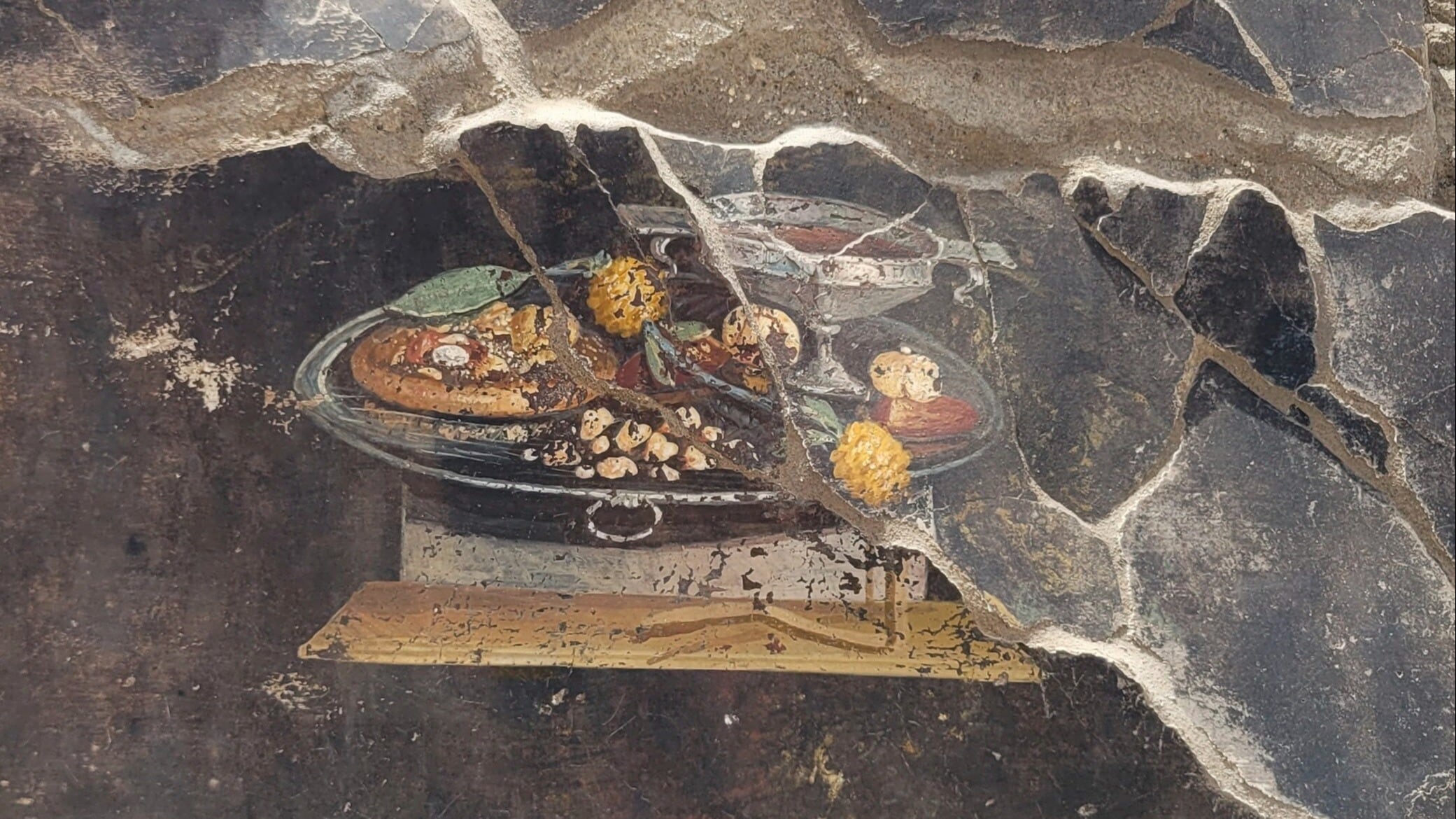
A still-life fresco discovered recently in the Pompeii archaeological site looks like a pizza, but it's not, experts at the archaeological site said Tuesday.
They noted that key ingredients needed to make Italy's iconic dish — tomatoes and mozzarella — were not available when the fresco was painted some 2,000 years ago.
Tomatoes were only introduced to Europe from the Americas a few centuries ago, and some histories have it that the discovery of mozzarella led directly to the invention of pizza in nearby Naples in the 1700s.
The image is instead believed to be a focaccia covered with fruit, including pomegranate and possibly dates, finished with spices or a type of pesto, experts said. In the fresco, it is served on a silver plate and a wine chalice stands next to it.
The contrast of the frugal meal served in a luxurious setting, denoted by the silver tray, is not unlike modern-day pizza, “born as a poor-man’s dish in southern Italy, which has won over the world and is served even in starred restaurants," said Gabriel Zuchtriegel, director of the Pompeii archaeological site.
The ancient Roman city of Pompeii was destroyed in the eruption of nearby Mount Vesuvius in 79 A.D. The sudden and deadly event left much of the structure intact, embalmed in volcanic ash, and the site is now a major archaeological project and tourist attraction.
The Coldiretti ag lobby immediately seized on the discovery of the fresco to promote pizza — invented as a quick meal for the working poor — as a national treasure. Today, pizza represents one-third of the food budget of foreign visitors and generates total annual revenues of 15 billion euros ($16.4 billion) in Italy.
The art of the Neapolitan pizzamaker was put on UNESCO’s intangible cultural heritage list in 2017, recognized for its four phases of dough preparation and for being baked exclusively in a wood oven at 485 degrees Celsius (905 degrees Fahrenheit.)
Never underestimate your friendly neighborhood Spider-Man, even with a mutating virus afoot. Despite rising concerns over the omicron variant, “Spider-Man: No Way Home” not only shattered pandemic-era box office records; it became the third best opening of all time behind “Avengers: Endgame” ($357.1 million) and “Avengers: Infinity War" ($257.7 million).
Carlo's joined by a quarantining Baker to discuss the headlines from the weekend as Omicron spreads like wildfire, Manchin kills Biden's signature bill and Spider-Man throws a lifeline to the box office.
Cheddar has been covering the biggest news of the week with some of the biggest names in the biz. In case you missed it, we've pulled together some of the highlights that will keep you informed as we get ready for the week ahead.
Educators have announced plans to increase security in response to TikTok posts warning of shooting and bomb threats at schools around the country Friday as officials assured parents the viral posts were not considered credible.
Carlo Versano and Baker Machado wrap up another week discussing the latest explosion in new Covid cases in the Northeast, President Biden's stalled agenda and more. Plus, Love, Hate, Ate featuring the question: why did movie dialogue get so hard to understand?
Authorities say at least five people died when a powerful storm system swept across the Great Plains and Midwest, spawning hurricane-force winds and likely tornadoes in Nebraska, Iowa and Minnesota.
Cheddar recommends "The Witcher," every Spider-Man feature film, "Selling Tampa," "This Christmas," and "A Christmas Carol" (1984).
The Fed decision, Omicron spread, NFTs and more. All the news you Need2Know for Thursday, December 16, 2021.
President Joe Biden is pledging to do “whatever it takes, as long as it takes” to help Kentucky and other states recover and rebuild after a series of deadly tornadoes that he says left a trail of unimaginable devastation.
As humans, we share this beautiful planet with more than eight million other species. In this episode of "The Deep End," we are looking at a few that we interact with most intimately. They provide us comfort, do our yard work, and one even predates us by 66 million years.