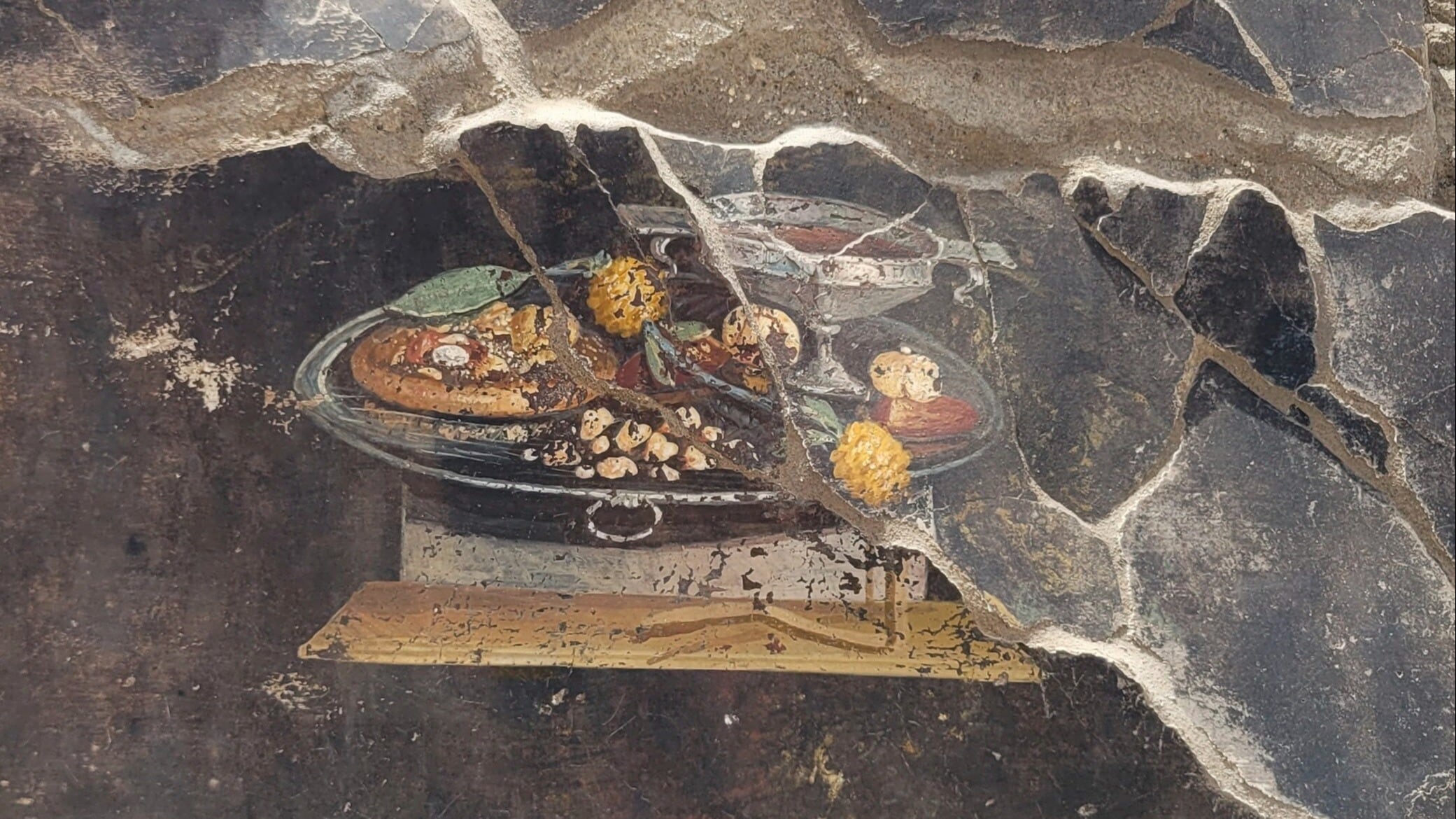
This picture provided on Tuesday, June 27, 2023, by the Pompeii Archaeological Park shows the wall of an ancient Pompeian house with a fresco depicting a table with food. The fresco was found in the atrium of a house in Insula 10 of Regio IX under excavation, to which a bakery was annexed, already partially explored between 1888 and 1891 and whose investigations were resumed last January. (Pompeii Archaeological Park via AP, ho)
A still-life fresco discovered recently in the Pompeii archaeological site looks like a pizza, but it's not, experts at the archaeological site said Tuesday.
They noted that key ingredients needed to make Italy's iconic dish — tomatoes and mozzarella — were not available when the fresco was painted some 2,000 years ago.
Tomatoes were only introduced to Europe from the Americas a few centuries ago, and some histories have it that the discovery of mozzarella led directly to the invention of pizza in nearby Naples in the 1700s.
The image is instead believed to be a focaccia covered with fruit, including pomegranate and possibly dates, finished with spices or a type of pesto, experts said. In the fresco, it is served on a silver plate and a wine chalice stands next to it.
The contrast of the frugal meal served in a luxurious setting, denoted by the silver tray, is not unlike modern-day pizza, “born as a poor-man’s dish in southern Italy, which has won over the world and is served even in starred restaurants," said Gabriel Zuchtriegel, director of the Pompeii archaeological site.
The ancient Roman city of Pompeii was destroyed in the eruption of nearby Mount Vesuvius in 79 A.D. The sudden and deadly event left much of the structure intact, embalmed in volcanic ash, and the site is now a major archaeological project and tourist attraction.
The Coldiretti ag lobby immediately seized on the discovery of the fresco to promote pizza — invented as a quick meal for the working poor — as a national treasure. Today, pizza represents one-third of the food budget of foreign visitors and generates total annual revenues of 15 billion euros ($16.4 billion) in Italy.
The art of the Neapolitan pizzamaker was put on UNESCO’s intangible cultural heritage list in 2017, recognized for its four phases of dough preparation and for being baked exclusively in a wood oven at 485 degrees Celsius (905 degrees Fahrenheit.)
Roku shares dropped during Friday's session after the streaming company reported Q4 revenue on Thursday that missed expectations, and disappointing guidance for the Q1 of 2022. Tuna Amobi, director and senior analyst at CFRA Research, joins Cheddar News' Closing Bell to discuss what it means for investors and the company's future.
The Retail Industry Leaders Association released a report alleging the safety risks, economic losses, and potential job losses they link to a surge in shoplifting crimes in the United States. Lisa LaBruno, senior EVP of retail operations at the trade organization, joined Cheddar News to discuss the impact of websites that allow for the resale of unverified goods and passing the INFORM Consumers Act to stamp it out. “We need to hold the online marketplaces accountable for being a favored venue for criminals to resell stolen product," LaBruno said. "And that is exactly what the INFORM Act is designed to do."
Jamaican Olympic alpine skier Benjamin Alexander joins Cheddar News to discuss his first Olympic appearance and creating more opportunities for diversity in the sport.
Nzingha Samuel, social entrepreneur and community developer at E & Z Star Culture, joins Cheddar News to talk about her efforts creating a space for Black Americans in Ghana.
Cindy Blanco, senior learning scientist at language learning platform Duolingo, joins Cheddar News to discuss users now being able to learn Haitian Creole.
While the United States were once again among the top nations in 2022 Beijing Winter Olympics to medal, with the games just ended, the focus turns to the athletes coming home and the mental toll the competition take on them. Lauren Gibbs, the 2018 Team USA silver medalist in bobsledding, joined Cheddar News to give her perspective on this year's games and what the competitors have gone through. “Its definitely a mixed bag, you know? It's like I just had the most incredible athletic experience of my life, but then its like its over in a flash," Gibbs said about the feelings an athlete can go through after finishing. She noted that it's important for them to be vocal and reach out to support networks after the rush of competition ends.
In 2021, Americans reported losses from so-called romance scams hit an all-time high of $547 million, or six times the total losses in 2017, according to the FTC.
Hank the Tank strikes again. The 500-pound black bear that has damaged more than 30 properties around Lake Tahoe last week broke into yet another home in its endless quest for a quick meal.