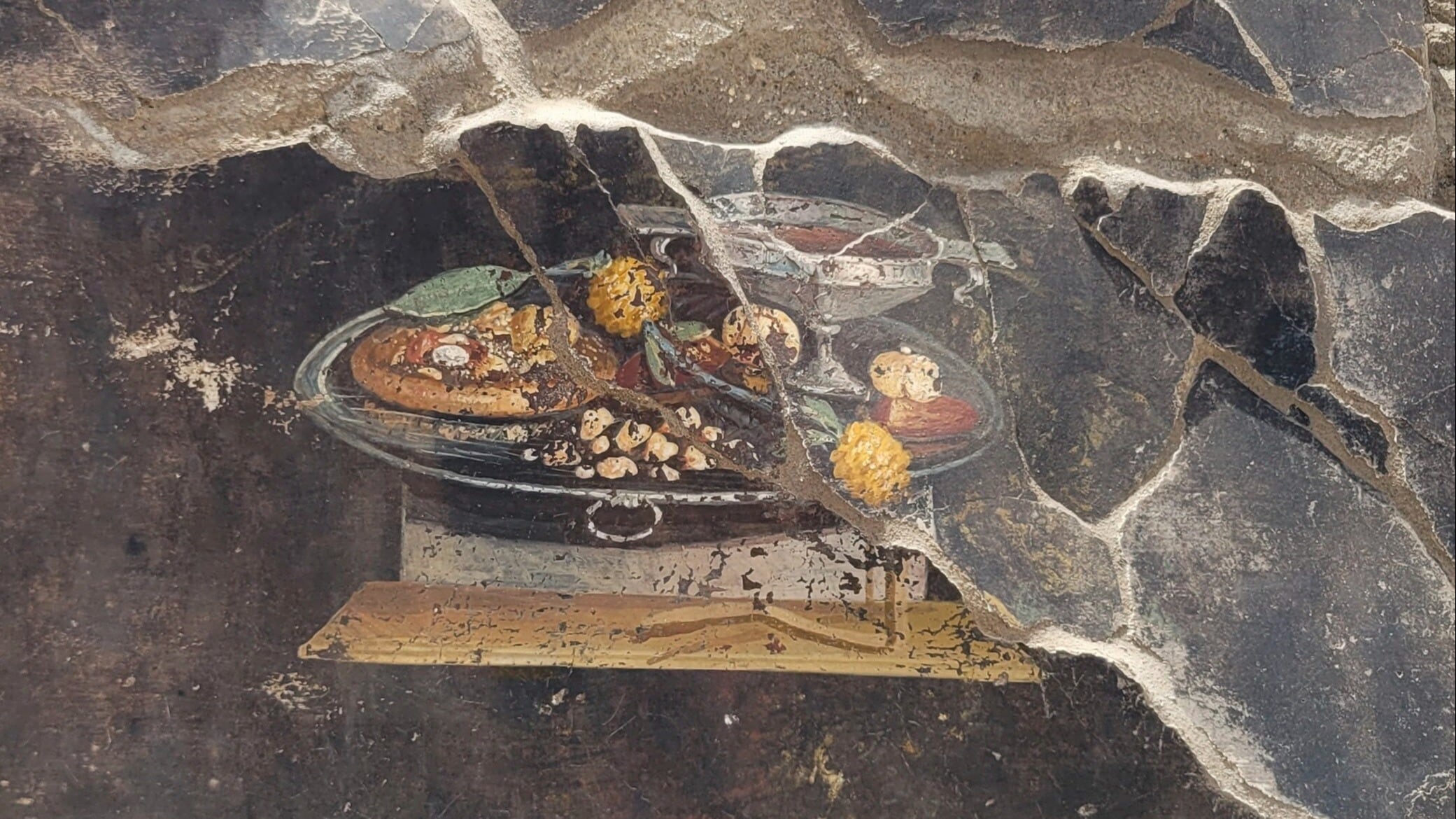
This picture provided on Tuesday, June 27, 2023, by the Pompeii Archaeological Park shows the wall of an ancient Pompeian house with a fresco depicting a table with food. The fresco was found in the atrium of a house in Insula 10 of Regio IX under excavation, to which a bakery was annexed, already partially explored between 1888 and 1891 and whose investigations were resumed last January. (Pompeii Archaeological Park via AP, ho)
A still-life fresco discovered recently in the Pompeii archaeological site looks like a pizza, but it's not, experts at the archaeological site said Tuesday.
They noted that key ingredients needed to make Italy's iconic dish — tomatoes and mozzarella — were not available when the fresco was painted some 2,000 years ago.
Tomatoes were only introduced to Europe from the Americas a few centuries ago, and some histories have it that the discovery of mozzarella led directly to the invention of pizza in nearby Naples in the 1700s.
The image is instead believed to be a focaccia covered with fruit, including pomegranate and possibly dates, finished with spices or a type of pesto, experts said. In the fresco, it is served on a silver plate and a wine chalice stands next to it.
The contrast of the frugal meal served in a luxurious setting, denoted by the silver tray, is not unlike modern-day pizza, “born as a poor-man’s dish in southern Italy, which has won over the world and is served even in starred restaurants," said Gabriel Zuchtriegel, director of the Pompeii archaeological site.
The ancient Roman city of Pompeii was destroyed in the eruption of nearby Mount Vesuvius in 79 A.D. The sudden and deadly event left much of the structure intact, embalmed in volcanic ash, and the site is now a major archaeological project and tourist attraction.
The Coldiretti ag lobby immediately seized on the discovery of the fresco to promote pizza — invented as a quick meal for the working poor — as a national treasure. Today, pizza represents one-third of the food budget of foreign visitors and generates total annual revenues of 15 billion euros ($16.4 billion) in Italy.
The art of the Neapolitan pizzamaker was put on UNESCO’s intangible cultural heritage list in 2017, recognized for its four phases of dough preparation and for being baked exclusively in a wood oven at 485 degrees Celsius (905 degrees Fahrenheit.)
Alex Walker, candidate for Colorado's 3rd Congressional District, joins Cheddar News to discuss why he's running against Lauren Boebert and the inspiration behind his viral campaign ad.
Lisa Hagen, politics reporter for U.S. News and World Report, joins Cheddar News to preview what to expect from President Biden's State of the Union Address on March 1.
GLAAD, the media watchdog for the LGBTQ community, released its “Where We Are on TV” report last week, with updated data on the entertainment industry. Rich Ferraro, chief communications officer for the non-profit organization, joined Cheddar News to talk about the progress that has been made on media representation and what's at stake in the process of humanizing queer people in popular culture as a recent backlash in legislative trends demonstrated. "We just saw the news yesterday in Texas, a move from Governor Abbott that would try to pull trans youth away from their parents for receiving gender-affirming care," Ferraro said. "And television and entertainment can be a frontline to preventing such anti-LGBTQ legislation from moving forward."
The real estate market is only continuing to heat up as home prices skyrocket across the country. The median price for an American home jumped nearly 20 percent in a year, with the number of 'million dollar cities' tripling since 2020. Tim Rood, Situs AMC Managing Director joined Cheddar's Opening Bell to discuss.
The workforce is incredibly different from what it was just two years ago. Ginnie Carlier, Vice Chair of Talent at EY Americas, joins Cheddar News to discuss the evolving role of the employer, and ways leaders can increase job satisfaction in this current environment.