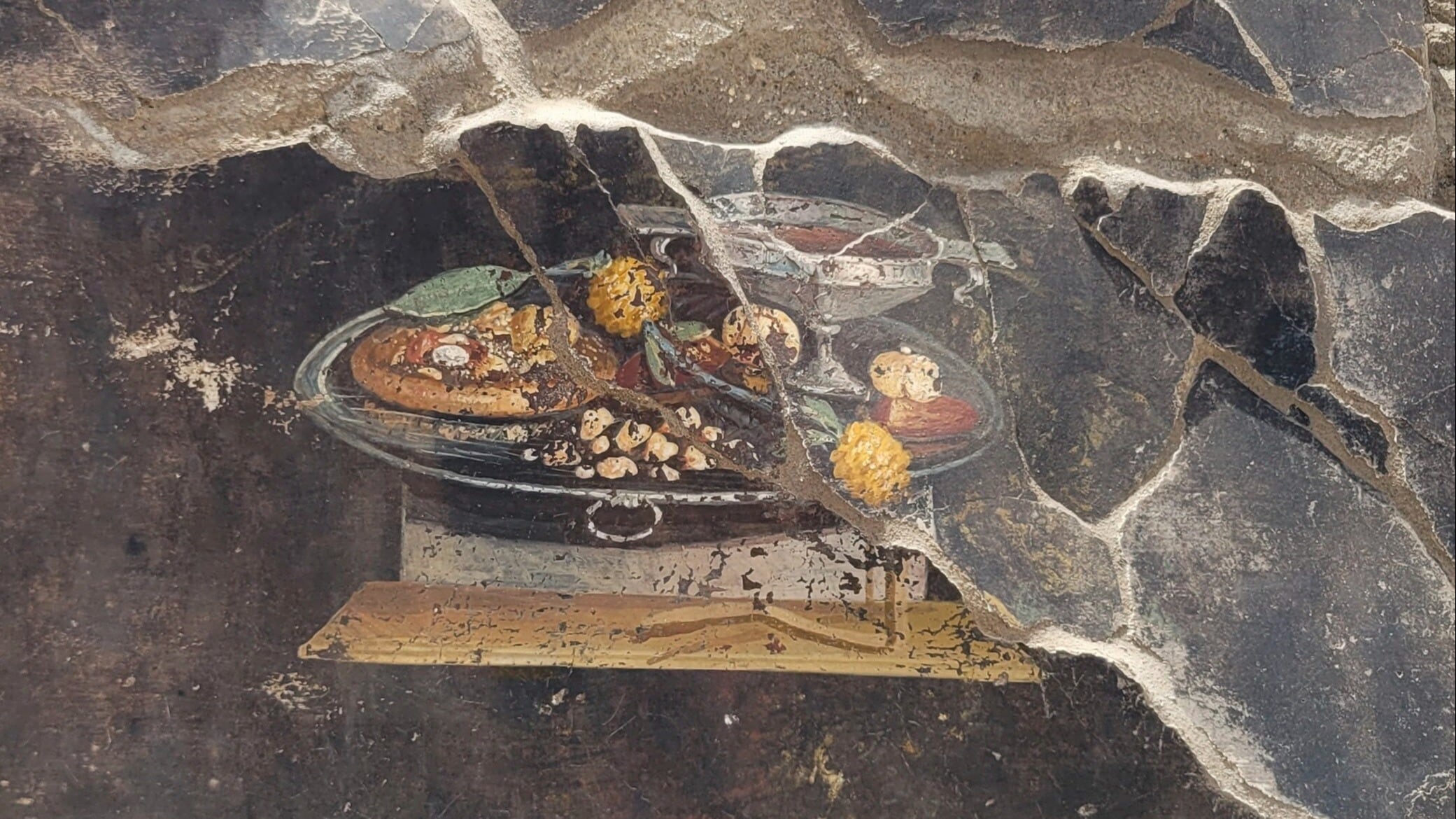
This picture provided on Tuesday, June 27, 2023, by the Pompeii Archaeological Park shows the wall of an ancient Pompeian house with a fresco depicting a table with food. The fresco was found in the atrium of a house in Insula 10 of Regio IX under excavation, to which a bakery was annexed, already partially explored between 1888 and 1891 and whose investigations were resumed last January. (Pompeii Archaeological Park via AP, ho)
A still-life fresco discovered recently in the Pompeii archaeological site looks like a pizza, but it's not, experts at the archaeological site said Tuesday.
They noted that key ingredients needed to make Italy's iconic dish — tomatoes and mozzarella — were not available when the fresco was painted some 2,000 years ago.
Tomatoes were only introduced to Europe from the Americas a few centuries ago, and some histories have it that the discovery of mozzarella led directly to the invention of pizza in nearby Naples in the 1700s.
The image is instead believed to be a focaccia covered with fruit, including pomegranate and possibly dates, finished with spices or a type of pesto, experts said. In the fresco, it is served on a silver plate and a wine chalice stands next to it.
The contrast of the frugal meal served in a luxurious setting, denoted by the silver tray, is not unlike modern-day pizza, “born as a poor-man’s dish in southern Italy, which has won over the world and is served even in starred restaurants," said Gabriel Zuchtriegel, director of the Pompeii archaeological site.
The ancient Roman city of Pompeii was destroyed in the eruption of nearby Mount Vesuvius in 79 A.D. The sudden and deadly event left much of the structure intact, embalmed in volcanic ash, and the site is now a major archaeological project and tourist attraction.
The Coldiretti ag lobby immediately seized on the discovery of the fresco to promote pizza — invented as a quick meal for the working poor — as a national treasure. Today, pizza represents one-third of the food budget of foreign visitors and generates total annual revenues of 15 billion euros ($16.4 billion) in Italy.
The art of the Neapolitan pizzamaker was put on UNESCO’s intangible cultural heritage list in 2017, recognized for its four phases of dough preparation and for being baked exclusively in a wood oven at 485 degrees Celsius (905 degrees Fahrenheit.)
Jordan Mauriello, CEO of MoreYellow, talks about the evolving landscape of female gamers and why brands see Influencers as more valuable than their male counterparts.
Apple's Racial Equity and Justice Initiative is a $100 million program aimed at combating systemic racism while working to advance racial equity across the country. Alisha Johnson, director of the initiative, joined Cheddar at SXSW to discuss the work being done. "We focused on three critical areas. The first is education. The second is criminal justice reform, and the third is economic empowerment, really looking first in our own supply chain, how can we really increase our spend with Latinx, Hispanic, and indigenous-owned businesses," she said. "And then how can we go further to empower entrepreneurs who have been cut out of access to funding and capital and really help them to get the funding."
What you Need to Know on Thursday, March 17. Updates from Ukraine, President Biden refers to Putin as a ‘war criminal’ for the first time, Walmart has ambitious hiring targets for Q1, and Netflix takes steps to crack down on password sharing.
Residents were cleaning their homes Thursday after a 7.4-magnitude earthquake struck off the coast of Fukushima in northern Japan, smashing furniture, knocking out power and killing four people.
Biden calls Putin a "war criminal," HBCUs are getting grant money for security after dozens of bomb threats, and Cannes may hate red-carpet selfies, but this year they're partnering with TikTok. Here is all the news you Need2Know for Thursday, March 17, 2022.
A Peacock streaming show about a '90s one-hit-wonder girl group getting another chance at musical success, "Girls5Eva" drops its second season on the platform on May 5. Cheddar's Michelle Castillo sat down with creator Meredith Scardino and actor Paula Pell from South By Southwest in Austin, Texas, to talk about what fans can expect from the series in Season 2. "They're going to create their first studio album, which is really exciting," Scardino said. "So we're going to follow that journey as they as they get back in the studio."
Cheddar News senior reporter Michelle Castillo was joined by the cast of 'Lizzo's Watch Out for the Big Grrrls' during South by Southwest 2022. They talk all about the new series, which premieres March 25 on Prime Video.