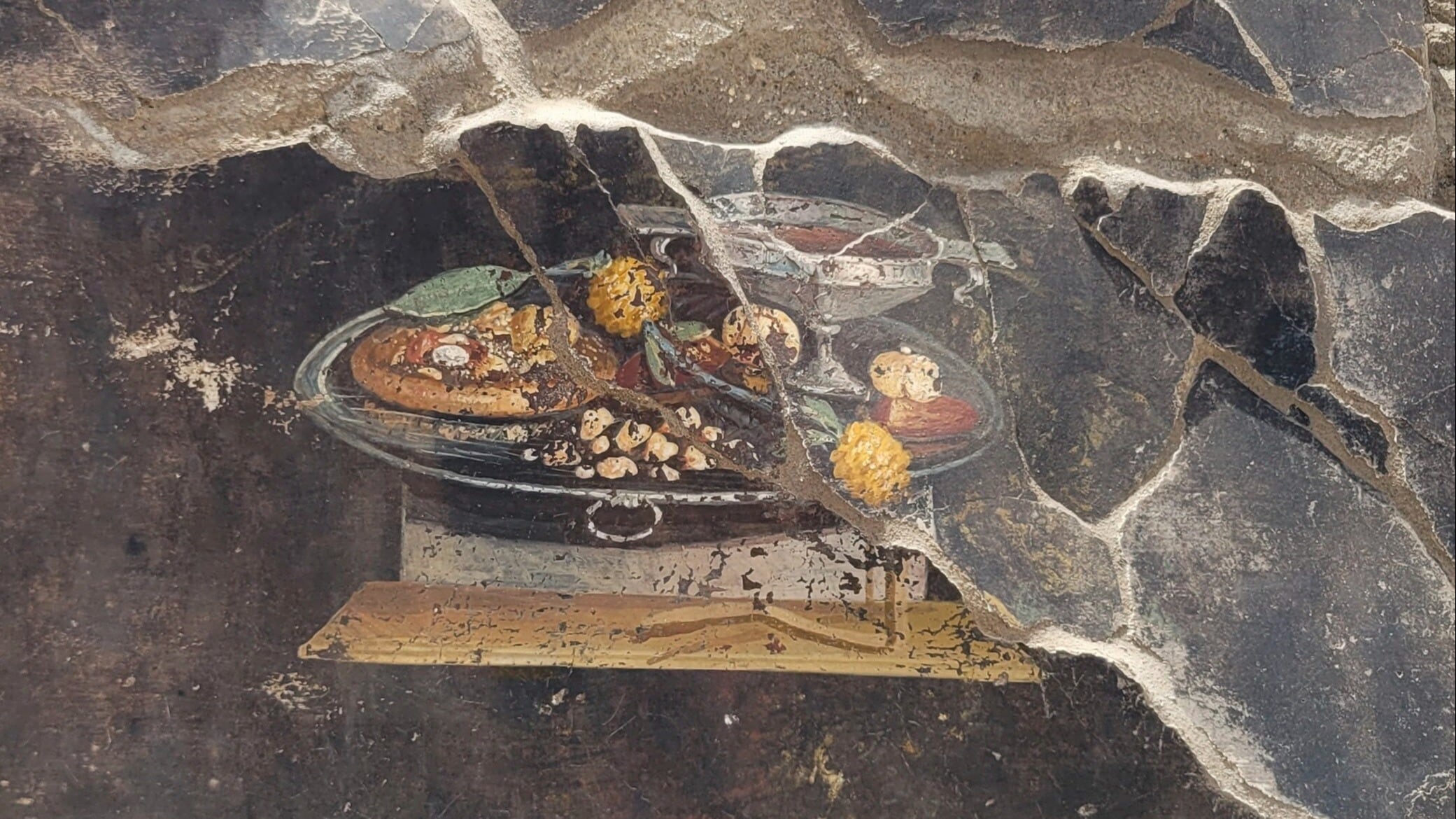
This picture provided on Tuesday, June 27, 2023, by the Pompeii Archaeological Park shows the wall of an ancient Pompeian house with a fresco depicting a table with food. The fresco was found in the atrium of a house in Insula 10 of Regio IX under excavation, to which a bakery was annexed, already partially explored between 1888 and 1891 and whose investigations were resumed last January. (Pompeii Archaeological Park via AP, ho)
A still-life fresco discovered recently in the Pompeii archaeological site looks like a pizza, but it's not, experts at the archaeological site said Tuesday.
They noted that key ingredients needed to make Italy's iconic dish — tomatoes and mozzarella — were not available when the fresco was painted some 2,000 years ago.
Tomatoes were only introduced to Europe from the Americas a few centuries ago, and some histories have it that the discovery of mozzarella led directly to the invention of pizza in nearby Naples in the 1700s.
The image is instead believed to be a focaccia covered with fruit, including pomegranate and possibly dates, finished with spices or a type of pesto, experts said. In the fresco, it is served on a silver plate and a wine chalice stands next to it.
The contrast of the frugal meal served in a luxurious setting, denoted by the silver tray, is not unlike modern-day pizza, “born as a poor-man’s dish in southern Italy, which has won over the world and is served even in starred restaurants," said Gabriel Zuchtriegel, director of the Pompeii archaeological site.
The ancient Roman city of Pompeii was destroyed in the eruption of nearby Mount Vesuvius in 79 A.D. The sudden and deadly event left much of the structure intact, embalmed in volcanic ash, and the site is now a major archaeological project and tourist attraction.
The Coldiretti ag lobby immediately seized on the discovery of the fresco to promote pizza — invented as a quick meal for the working poor — as a national treasure. Today, pizza represents one-third of the food budget of foreign visitors and generates total annual revenues of 15 billion euros ($16.4 billion) in Italy.
The art of the Neapolitan pizzamaker was put on UNESCO’s intangible cultural heritage list in 2017, recognized for its four phases of dough preparation and for being baked exclusively in a wood oven at 485 degrees Celsius (905 degrees Fahrenheit.)
In a 5-4 vote, the U.S. Supreme Court allowed for a controversial new version of the Alabama congressional map to remain in place. The lower court had previously ordered that the state must redraw that congressional map because it violates the Voting Rights Act by diluting the political power of Black voters. Redistricting expert Yurij Rudensky joins Cheddar News to weigh in.
The Winter Olympics are in full swing and athletes from around the globe are showcasing their elite skills at a wide variety of events. There's a lot of excitement but also a lot of pressure for these athletes. Former NFL defensive tackle and Super Bowl champion Dominique Easley joined Cheddar News to weigh in.
American freestyle skier Jaelin Kauf joins Cheddar News to talk about taking home the silver medal in the Women's Moguls Final at the 2022 Winter Olympics.
This episode of ChedHER is all about helping women thrive in their careers and rise up in the ranks. Guests include female leaders from across industries including sports, advertising, and so much more.
Sonja Stills, Commissioner of the Mid-Eastern Athletic Conference, joins ChedHER to discuss her experience being the first female leader in this role, and how she plans on carrying on the legacy of the MEAC.
Sheri Bachstein, CEO of The Weather Company and GM of IBM Watson Advertising, joins ChedHER to discuss her successes in this role, and how she's helping women thrive in the c-suite.
Cate Luzio, CEO and Founder of Luminary, joins ChedHER to discuss how Luminary is supporting women at all stages of their career journeys, and the upcoming Chase for Business Fellowship to support business owners.