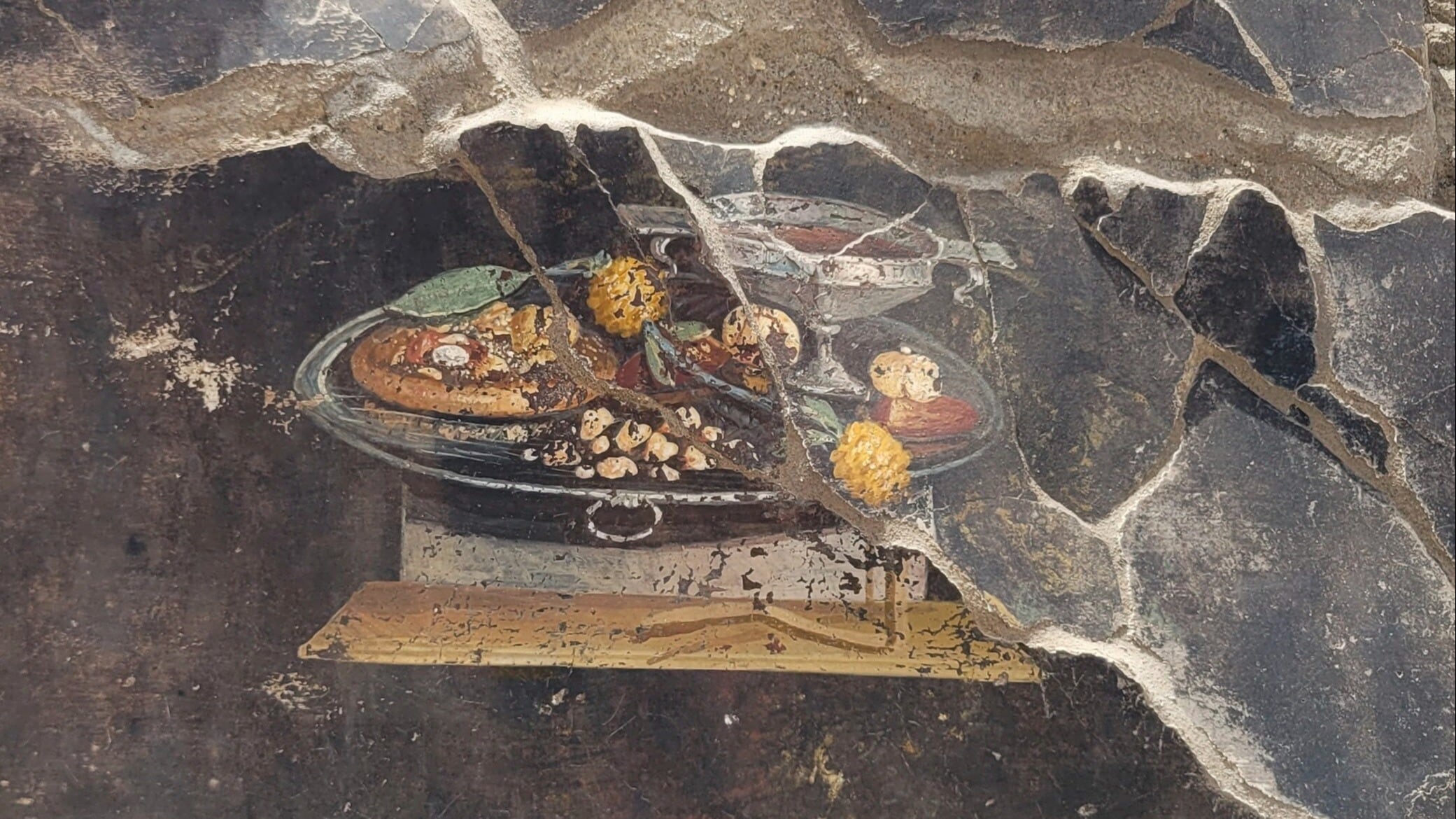
This picture provided on Tuesday, June 27, 2023, by the Pompeii Archaeological Park shows the wall of an ancient Pompeian house with a fresco depicting a table with food. The fresco was found in the atrium of a house in Insula 10 of Regio IX under excavation, to which a bakery was annexed, already partially explored between 1888 and 1891 and whose investigations were resumed last January. (Pompeii Archaeological Park via AP, ho)
A still-life fresco discovered recently in the Pompeii archaeological site looks like a pizza, but it's not, experts at the archaeological site said Tuesday.
They noted that key ingredients needed to make Italy's iconic dish — tomatoes and mozzarella — were not available when the fresco was painted some 2,000 years ago.
Tomatoes were only introduced to Europe from the Americas a few centuries ago, and some histories have it that the discovery of mozzarella led directly to the invention of pizza in nearby Naples in the 1700s.
The image is instead believed to be a focaccia covered with fruit, including pomegranate and possibly dates, finished with spices or a type of pesto, experts said. In the fresco, it is served on a silver plate and a wine chalice stands next to it.
The contrast of the frugal meal served in a luxurious setting, denoted by the silver tray, is not unlike modern-day pizza, “born as a poor-man’s dish in southern Italy, which has won over the world and is served even in starred restaurants," said Gabriel Zuchtriegel, director of the Pompeii archaeological site.
The ancient Roman city of Pompeii was destroyed in the eruption of nearby Mount Vesuvius in 79 A.D. The sudden and deadly event left much of the structure intact, embalmed in volcanic ash, and the site is now a major archaeological project and tourist attraction.
The Coldiretti ag lobby immediately seized on the discovery of the fresco to promote pizza — invented as a quick meal for the working poor — as a national treasure. Today, pizza represents one-third of the food budget of foreign visitors and generates total annual revenues of 15 billion euros ($16.4 billion) in Italy.
The art of the Neapolitan pizzamaker was put on UNESCO’s intangible cultural heritage list in 2017, recognized for its four phases of dough preparation and for being baked exclusively in a wood oven at 485 degrees Celsius (905 degrees Fahrenheit.)
Angel Cornelius, Founder & CEO of Maison 276, joins ChedHER to discuss how she created her own beauty solutions right from her kitchen using plant-based, sustainable ingredients and why it's important to celebrate women of all ages and races.
On this episode of ChedHER:PWR WMN Co-Founders discuss how they are building an apparel brand to make women feel confident and powerful; Founder & CEO of Jack & Annie's breaks down the benefits to jackfruit, and how our meat consumption impacts the environment; Founder & CEO of Maison 276 explains how she created her own beauty solutions right from her kitchen using plant-based, sustainable ingredients and why it's important to celebrate women of all ages and races.
Catching you up on what you need to know on April 18, 2022, with Russian missile attacks on the Ukrainian city of Lviv killing seven, mass shootings in South Carolina and Pittsburgh, Lucky Charms cereal under official investigation by the FDA, and more.
Lisa Whalen, Automotive and Mobility Analyst at Morning Consult, joined Cheddar News' Closing Bell to break down the famed auto show's emphasis on electric vehicles this year, reflecting a shift toward electrification in the automotive industry.
On this episode of ChedHER, Amira Rasool, CEO and Founder of The Folklore, discusses her $1.7 million pre-seed funding round and why she's being intentional about the investors she's working with; Brittany Merrill-Yeng, co-founder Skrewball Whiskey, reveals the origins of Skrewball Whisky, experiencing a period of rapid growth, and navigating a male-dominated industry; Suz Hernandez, Owner of MamaP, breaks down how her company is combining eco-friendly and sustainable products with a mission to donate to non-profits that help people and the planet.
On this episode of ChedHER: Founder and CEO of IvyWise discusses how the higher education industry has evolved over the past 20 years; CEO and Founder of Stax Payments breaks down how to get more female founders to break $1 million in revenue; Chief Impact Officer & SVP at The Minneapolis Foundation explains how the foundation is driving action for the greatest civic, social, and economic needs.
On this episode of Cheddar Innovates: President of The Pillow Bar breaks down how everyone can benefit from a pillow customized to their unique way of sleeping; CEO of H2Pro explains how to bring environmentally friendly hydrogen to scale; Cheddar gets a look at Curiosity Stream's 'Suppressed Science.'
On this episode of Cheddar Reveals, Andrea Swift, Chair of NYFA Documentary Department, discusses the documentary filmmaking process and why they remain so important in 2022; Nina Gilden Seavey, Founding Director, The Documentary Center Research at George Washington University, dissects the evolution of documentaries in the streaming age; Cheddar gets a look at Curiosity Stream's 'Nature Through Her Eyes.'
On this episode of ChedHER: Founder and CEO at Allara Health discusses how she's creating a platform for women with Polycystic Ovary Syndrome or PCOS; General Manager of the Run/Train Business Unit at Puma breaks down how Puma is approaching a hybrid work model, and ways to empower women in the workplace; Founder and CEO of Mi Golondrina explains how she's empowering over 600 artisans from Mexico.
On this episode of Cheddar Innovates: Gardenuity CEO breaks down how gardening can improve your wellbeing; Augmedix CEO discusses how this technology is helping doctors fight burnout; Cheddar gets a look at Curiosity Stream's 'Suppressed Science.'