By Andrew Taylor
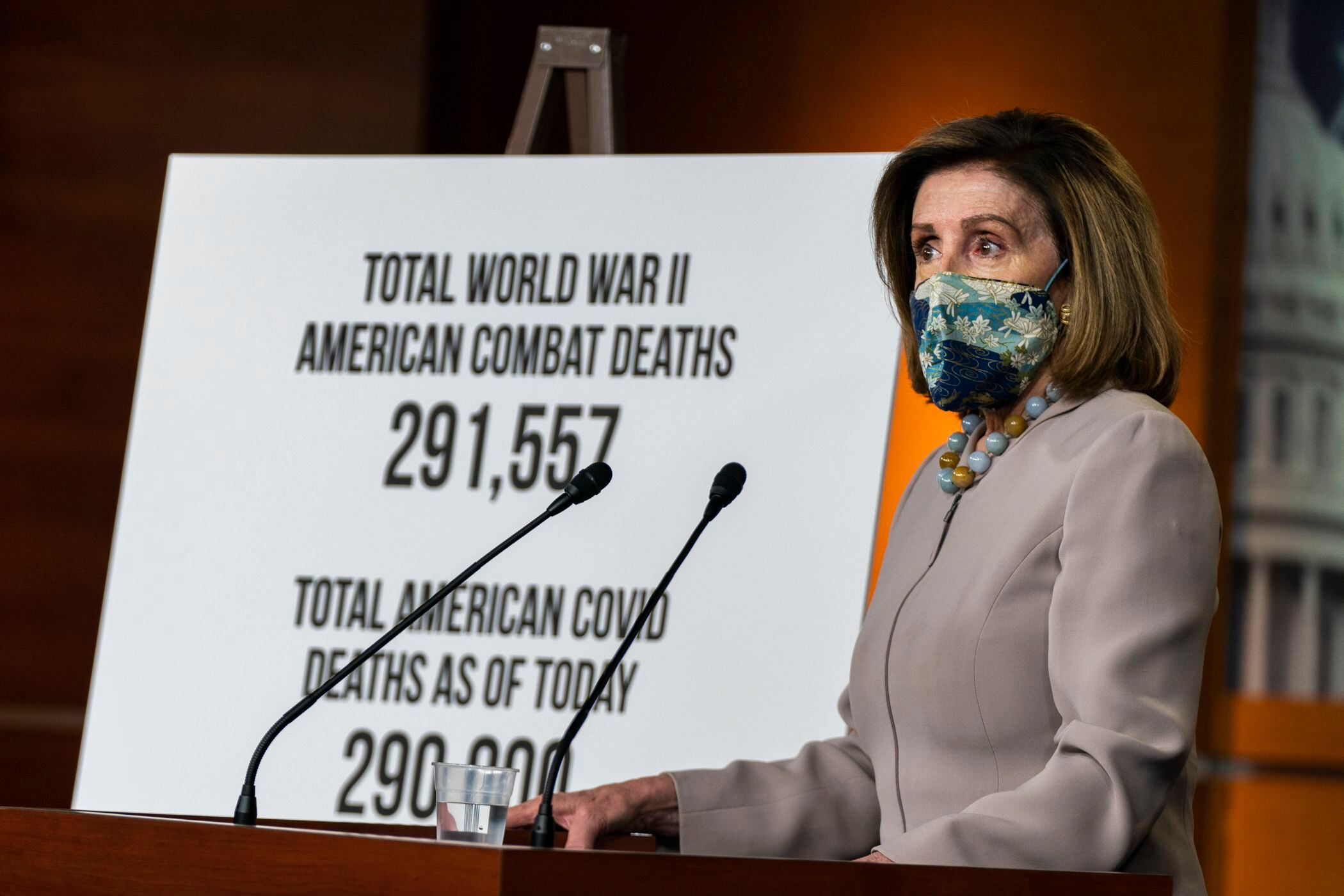
Talks on a long-delayed COVID-19 aid package intensified Tuesday as House Speaker Nancy Pelosi summoned other top congressional leaders for a potentially critical meeting.
Pelosi, D-Calif., spoke with Treasury Secretary Steven Mnuchin for more than an hour, her office tweeted, and Mnuchin will join the make-or-break meeting of Capitol Hill’s “big four” leaders by phone.
The uptick in activity could be a sign that an agreement is near, though COVID-19 relief talks have been notoriously difficult.
Pelosi hasn't met with Senate Republican Leader Mitch McConnell in months. The Kentucky Republican is playing a strong hand in the lame-duck session and is pressuring Democrats to drop a much-sought $160 billion aid package for states and local governments struggling to balance their budgets because of the pandemic.
Rank-and-file Democrats appear increasingly resigned to having to drop, for now, the party's demand for fiscal relief for states and local governments whose budgets have been thrown out of balance by the pandemic.
Pelosi, D-Calif., pressed in talks with Mnuchin on Monday for help for struggling states and localities. But top Democratic allies of President-elect Joe Biden came out in support of a $748 billion plan offered by a bipartisan group of lawmakers and hinted they won't insist on a pitched battle for state and local aid now.
“We cannot afford to wait any longer to act. This should not be Congress’ last COVID relief bill, but it is a strong compromise that deserves support from both Republicans and Democrats in the Senate," said Sen. Chris Coons, D-Del. “We cannot leave for the holidays without getting relief to those Americans who need it.”
The message from Coons, a confidant of Biden, and a similar message from Senate Majority Whip Dick Durbin, D-Ill., came as a bipartisan group of lawmakers unveiled a detailed COVID-19 aid proposal in hopes it would serve as a model for their battling leaders to follow as they try to negotiate a final agreement.
But the group was unable to forge a compromise on GOP-sought provisions shielding businesses from COVID-19-related lawsuits, a key priority of McConnell. He is pressing a lowest-common-denominator approach that would drop the lawsuit shield idea for now if Democrats agree to drop a $160 billion state and local aid package.
“We can live to fight another day on what we disagree on,” McConnell said Tuesday. “But we ought to go forward with what we can agree on."
Pelosi has insisted for months that state and local aid would be in any final bill, but as time is running out, Democrats appear unwilling to hold the rest of the package hostage over the demand. Several Democrats appeared at a bipartisan news conference on Monday to endorse the $748 billion package.
“We’re not going home until this is done,” said Sen. Joe Manchin, D-W.Va., on CNN Tuesday morning. “We’ve got to get people a lifeline. It will pass — the $748 (billion).”
The $748 billion aid package contains money for struggling businesses, the unemployed, schools and vaccine distribution. There is also $45 billion for transportation and transit assistance, funding for rural internet service and help for the Postal Service, among other provisions. The other bill proposes a $160 billion aid package for state and local governments and a modified liability shield that is backed by Republicans and Democratic moderate Manchin, but it is probably too politically freighted to advance.
Outstanding issues in the leadership talks include a potential second round of direct payments to individuals, a plan for $300-per-week bonus unemployment benefits, state and local aid, and the GOP-sought liability shield against COVID-19-related lawsuits.
Lawmakers also worked to finalize a yearend catchall funding package that will be the basis for the last significant legislation of the Trump presidency.
There's a hoped-for deadline of midnight Friday to deliver the completed package to President Donald Trump, which is when a partial government shutdown would arrive with the expiration of last week's temporary funding bill. But there's no guarantee that the massive yearend measure will be completed in time. If the talks drag, further temporary bills could be needed.
Negotiations on the $1.4 trillion catchall spending bill are “essentially finished," said a congressional aide participating in the talks. While details are closely held, “the status quo is prevailing." That means Trump would get another $1.4 billion or so for a final installment to continue construction of his long-sought U.S.-Mexico border wall.
Republicans have succeeded in killing a $12 billion plan to break last year's budget mini-agreement by using accounting maneuvers to pad veterans health care funding to accommodate big cost increases from expanding access to health care services from private providers. Instead, a different set of moves is being employed to provide for equivalent spending increases for other domestic programs.
The post-election lame-duck session is the last chance to wrap up the unfinished work this year, a goal of all involved, though they have been slow until now to forge the often-tricky compromises required to pull the measure together.
Pelosi has not thrown in the towel on her drive to obtain state and local aid, which was part of the almost $2 trillion CARES Act that passed the Senate unanimously in March. The $150 billion aid package to states and large cities evoked little controversy then, but many Republicans are adamantly against the idea now, though any additional aid would also go to smaller municipalities left out of the prior round.