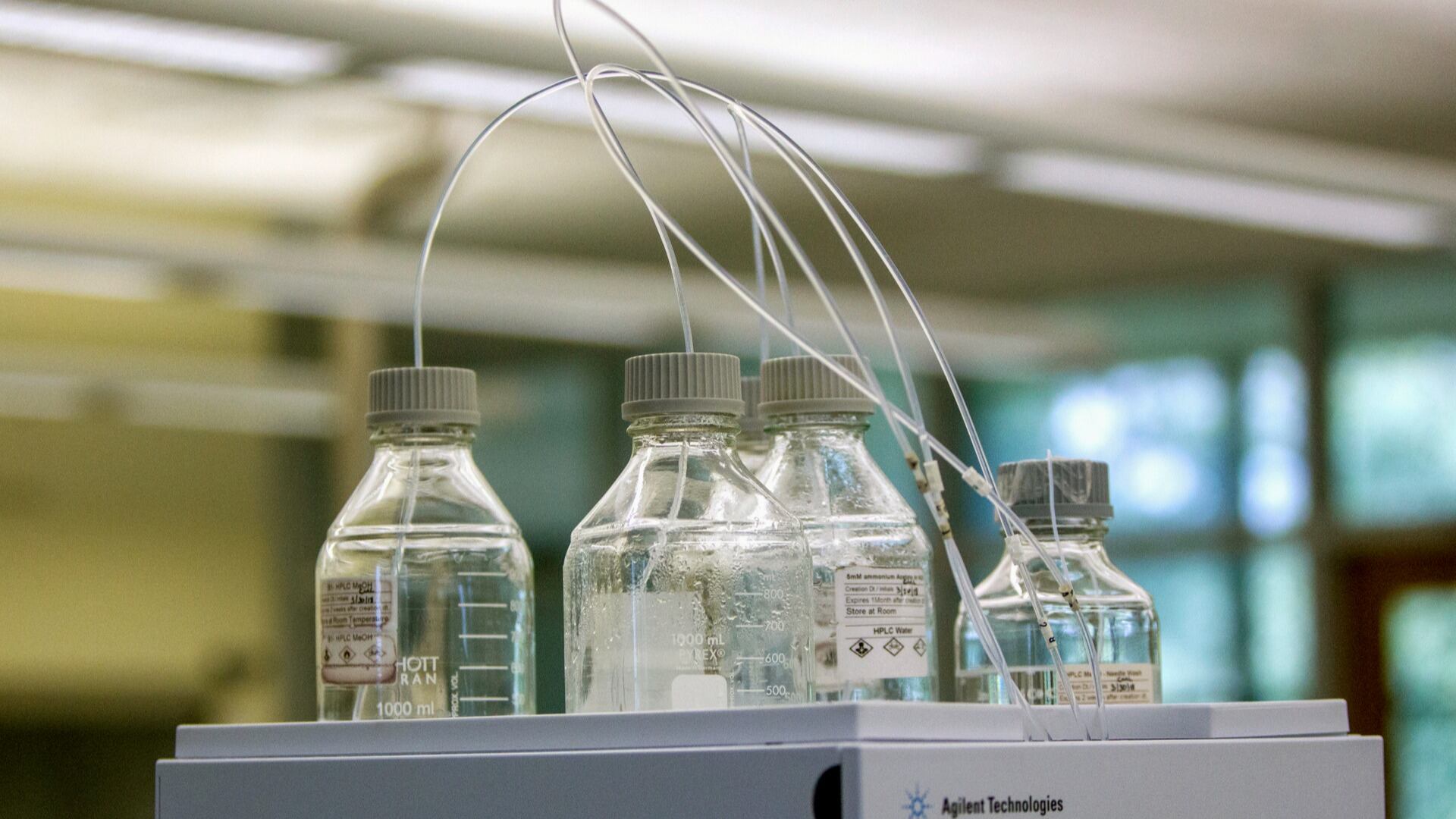
FILE - Equipment used to test for perfluoroalkyl and polyfluoroalkyl substances, known collectively as PFAS, in drinking water is seen at Trident Laboratories in Holland, Mich., June 18, 2018. Drinking water from nearly half of U.S. faucets likely contains “forever chemicals” linked to kidney cancer and other health problems, according to a government study released Wednesday, July 5, 2023. (Cory Morse/The Grand Rapids Press via AP, File)
TRAVERSE CITY, Mich. (AP) — Drinking water from nearly half of U.S. faucets likely contains “forever chemicals” that may cause cancer and other health problems, according to a government study released Wednesday.
The synthetic compounds known collectively as PFAS are contaminating drinking water to varying extents in large cities and small towns — and in private wells and public systems, the U.S. Geological Survey said.
Researchers described the study as the first nationwide effort to test for PFAS in tap water from private sources in addition to regulated ones. It builds on previous scientific findings that the chemicals are widespread, showing up in consumer products as diverse as nonstick pans, food packaging and water-resistant clothing and making their way into water supplies.
Because the USGS is a scientific research agency, the report makes no policy recommendations. But the information “can be used to evaluate risk of exposure and inform decisions about whether or not you want to treat your drinking water, get it tested or get more information from your state" about the situation locally, said lead author Kelly Smalling, a research hydrologist.
The U.S. Environmental Protection Agency in March proposed the first federal drinking water limits on six forms of PFAS, or per- and polyfluorinated substances, which remain in the human body for years and don't degrade in the environment. A final decision is expected later this year or in 2024.
But the government hasn't prohibited companies using the chemicals from dumping them into public wastewater systems, said Scott Faber, a senior vice president of the Environmental Working Group, an advocacy organization.
“We should be treating this problem where it begins, instead of putting up a stoplight after the accident," he said. “We should be requiring polluters to treat their own wastes.”
Studies of lab animals have found potential links between PFAS chemicals and some cancers, including kidney and testicular, plus issues such as high blood pressure and low birth weight.
Federal and state programs typically measure exposure to pollutants such as PFAS at water treatment plants or groundwater wells that supply them, Smalling said. In contrast, the USGS report was based on samples from taps in 716 locations, including 447 that rely on public supplies and 269 using private wells.
The samples were taken between 2016 and 2021 in a range of locations — mostly residences but also a few schools and offices. They included protected lands such as national parks; residential and rural areas with no identified PFAS sources; and urban centers with industry or waste sites known to generate PFAS.
Most taps were sampled just once. Three were sampled multiple times over a three-month period, with results changing little, Smalling said.
Scientists tested for 32 PFAS compounds — most of the ones detectable through available methods. Thousands of others are believed to exist but can't be spotted with current technology, Smalling said.
The types found most often were PFBS, PFHxS and PFOA. Also making frequent appearances was PFOS, one of the most common nationwide.
Positive samples contained as many as nine varieties, although most were closer to two. The median concentration was around seven parts per trillion for all 32 PFAS types, although for PFOA and PFOS it was about four parts per trillion — the limit EPA has proposed for those two compounds.
The heaviest exposures were in cities and near potential sources of the compounds, particularly in the Eastern Seaboard; Great Lakes and Great Plains urban centers; and Central and Southern California. Many of the tests, mostly in rural areas, found no PFAS.
Based on the data, researchers estimated that at least one form of PFAS could be found in about 45% of tap water samples nationwide.
The study underscores that private well users should have their water tested for PFAS and consider installing filters, said Faber of the Environmental Working Group. Filters containing activated carbon or reverse osmosis membranes can remove the compounds.
The USGS study is “further evidence that PFAS is incredibly pervasive and folks who rely on private wells are particularly vulnerable to the harms caused by these chemicals,” Faber said.
After the latest school shooting in Uvalde, Texas, it wouldn't be a surprise if the traumatic event takes a toll on your mental health — or that of your children. Amy Morin, the editor-in-chief of Verywell Mind and licensed psychotherapist, joined Cheddar News to share coping skills and offer advice about how to talk to your children about these increasingly common tragic events. “I think its important for parents to know what the school’s plan is, what the teacher's plan is, and then we can have our own plans with kids too," she noted. "It's so important for us to talk to kids about how they're feeling — guaranteed they've heard something about it, so ask them what they know already, use age-appropriate language, and rather than just dismissing their fears by saying don't worry about it or I'm sure you'll be safe, talk to them about their feelings."
An recently conducted AP-NORC poll found that majorities of the Black and Hispanic populations in the U.S. still find themselves either somewhat worried or extremely worried over the pandemic, while more than half of white Americans responded with either being not too worried or not worried at all. Dr. Chris Pernell, the chief strategic integration and health equity officer at University Hospital, joined Cheddar News to talk about how perceptions of COVID-19 differ between groups of Americans. "We’re still seeing people get infected, and because of the toll of the disproportionate impact, we have concerns among the Black and brown community about whether or not they have an increased risk of exposure because of where they work, because of the use of public transportation, because they live in homes that they may not be able to safely quarantine and or isolate in, and because they have at baseline chronic health conditions that may make coronavirus more severe in those persons," she said.
Judith Enck, a former regional administrator for the EPA and the president of Beyond Plastics, joined Cheddar News to talk about the role of plastics in the climate crisis and California's investigation of ExxonMobil and other oil companies for misleading the public on the ability to recycle plastics. "The reason why petrochemical companies like Exxon have gotten away with selling more and more plastic is that they've lied to the public and told us don't worry about all those negative upstream impacts and downstream impacts of plastics. Just be sure to recycle it. Well, guess what? Plastics largely are not recycled," Enck said.
Catching you up on what you need to know on April 29, 2022, with President Biden asking Congress for a $33 billion aid package for Ukraine, a shrinking GDP potentially leading to a recession, Beijing banning weddings and funerals while closings schools amid COVID, and more.
Virtual care and digital medicine provider Biofourmis recently raised $300 million in a Series D round led by General Atlantic and with participation from CVS Health. Biofourmis offers at-home care and digital therapies backed by artificial intelligence, which can remotely monitor patients while they are at home. The company says it hopes its technology can improve patient outcomes while reducing the cost and burden of care. Kuldeep Signh Rajput, Founder and CEO of Biofourmis, joins Cheddar News' Closing Bell to discuss.
Moderna is asking the FDA to consider emergency use authorization for its COVID vaccine to be used with children under 6 years old. Dr. Christina Johns, a senior medical advisor at PM Pediatrics, joined Cheddar News to talk about the pharmaceutical company's research into the safety and efficacy of the vaccine for the very youngest of children. "This is very exciting news because children met that goal in their neutralizing antibody response in this age group — means that we really can extrapolate a lot from what we know about data in adults," she said. "I will say that there's a caveat that we have not seen yet the full dataset released, so I'm waiting for that and my fingers are crossed for next week."
Mental health platform Real recently raised $37 million in a Series B round led by Owl Ventures. Through its mobile app, Real says it provides mental health care at a lower cost than traditional therapy and aims to make mental wellness a part of everyone's daily routine. The company also announced that U.S. soccer star Megan Rapinoe will serve as an adviser to the company. Ariela Safira, Founder & CEO of Real, joins Cheddar News' Closing Bell to discuss.
Catching you up on what you need to know on April 28, 2022, with Elon Musk mocking Twitter's top legal exec Vijaya Gadde on the platform itself, a probe in George Floyd's death finding discrimination within the Minneapolis police force, the latest California drought leading to new water restrictions, and more.