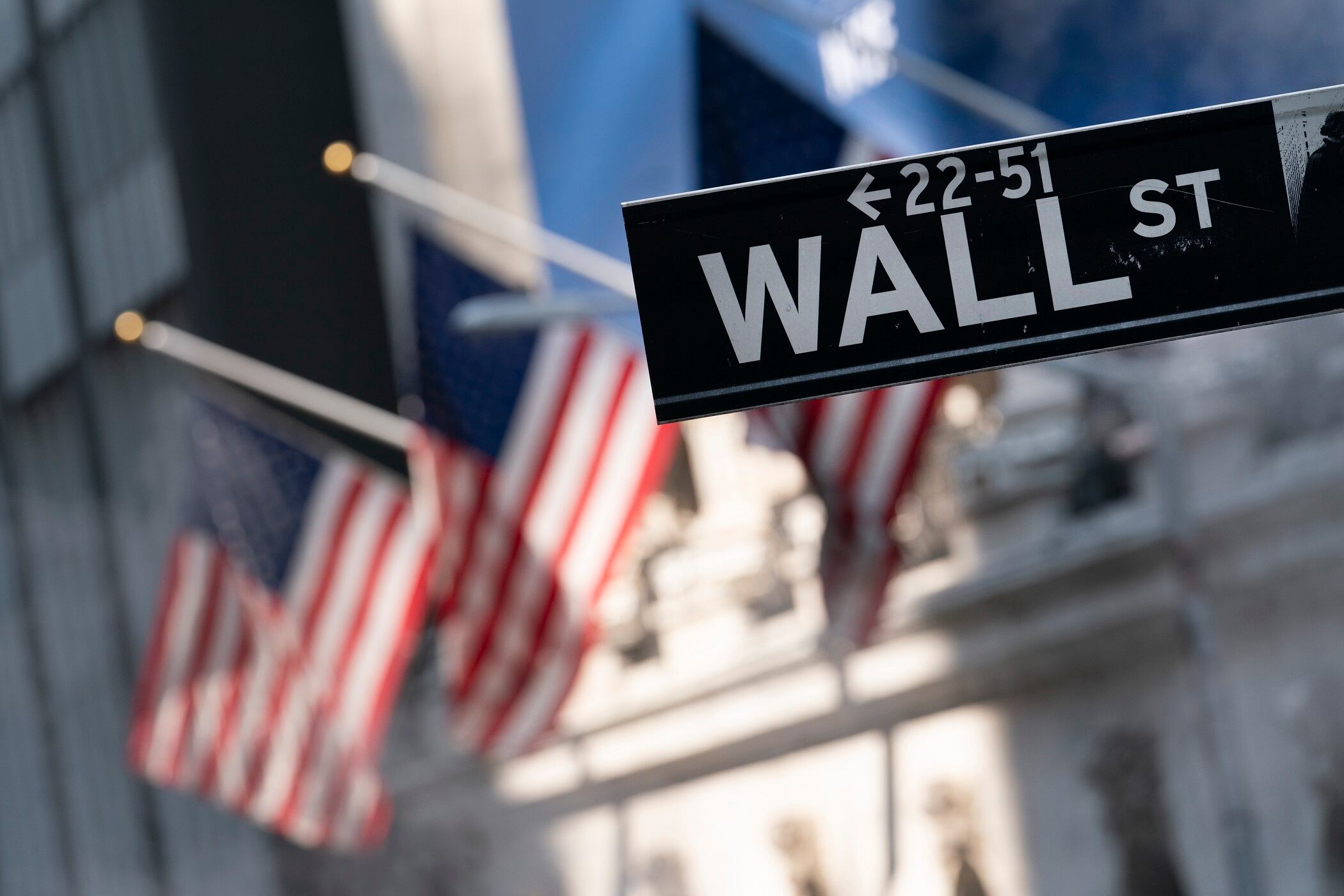
A sign for Wall Street hangs in front of the New York Stock Exchange, July 8, 2021. Stocks are off to a mostly lower start on Wall Street Friday, Sept. 17, as the market heads for a weak ending to an up-and-down week of trading. (AP Photo/Mark Lennihan, file)
By Damian J. Troise and Alex Veiga
Wall Street capped an up-and-down week of trading Friday with a broad sell-off that wiped out the major indexes' gains for the week.
The S&P 500 lost 0.9% and posted its second straight weekly loss. Roughly 80% of the stocks in the benchmark index fell. Technology and communication companies accounted for much of the pullback. Industrial and financial stocks also were big drags on the index. Only the index's health care sector managed a gain.
Small-company stocks bucked the overall market slide. Bond yields rose broadly. Energy prices fell.
Trading has been choppy throughout the week as investors weighed a mixed bag of economic data reflecting how the economy is weathering a spike in COVID-19 cases and how it might continue its recovery in the coming months. Wall Street is also looking ahead to next Wednesday, when the Federal Reserve is due to deliver its latest economic and interest rate policy update.
"We’ve seen a gradual deterioration over the course of the week, with two little up periods, but for the most part, generally a weakening (stock) market,” said Alan McKnight, chief investment officer at Regions Asset Management.
The S&P 500 fell 40.76 points to 4,432.99. Despite being down about 0.6% for the week, the index is within 2.3% of the all-time high it set Sept. 2.
The Dow Jones Industrial Average fell 166.44 points, or 0.5%, to 34,584.88, while the tech-heavy Nasdaq composite slid 137.96 points, or 0.9%, to 15,043.97.
The Russell 2000 index of smaller companies recovered from an early slide and rose 3.96 points, or 0.2%, to 2,236.87.
Bond yields rose. The yield on the 10-year Treasury rose to 1.38% from 1.33% late Thursday.
Technology and communication stocks were the biggest weights on the market. Apple fell 1.8% and Facebook dropped 2.2%.
Oil prices fell 0.9% and natural gas prices fell 4.3%. The weak energy prices helped pull down energy stocks. Oilfield services company Schlumberger fell 1.9%.
Health care stocks eked out gains. Lab equipment maker Thermo Fisher Scientific was a standout with a 6.5% jump after giving investors an encouraging business update. Some travel-related stocks made solid gains. Cruise line operator Carnival rose 2%, while Norwegian Cruise Line gained 2.1%.
Also influencing the market’s gyrations was “quadruple witching,” the simultaneous expiration of four kinds of options and futures contracts. The phenomenon happens four times a year and forces traders to tie up loose ends in contracts they hold. More than 750 billion single stock options were due to mature Friday, said McKnight.
“Just the sheer size of that plays into this,” he said. “It creates more volume in the market and some of the volatility associated with that.”
Much of this week’s economic data pointed to an economy struggling to move forward in the last few months. Inflation remains a concern for businesses, which are dealing with supply chain problems and facing higher costs. Concerns about the highly contagious delta variant also have analysts worried that consumer spending, a key piece of economic growth, could stall.
Investors will have their eye on the Fed next week to see whether the central bank takes any action to address the impact of rising prices on businesses and consumers. The Fed has said higher costs for raw materials and consumer goods will likely remain temporary as the economy recovers, but analysts are concerned that the higher prices could stick around and dent companies’ bottom lines while also crimping spending.
Plans to add affordable housing to a development in Yellow Springs, Ohio, were squashed after comedian Dave Chappelle and other community members spoke out against the project. Chappelle threatened to pull the plug on his local comedy club and restaurant projects if the development had been approved.
Jason Moser, Senior Analyst at The Motley Fool, joined Wake Up With Cheddar to talk about the big takeaways from Disney's Q1 report, which showed the company nearing 130 million Disney+ subscribers as parks revenue ticks up.
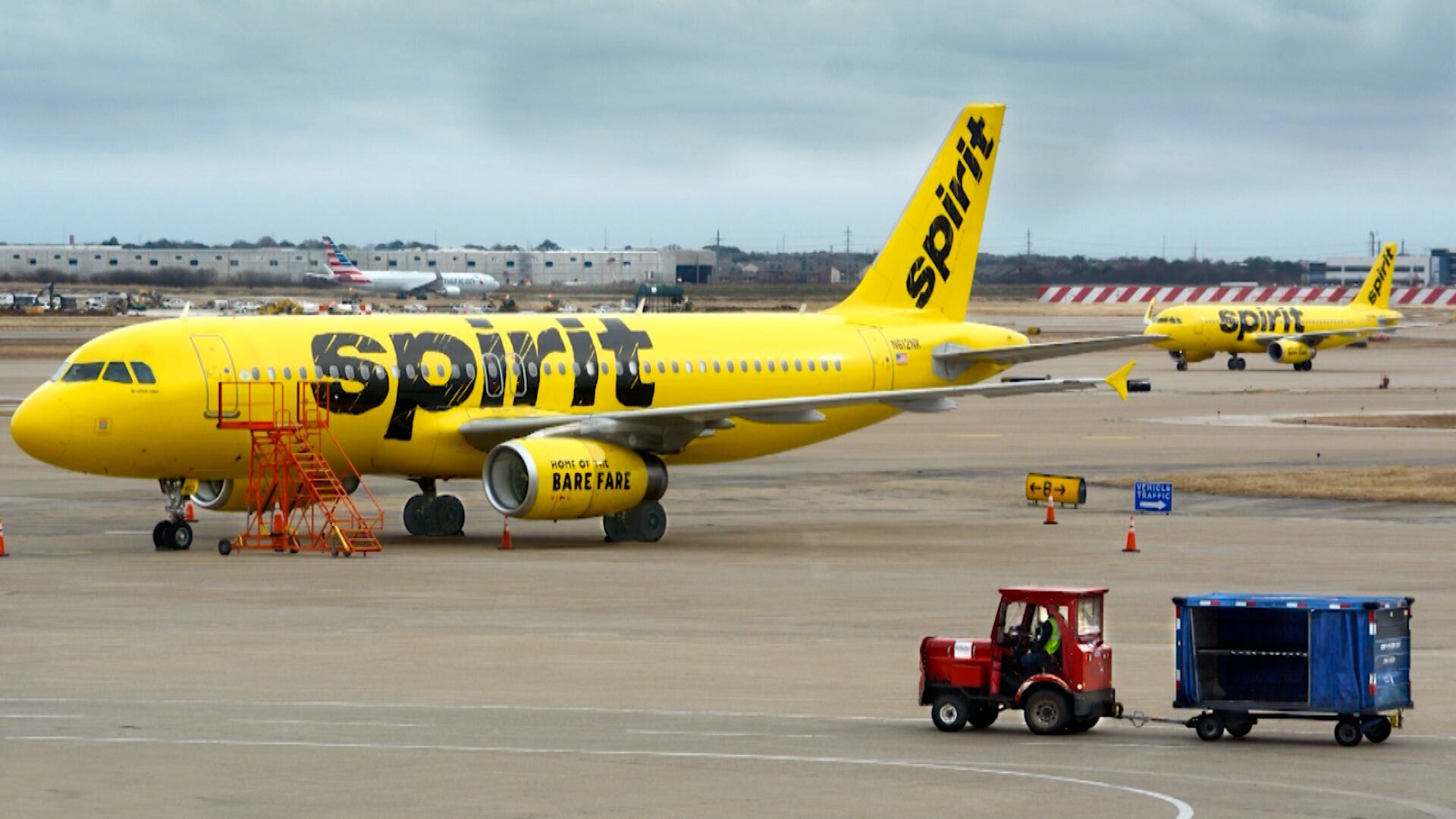
The airline industry is seeing a major consolidation as Frontier and Spirit Airlines have agreed to merge in a deal valued at $6.6 billion dollars. Frontier will control just over 51% of the company, and Spirit will control the other 48%, creating what would become the fifth-largest airline in the U.S. The deal was approved over the weekend, with Spirit CEO Ted Christie saying that the merger aims to create an aggressive, low-fare competitor focused on consumer-friendly pricing. John Grant, Senior Analyst at OAG explains the gravity of the merger, and the wider impact it could have on competition and the airline industry as a whole.
Cheeze, Inc. is a media platform that hopes to help photographers to tell stories through the use of NFT’s. Simon Hudson, founder and CEO of Cheeze, Inc. joined Cheddar News to explain the process as well as teasing its "Women of Authenticity" display for Women’s History Month. "We've made it very simple and focused very hard on reducing all of the friction to bring their items to the blockchain." Hudson explained. He also addressed reports that cloud software giant Salesforce could be getting into the NFT marketplace.
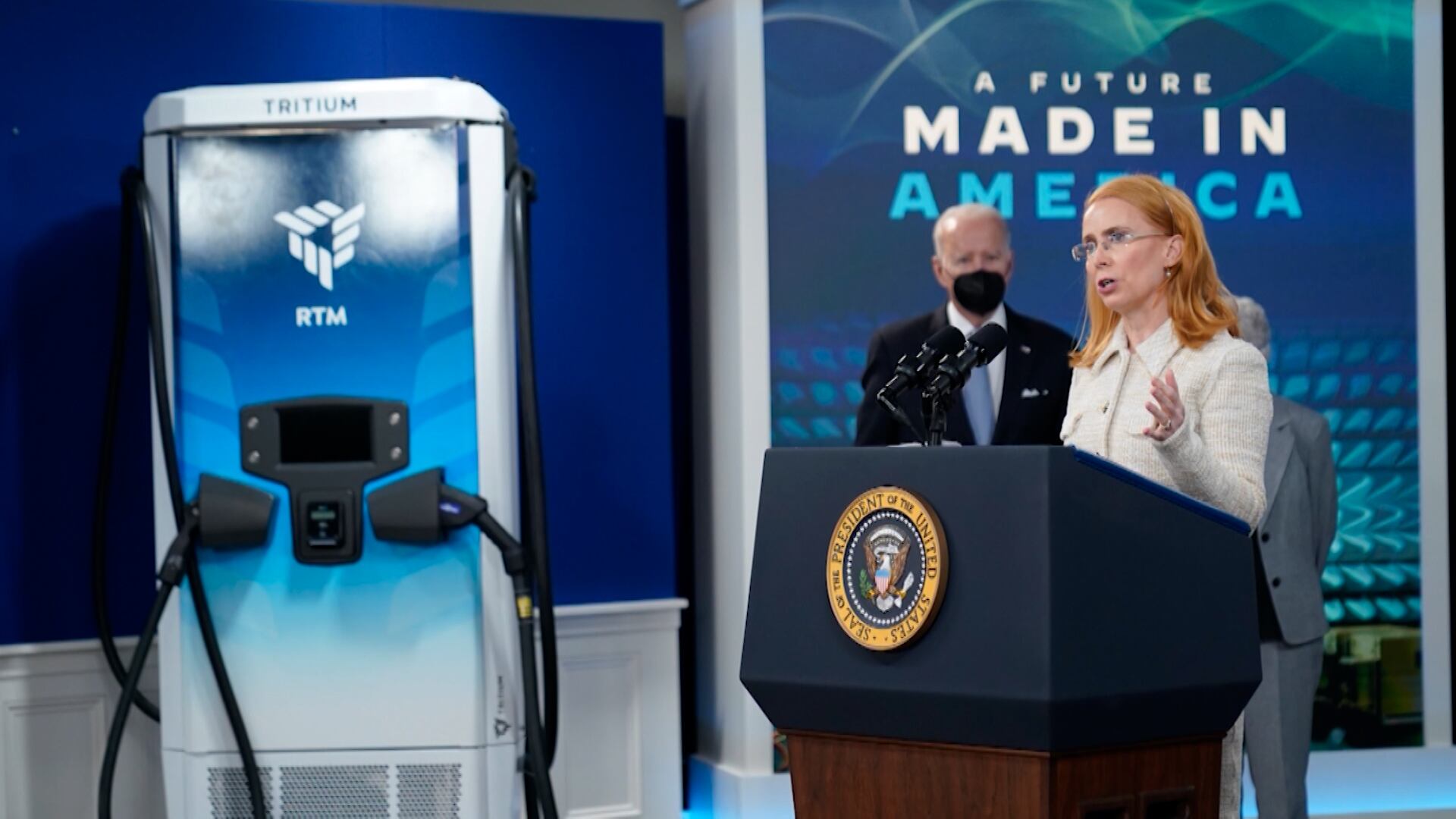
President Biden's push for electric vehicles is doing more than trying to hold off climate change as it also hopes to revive American manufacturing jobs. The latest company to open an EV charging production plant in the U.S. is Australia-based Tritium, looking to open its new Lebanon, Tennessee, facility in the fall of 2022. It's expected to create at least 500 jobs in the region and reach a production capacity of 10,000 charging units per year. Jane Hunter, CEO and executive director of Tritium, joined Closing Bell to discuss the plant, production capacity, and working with the Biden administration. "The policies that they put in place have directly driven demand for our fast charging products," she said. "Discussions that we have are just incredibly positive because this administration wants to have an electric superhighway that runs all across the country so that it's open equitably for all people to drive electric vehicles."
Samsung unveiled its latest product lineup, including a new family of Galaxy S22 smartphones featuring the S22 Ultra with a larger screen, more powerful camera, and the Samsung S Pen stylus. The company also revealed its latest tablet, the Tab S8 Ultra, featuring a 14.6" screen, expanded storage, and 4K video capability. Cheddar News was able to showcase each device as Allison Johnson, reviews writer at The Verge, joined Closing Bell to discuss the new releases, the standout features, and more.
Shares of Canadian cannabis giant Canopy Growth surged after the company reported Q3 earnings Wednesday morning, with shares up more than 15 percent at the close of the day's trading session. Despite net revenue declining year-over-year, Canopy beat analyst expectations and has ramped up efforts to develop a "THC ecosystem' in the U.S. Canopy Growth's CEO, David Klein, joined Cheddar News' Closing Bell to discuss the report. He noted that its brands Storz & Bickel vaporizers and BioSteel beverages showed record growth.