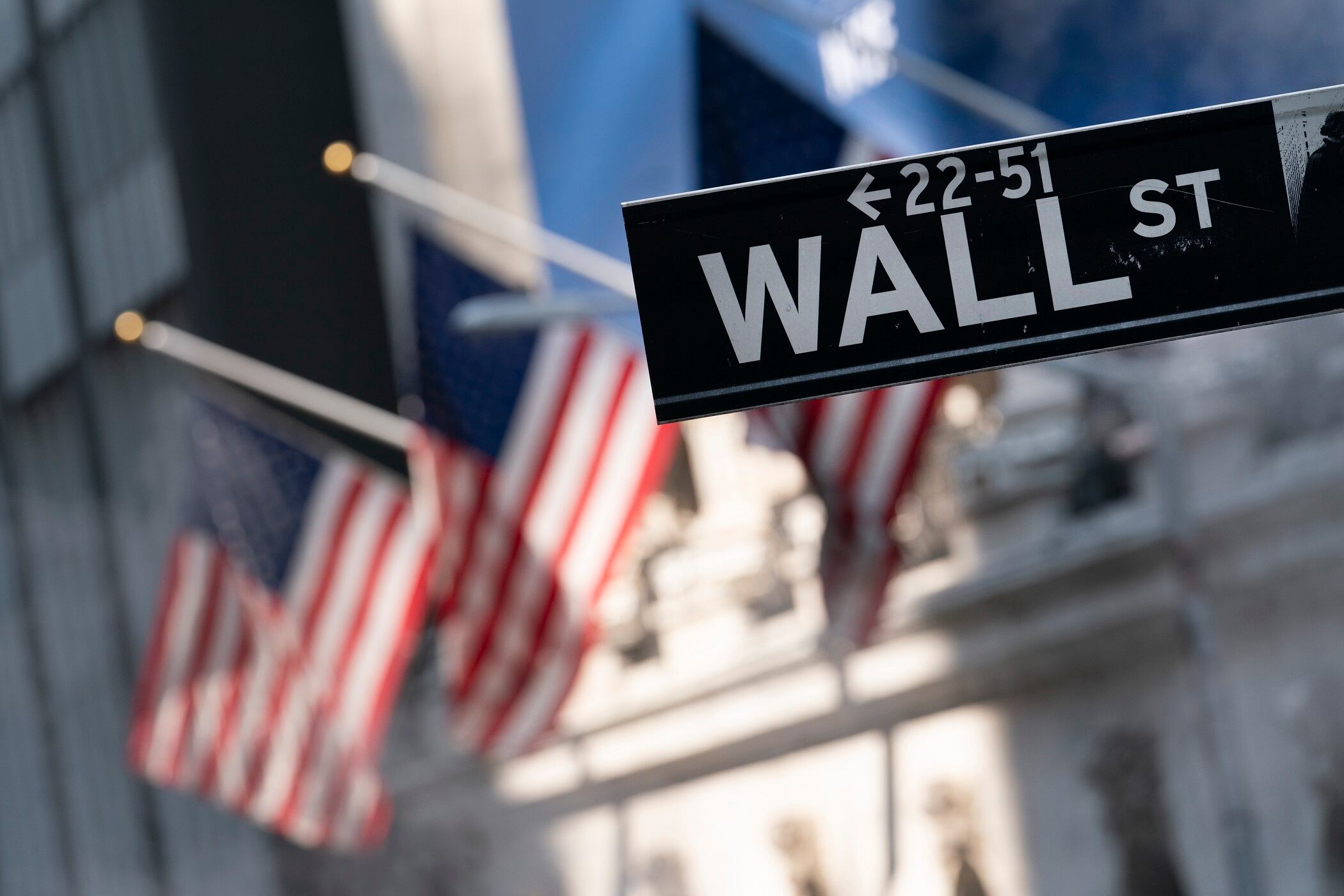
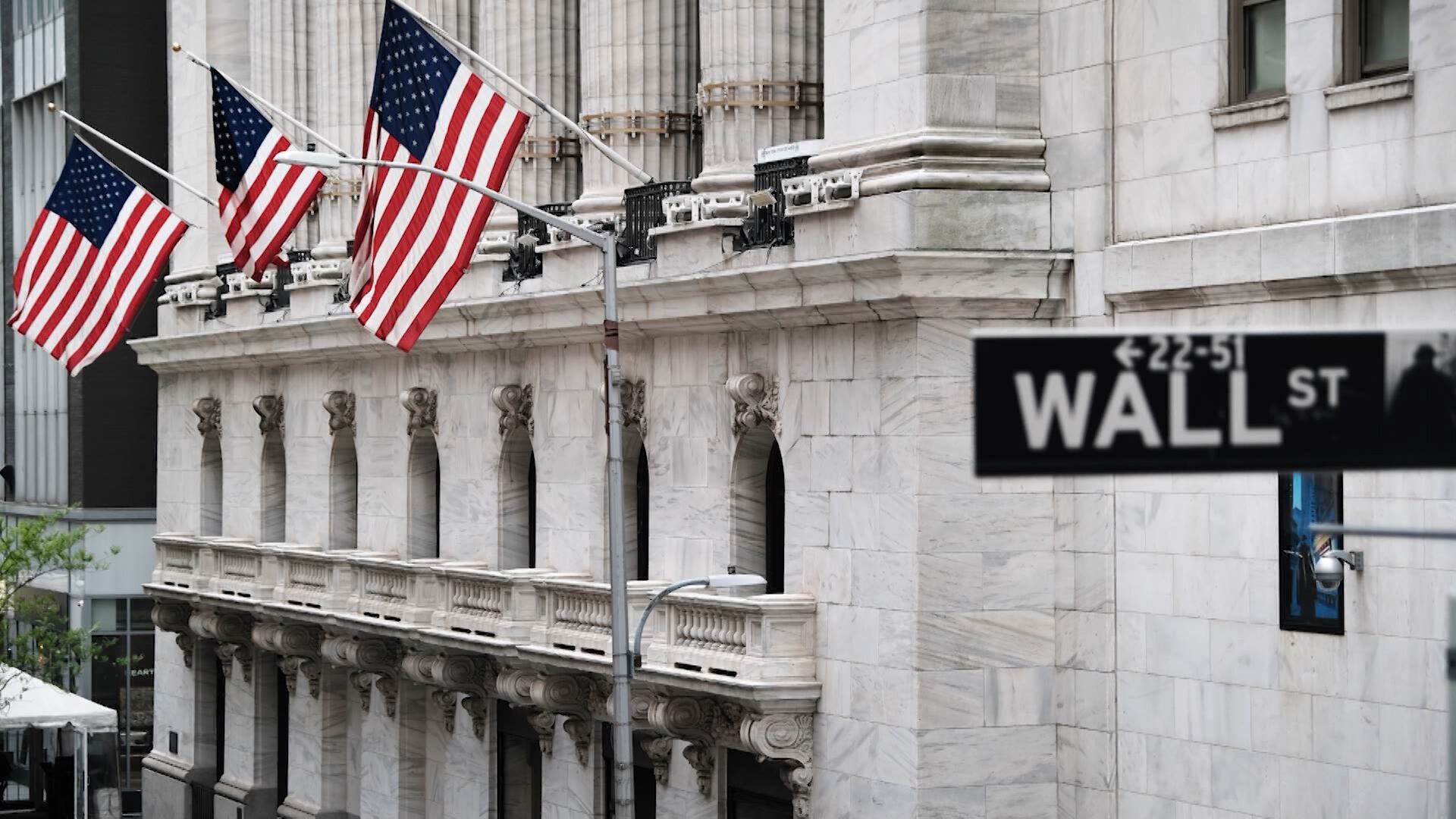
A sign for Wall Street hangs in front of the New York Stock Exchange, July 8, 2021. Stocks are off to a mostly lower start on Wall Street Friday, Sept. 17, as the market heads for a weak ending to an up-and-down week of trading. (AP Photo/Mark Lennihan, file)
By Damian J. Troise and Alex Veiga
Wall Street capped an up-and-down week of trading Friday with a broad sell-off that wiped out the major indexes' gains for the week.
The S&P 500 lost 0.9% and posted its second straight weekly loss. Roughly 80% of the stocks in the benchmark index fell. Technology and communication companies accounted for much of the pullback. Industrial and financial stocks also were big drags on the index. Only the index's health care sector managed a gain.
Small-company stocks bucked the overall market slide. Bond yields rose broadly. Energy prices fell.
Trading has been choppy throughout the week as investors weighed a mixed bag of economic data reflecting how the economy is weathering a spike in COVID-19 cases and how it might continue its recovery in the coming months. Wall Street is also looking ahead to next Wednesday, when the Federal Reserve is due to deliver its latest economic and interest rate policy update.
"We’ve seen a gradual deterioration over the course of the week, with two little up periods, but for the most part, generally a weakening (stock) market,” said Alan McKnight, chief investment officer at Regions Asset Management.
The S&P 500 fell 40.76 points to 4,432.99. Despite being down about 0.6% for the week, the index is within 2.3% of the all-time high it set Sept. 2.
The Dow Jones Industrial Average fell 166.44 points, or 0.5%, to 34,584.88, while the tech-heavy Nasdaq composite slid 137.96 points, or 0.9%, to 15,043.97.
The Russell 2000 index of smaller companies recovered from an early slide and rose 3.96 points, or 0.2%, to 2,236.87.
Bond yields rose. The yield on the 10-year Treasury rose to 1.38% from 1.33% late Thursday.
Technology and communication stocks were the biggest weights on the market. Apple fell 1.8% and Facebook dropped 2.2%.
Oil prices fell 0.9% and natural gas prices fell 4.3%. The weak energy prices helped pull down energy stocks. Oilfield services company Schlumberger fell 1.9%.
Health care stocks eked out gains. Lab equipment maker Thermo Fisher Scientific was a standout with a 6.5% jump after giving investors an encouraging business update. Some travel-related stocks made solid gains. Cruise line operator Carnival rose 2%, while Norwegian Cruise Line gained 2.1%.
Also influencing the market’s gyrations was “quadruple witching,” the simultaneous expiration of four kinds of options and futures contracts. The phenomenon happens four times a year and forces traders to tie up loose ends in contracts they hold. More than 750 billion single stock options were due to mature Friday, said McKnight.
“Just the sheer size of that plays into this,” he said. “It creates more volume in the market and some of the volatility associated with that.”
Much of this week’s economic data pointed to an economy struggling to move forward in the last few months. Inflation remains a concern for businesses, which are dealing with supply chain problems and facing higher costs. Concerns about the highly contagious delta variant also have analysts worried that consumer spending, a key piece of economic growth, could stall.
Investors will have their eye on the Fed next week to see whether the central bank takes any action to address the impact of rising prices on businesses and consumers. The Fed has said higher costs for raw materials and consumer goods will likely remain temporary as the economy recovers, but analysts are concerned that the higher prices could stick around and dent companies’ bottom lines while also crimping spending.
Art Hogan, Chief Market Strategist at National Securities, joined Cheddar News' Closing Bell, where he says investors are taking a wait-and-see approach when it comes to the situation between Russia and the Ukraine and elaborates on the impact higher oil prices stemming from the conflict would have on the market.
Kyle Jaeger, senior editor for Marijuana Moment, joined Cheddar News' Closing Bell, where he explains why a stigma still exists for the cannabis industry in advertising and social media after NBC rejected Weedmaps' ad for the big game even though more states across the country are legalizing cannabis.
A bipartisan bill introduced by U.S. Senators Amy Klobuchar (D-MN) and Cynthia Lummis (R-WY) aims to tackle the spread of misinformation on social media platforms, as well as the addictive nature of the sites and negative mental health impacts they have on users. The 'Nudge Act' would require studies to find and compile potential interventions that platforms could use to encourage people to think before they share a post, or log off after spending too much time on an app. The FTC would create rules based on these findings, and hold the platforms accountable. But will it work? Jesse Lehrich, co-founder of Accountable Tech, joins Closing Bell to discuss the bill, whether real results and regulations could come from it, and more.
We know that the Los Angeles Rams emerged as Super Bowl champions, but the crypto industry also came out a winner on Sunday with several notable companies getting airtime in primetime. However, Richard Smith, author of the Risk Rituals Newsletter, joins Cheddar News' Closing Bell, where he says the campaigns were a 'disappointment' and adds that crypto companies would be wiser spending their resources on creating value.
A.I.-based entertainment company, Deedub, recently raised
$20 million in a Series A round, led by Insight Partners. Deepdub uses A.I. technology to automate the dubbing process for foreign-language movies or TV shows, while using actors' original voices. The company says it can take just two to three minutes of data from an actor's voice and transform the voice into a different language. The funding comes as foreign-language films and shows like Netflix's 'Squid Game' have recently become more popular with audiences in the U.S. and around the world. Oz Krakowski, Chief Revenue Officer at Deepdub, joins Cheddar News' Closing Bell to discuss.
Energy Vault, the company developing sustainable, grid-scale energy storage solutions, is now trading on the New York Stock Exchange following the completion of its business combination with Novus Capital Corporation II. Energy Vault develops sustainable, grid-scale energy storage solutions designed to advance the transition to a carbon free, resilient power grid. Robert Piconi, co-founder and CEO of Energy Vault, joins Cheddar News' Closing Bell to disucss.
A new mobile app has launched just in time for Valentine's Day. Our.Love bills itself as an A.I.-powered, gamified, relationship wellness app for couples. The app is set in what the company calls the Coupleverse, a virtual world where each couple can build a virtual relationship home as they also build their real-world relationship. Founder and CEO Tal Zlotnitsky joined Cheddar to discuss how the app works. "The concept behind Our.Love is to give people the opportunity to understand where they stand in their relationship through very simple metrics that we provide within the app that will help them in real-time, see where they stand, see where their partner is, and be able to get closer together," he said.
Alyson Wilson, VP of Brand Innovation at Alo Yoga, joins Cheddar News to discuss the yoga apparel company entering the metaverse and teaming up with Spring Studios for New York Fashion Week.