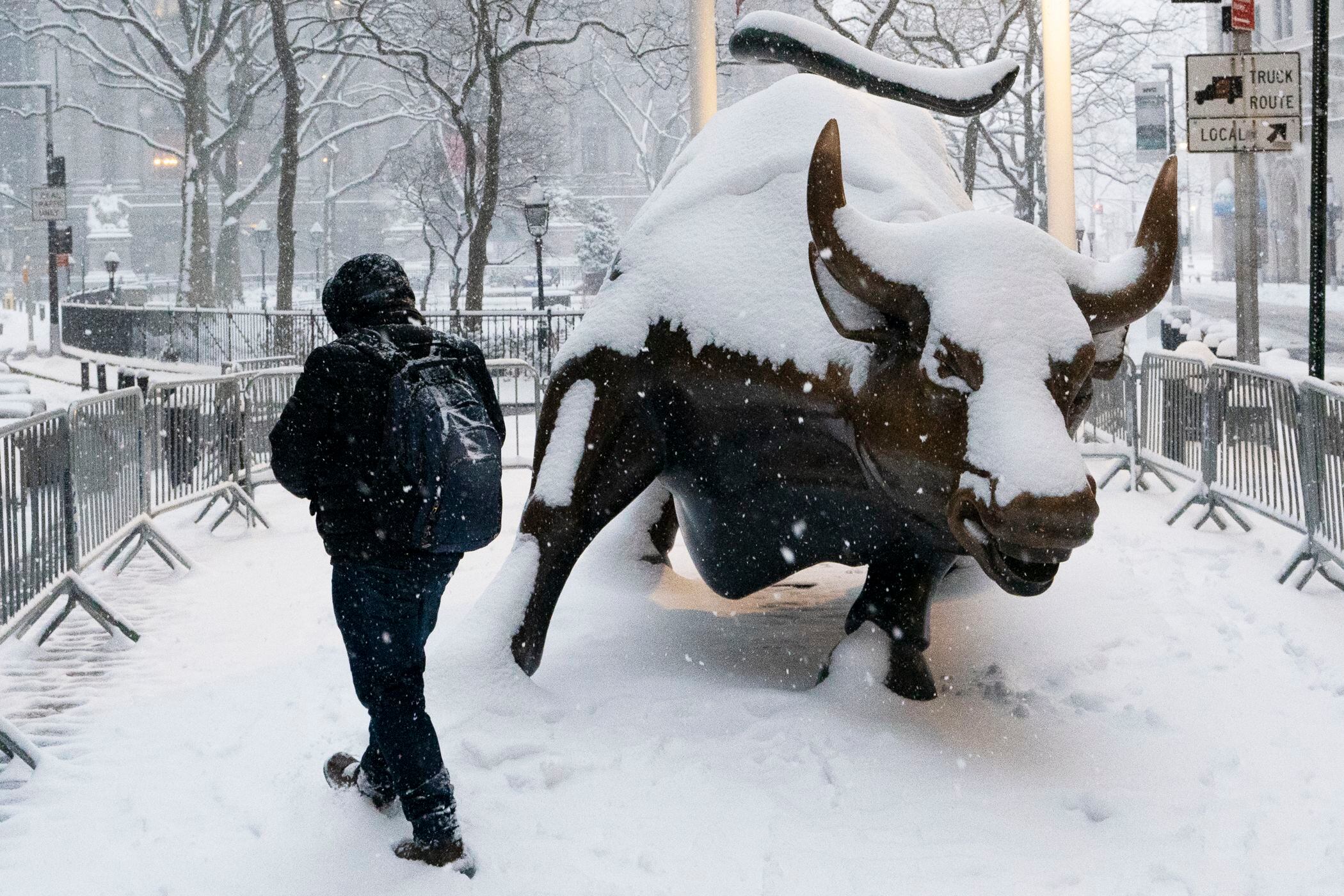
A man walks past the Charging Bull statue during a snowstorm, Monday, Feb. 1, 2021, in New York's financial district. (AP Photo/Mark Lennihan)
By Damian J. Troise and Alex Veiga
Stocks notched broad gains on Wall Street Monday, clawing back some of their losses following the market's worst weekly loss since October.
The S&P 500 rose 1.6%. The benchmark index was coming off a 3.3% slide last week, when volatility spiked as online traders hoping to inflict damage on hedge funds fueled a frenzy in GameStop and a few other stocks.
Investors large and small continued to focus those stocks Monday, and GameStop slumped 30.8% to $225 a share, the latest rocky ride for the stock, which ended last year at about $18.
Meanwhile, the price of silver jumped at one point to its highest level in eight years. Analysts said the precious metal became another target for online investors seeking to go up against big Wall Street players.
A measure of fear in the market, the VIX, fell Monday, suggesting some of last week's market jitters were easing, said Pauline Bell, analyst at CFRA Research.
“Today the market is sensing that the heightened volatility that we saw over the last week is reverting to a more settled type of volume,” Bell said. “The market is sensing the return to normalcy.”
The S&P 500 gained 59.62 points to 3,773.86. The Dow Jones Industrial Average rose 229.29 points, or 0.8%, to 30,211.91. The Nasdaq composite climbed 332.70 points, or 2.6%, to 13,403.39.
The gains were broad, with technology companies leading the way higher. Communication stocks and a variety of companies that rely on direct consumer spending such as Starbucks and AutoZone also helped lift the market.
Smaller companies also notched solid gains. The Russell 2000 index of small-cap stocks picked up 52.52 points, or 2.5%, to 2,126.16.
Monday's steep drop in GameStop echoed what has become a typical move for a company that has regularly seen double-digit swings most of the last two weeks. Trading of the retailer was still limited on trading platforms like Robinhood.
Silver for March delivery rose $2.50, or 9%, to settle at $29.42 an ounce. Some analysts called the price jump the latest assault by the smaller investors who sent GameStop soaring recently. But many of those same traders instead called it a trap set by hedge funds to divert their attention away from GameStop, as the saga captivating Wall Street gets even more dramatic.
While volatility eased Monday, analysts said the market is likely to remain choppy as small investors continue to play a bigger role in stock trading than they have in the past.
“Definitely having easy access to information, encouragement on social media and a very easy trading experience has gotten more people involved,” said Sunitha Thomas, national portfolio advisor at Northern Trust Wealth Management. “All of that combined is going to lead to more volatility as investors with a shorter outlook are a bigger part of the daily trading volume.”
Investors are watching negotiations in Washington over President Joe Biden’s proposed $1.9 trillion economic aid package. Hopes for aid, along with the Federal Reserve’s pledge to keep low-cost credit plentiful, have carried the S&P 500 and other major indexes to record highs.
“Ultimately, what’s going to drive this recovery is consumer spending coming back,” Thomas said.
Investors bid up stocks heading into 2021 in expectation the rollout of coronavirus vaccines would allow global business and travel to return to normal. That optimism has been dented recently by new infection spikes and disruptions in vaccine deliveries.
Markets were rattled last week by AstraZeneca’s announcement it would supply the European Union with fewer than half the promised doses, which prompted the EU to impose export controls. On Sunday, AstraZeneca promised to increase European supplies and start delivery earlier. This helped boost shares of European companies on Monday. Germany's DAX rose 1.4%, France's CAC-40 gained 1.2% and the U.K.'s FTSE-100 added 0.9%.
The yield on the 10-year Treasury rose to 1.08% from 1.07% late Friday.
The La Niña effect in the Pacific Ocean is leading to rough forecasts this winter in the Northern Hemisphere. Suketu Gandhi, supply chain partner at Kearney, joined Cheddar to discuss the likelihood food prices and shipping get disrupted amid the meteorological event especially considering existing supply chain problems. "The global supply chains are going to be truly disrupted with La Niña," he said, pointing to COVID-19 and political changes as factors. "So, the Jenga called 'supply chain' is just one brick away from falling down completely." In 2011, the last significant La Niña year, food prices reached record highs.
Emily Tisch Sussman, senior advisor at Paid Leave US, joined Cheddar's "Between Bells" to discuss paid leave being stripped from the latest budget bill and why it is crucial for parents to have paid time off. Sussman said the pandemic, in particular, highlighted the disparity between women, who left the work force in droves to care for family, and men who continue to work and be rehired as impacted sectors of the economy return.
Amid weeks of recent controversy, Facebook this week announced it would be changing its corporate name to Meta as it pivots to the metaverse and virtual reality products. Dan Ives, Managing Director of Equity Research at Wedbush Securities, joins Cheddar News' Closing Bell to discuss the rebrand, whether chief Mark Zuckerberg can separate his identity from the company, and what the rebrand means for shareholders.
The Dow, S&P, and Nasdaq each ended Friday's session at a record high as stocks rallied into the green. Chris Vecchio, Senior Analyst at DailyFX, joins Cheddar News' Closing Bell, where he says this was an 'October to remember' for Wall Street.
Cryptocurrency platform Blockchain.com launched margin trading on its exchange earlier this month. The company's Chief Business Officer, Lane Kasselman, joins Cheddar News' Closing Bell, where he discusses how margin trading works in the crypto space and what users will be able to do on the platform.
Apple reported strong fourth quarter earnings, but sales fell below expectations. CEO Tim Cook said chip shortages and manufacturing delays cost the company $6 billion. The issues have led to the newly-launched iPhone 13 Pro being in short supply around the world, as well as to back orders for Apple's new Macbook Pro. Exponential Investment Partners Managing Partner Kevin Riley joined Cheddar News' Closing Bell to discuss.
Electric bike company Dance recently raised $19.4 million, just weeks after rolling out its e-bike subscription service in Berlin. Dance allows users to subscribe to use an e-bike for around €79, or about $91, a month. Dance says its subscription model allows the company to reuse and refurbish its products, and further its mission to build more sustainable and livable cities. Dance founder and CEO Eric Quidenus-Wahlforss joined Cheddar News' Closing Bell to discuss.
Project management platform ClickUp raised $400 million in Series C funding this week, and founder and CEO Zeb Evans joined Cheddar's "Closing Bell" to talk about taking the added funds to help make the workplace more efficient by being a one-stop-shop for office needs. He also discussed a growing demand for his company's services during the pandemic as companies seek solutions to keep their employees on the same page.
How much real money would you pay for a virtual plot of land? Developing technology is introducing everyone in the real world to new, virtual worlds, like Decentraland. In this metaverse economy, users are buying virtual real estate at high value – and it’s not just the average Joe that’s looking to invest. Company's like Facebook are betting big.
The dating app Hinge says it's taking online dating to the next level by introducing a voice prompt feature for profiles. Michelle Parsons, chief product officer, joined Cheddar to talk about providing the question prompts for users to make accounts more personable in their own voice. She also went into how much the pandemic has had an impact on engagement.